


Water Demand Standard: Average daily water consumption is estimated at 180–220 L per guest room. The water treatment system is designed with a 1.8× peak-season capacity reserve.Two Main Island Water Sources:
① Nearshore Seawater: TDS ≈ 32,000 mg/L.
② Shallow Island Well Water: High iron and manganese levels, with saltwater intrusion during high tides; TDS typically ranges from 500–3,000 ppm.
Suitable for island resort chains, mid-sized island resorts, and properties featuring swimming pools, SPA facilities and buffet restaurants.
Average Total Daily Water Consumption: 50–100 m³/day
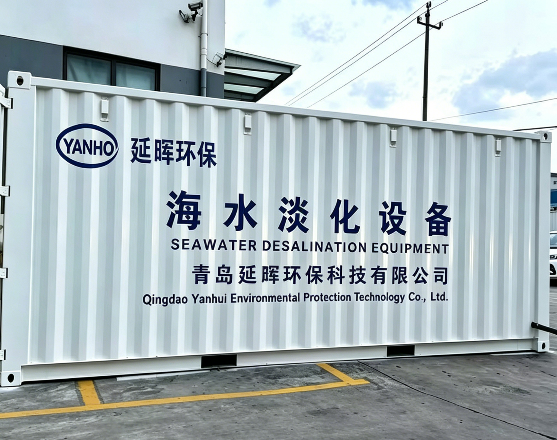
40-Foot Containerized Desalination System
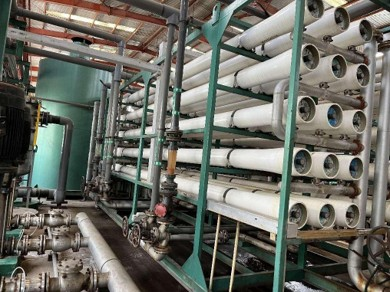
Mid-Capacity Seawater RO System
40-Foot Containerized SWRO: Freshwater production capacity of 60 m³/day (2.5 m³/h), equipped with a two-stage pretreatment system and two high-pressure pumps configured in duty-and-standby operation. Desalination rate ≥99%.
Product Water Storage: Two 15 m³ PE corrosion-resistant water storage tanks with automatic level control for start/stop operation of the desalination system.
High-Flow Main-Inlet Pre-Filter: 10 m³/h industrial-grade automatic backwash pre-filter with DN50 connection, designed for removing suspended solids, rust and other particulate impurities from the incoming water supply.
Well-Water Treatment Package: 8 m³/h dual-tank multimedia filtration system combined with a 5 m³/h automatic backwash iron and manganese removal system for island groundwater applications.
Central Water Purifier: Single-tank 6 m³/h configuration, with an optional dual-tank duty-and-standby configuration. Equipped with an automatic multi-port control valve and bypass maintenance valve for convenient operation and servicing.
Central Water Softener: 5 m³/h dual-tank alternating-regeneration system designed to support continuous softened water supply. Flow-based smart regeneration helps adapt the system to SPA pools and simultaneous water demand from multiple guest rooms.
Centralized Commercial RO Purification System: 1 m³/h centralized RO pure water system for the entire hotel.
Distributed Drinking Water Supply: UV disinfection units are installed in each floor-level water distribution zone, combined with commercial pipeline-connected water dispensers for convenient drinking water supply throughout the hotel.
Seawater Desalination Equipment for Mid-sized Island Resorts | 35–100 Guest Rooms
Running a mid-sized island resort is not quite the same as running a hotel in a city. On paper, a resort with 35–100 guest rooms may look like a normal commercial hotel. In practice, the water supply can be much harder to manage. The resort may have a swimming pool, spa, buffet restaurant, guest laundry, kitchens, staff accommodation, landscaping, and other facilities that all depend on a stable water source.
When the resort is located on an island, the problem becomes even more obvious. Freshwater resources may be limited, groundwater may contain high levels of salt, and transporting bottled or bulk water from the mainland can add cost and logistical pressure. For this type of project, I usually look at Seawater Desalination as part of the resort's basic infrastructure rather than treating it as a simple piece of filtration equipment.
At Qingdao Yanhui Environmental Protection Technology Co., Ltd., we have been working in water treatment since 2015. Our business covers seawater desalination, high-salinity wastewater treatment, concentration and purification, and industrial wastewater treatment. For island resort projects, we focus on the complete water treatment system, from process design and equipment manufacturing to installation, commissioning, operation, and maintenance.
The system described on this page is intended for a typical mid-sized island resort with 35–100 guest rooms, especially chain resort hotels that include a swimming pool, spa, buffet restaurant, kitchen, laundry, and other supporting facilities. The actual design is always adjusted according to seawater quality, required water production, peak demand, available space, local regulations, and the owner's operating plan.
In my experience, the most important mistake in an island water project is to calculate water demand only from the number of guest rooms. A 60-room resort does not simply need “60 rooms worth of water.” Guests use showers, toilets, wash basins, restaurants, laundry services, pools, spas, and public areas. Staff also need water, and the kitchen may have a very different demand pattern from guest rooms.
There is also a difference between average demand and peak demand. A resort may have relatively low occupancy during part of the year but experience a large increase in water consumption during holidays or high tourist seasons. A desalination system therefore needs to be designed around the real operating pattern rather than one simple room-count calculation.
Resort Area | Typical Water Requirement | Why Stable Water Matters |
Guest rooms | Showers, toilets, wash basins and housekeeping | Directly affects guest comfort and daily hotel operations |
Swimming pool | Make-up water and cleaning-related demand | Helps maintain pool operation and water quality |
Spa | Bathing, cleaning and service water | Requires reliable water availability during operating hours |
Buffet restaurant | Cooking, food preparation, dishwashing and cleaning | Important for hygiene and uninterrupted food service |
Laundry | Guest linen, towels and staff uniforms | Can create significant recurring water demand |
Public areas | Cleaning and maintenance | Supports overall resort operation |
Staff facilities | Daily domestic water use | Needed throughout the year, not only when rooms are occupied |
Source note: This table is an engineering planning framework based on typical resort functions, not a regulatory water-use standard. Actual demand should be calculated from the project's occupancy, facilities, local conditions and operating schedule.
The World Health Organization notes that desalination has become an increasingly viable alternative source of drinking water in water-stressed coastal areas and small island states. Its guidance also emphasizes managing source-water quality, treatment, final-water quality and operational risks as part of a complete water safety approach.
That is why I prefer to start a resort project by asking a few simple questions: How much water is actually needed? What is the seawater quality? What water quality is required after treatment? Where will the equipment be installed? How will the concentrate be handled? How will operators maintain the system?
These questions often matter more than simply choosing a machine from a catalog.
For many island resort projects, reverse osmosis, or RO, is the core desalination process. The basic idea is easier to understand than the name sounds. We use pressure to push seawater through a special semi-permeable membrane. Water can pass through the membrane, while most dissolved salts and other rejected substances remain in the concentrated stream.
The U.S. Environmental Protection Agency describes reverse osmosis as a membrane process in which hydraulic pressure is used to overcome osmotic pressure, allowing treated water to pass while contaminants are retained in the concentrate stream.
A complete Seawater Desalination System is usually more than an RO membrane skid. Before seawater reaches the RO membranes, we normally need to consider intake conditions and pretreatment. Depending on the source water, the system may include seawater intake equipment, screening, filtration, cartridge filtration, chemical dosing, high-pressure pumping, RO membrane modules, post-treatment, disinfection, storage, and control equipment.
The basic process can be understood as:
Seawater intake → Pretreatment → Fine filtration → High-pressure pumping → RO membrane separation → Post-treatment → Disinfection → Freshwater storage
At the front end, pretreatment is especially important. Seawater can contain suspended solids, microorganisms, organic matter and other substances that may affect membrane performance. If these materials are allowed to build up on the membrane surface, the system may require more frequent cleaning and may lose operating efficiency.
EPA technical material explains that membrane desalination produces both a treated water stream and a concentrate stream, and that the concentrate characteristics depend on source-water quality, treatment chemicals, membrane rejection and system recovery.
This is one reason I do not recommend selecting an island resort desalination system based only on the RO membrane itself. The pretreatment, pumps, controls, piping, water storage, cleaning arrangement and concentrate management all have to work together.
Imagine seawater entering the system from an intake point near the resort. The first step is to remove larger particles and protect the downstream equipment. The water then passes through finer pretreatment stages before entering the high-pressure section.
The high-pressure pump provides the pressure needed for RO separation. The membrane system then divides the feed into two streams: permeate, which becomes the treated water, and concentrate, which contains a higher concentration of rejected salts and other substances.
The treated water may then need stabilization, remineralization, pH adjustment, disinfection, or other post-treatment depending on the intended use and local requirements. WHO guidance specifically notes that desalinated water can have different mineral characteristics from conventional freshwater and that treatment and risk management should be considered before distribution.
For an island resort, the final water quality target should therefore be defined before the equipment is manufactured. Water used for guest drinking, food preparation, general domestic use, laundry, pool make-up, or other purposes may have different treatment requirements.
When I design a seawater desalination system for a mid-sized resort, I pay attention to four things first: corrosion resistance, stable operation, automation, and adaptability.
Seawater is a difficult working environment for ordinary metal components. Chloride-rich water can accelerate corrosion, especially when equipment is installed close to the sea. For this reason, material selection is not something I leave until the end of the project.
Depending on the process and component location, we consider suitable corrosion-resistant materials for wetted parts, piping, pumps, pressure vessels, valves, fittings and other components. The exact material selection depends on seawater characteristics, pressure, temperature, chemical conditions and project requirements.
This matters because a desalination system can have excellent membranes and still experience problems if other components are not suitable for the environment.
A resort cannot afford to stop producing water simply because the tourist season has arrived. The system should therefore be designed with stable operation in mind.
We consider the quality of the feed water, pretreatment capacity, pressure control, membrane arrangement, instrument selection, cleaning requirements and maintenance access. A system that is easy to understand and maintain is often more useful to a hotel operator than a complicated system with features nobody on site knows how to use.
Modern water treatment equipment can automate many routine tasks. Depending on the project, the control system can monitor operating pressure, flow, water quality indicators, pump status and other important operating conditions.
Automation does not mean that operators never need to check the system. I see it differently. Good automation should help operators understand what the equipment is doing and react quickly when something changes.
There is no single “standard island resort” water condition. Two resorts may both have 60 guest rooms but face completely different seawater conditions and operating requirements.
One may have relatively clean seawater and sufficient installation space. Another may have higher suspended solids, limited space, difficult access, seasonal occupancy changes, or a requirement for containerized equipment.
For this reason, we design according to the project rather than simply changing the nameplate on a standard machine.
Design Factor | What We Check | Effect on System Design |
Seawater quality | Salinity, suspended solids, temperature and other available test data | Determines pretreatment and RO configuration |
Required water production | Average demand, peak demand and operating hours | Influences system capacity and storage strategy |
Installation site | Available space, access, ventilation and environment | Influences equipment layout and structure |
Water application | Drinking, domestic use, kitchen, laundry or other uses | Determines post-treatment and final water requirements |
Power supply | Voltage, frequency and available electrical capacity | Determines pump and electrical configuration |
Maintenance conditions | Operator skills, spare parts and service access | Influences automation and maintenance design |
Source note: This table summarizes our engineering design considerations. It is not a substitute for project-specific water analysis or local design requirements. WHO recommends risk-based management of drinking-water quality from source through consumer, while EPA materials describe the importance of source water, membrane treatment and concentrate characteristics in desalination systems.
For a chain resort hotel with 35–100 rooms, consistency is often just as important as equipment capacity. If the owner operates several resorts in different coastal locations, the water treatment equipment should be easy to understand across different sites.
Our approach is to combine customized engineering with practical equipment design. The final configuration can be adjusted according to the project's water source, production target, site conditions and operating requirements.
I do not recommend choosing capacity based only on room numbers. We look at the whole resort. A property with a large spa, busy restaurant and laundry facility can have a very different demand from a similar-sized property with fewer supporting facilities.
Storage tanks can also be part of the overall water strategy. Instead of requiring the desalination unit to match every short-term change in demand, properly planned storage can help separate production from consumption patterns.
RO performance depends heavily on the condition of the water entering the membrane. Pretreatment may include different filtration and conditioning stages depending on the source-water test results.
A technical review of RO pretreatment published through the U.S. EPA's research database notes that suitable pretreatment can help reduce organic and inorganic fouling and improve RO operating performance.
In practical terms, this means I would rather spend time getting pretreatment right than try to solve every problem after the membrane system has already been installed.
A hotel engineer should not need to become a membrane specialist just to operate the water plant. We therefore aim for clear operating logic and useful monitoring information.
The exact control system depends on the project, but typical functions may include pump control, pressure monitoring, flow monitoring, alarm management, automatic shutdown protection and other process controls.
Island resorts often have limited technical space. The equipment may need to be installed in a plant room, service building, utility area or container.
We can adjust the layout according to the available space and transportation conditions. For projects with restricted access, a modular or containerized arrangement may make installation and transportation easier.
Every desalination system needs maintenance. Membranes need monitoring and periodic cleaning. Filters and consumables need replacement. Pumps, valves, instruments and electrical components need inspection.
I prefer to make these tasks straightforward from the beginning. Maintenance space, access to components, labeling, operating documentation and spare-parts planning should be considered during design, not after commissioning.
The 35–100 room island resort is one typical application, but the same engineering approach can be used in several coastal industries.
This is the most direct application. A seawater desalination system can provide a controlled freshwater source for resort operations when local freshwater resources are limited or unreliable.
Coastal hotels may have access to municipal water but still need an independent or supplementary water source. In some locations, seawater desalination can be considered as part of a long-term water supply strategy.
Ships and marine facilities have limited space and cannot depend on normal city water infrastructure while operating offshore. Compact desalination systems can therefore be useful where freshwater needs to be produced from seawater.
Offshore platforms require reliable utility systems in a difficult environment. Equipment selection needs to consider space, corrosion, power supply, safety requirements and maintenance access.
Fishing bases and related coastal facilities may need treated freshwater for workers, processing operations or other utility purposes. The exact water quality target should always be defined according to the application.
Some industrial facilities located near the coast may use seawater desalination as part of their process-water supply. In these cases, the required water quality can be very different from hotel domestic water, so the treatment process needs to be designed around the actual industrial process.
Application | Typical Water Challenge | Desalination Consideration |
Island resort | Limited freshwater and seasonal tourism demand | Stable freshwater production and storage planning |
Coastal hotel | High domestic water demand | Supplementary or independent water source |
Ship | Limited freshwater storage and space | Compact marine desalination configuration |
Offshore platform | Remote operation and harsh environment | Corrosion resistance, automation and reliability |
Industrial facility | Specific process-water quality | Customized pretreatment and post-treatment |
Source note: Application categories reflect common water-treatment engineering scenarios. WHO specifically identifies coastal areas and small island states among regions where desalination has become an increasingly viable alternative source of drinking water.
For me, manufacturing a desalination system is not simply about assembling pumps, pipes and membrane housings. The process starts with understanding the project.
We first review the available seawater analysis, required production, water-use purpose, installation location, power supply, operating conditions and other technical information.
If the customer has laboratory water analysis, we use it as an important basis for process selection. If some information is unavailable, we identify the missing items before finalizing the system rather than making unnecessary assumptions.
We determine the suitable pretreatment, RO configuration, pumping arrangement, control method and post-treatment according to the project requirements.
The process design should balance water quality, production, equipment footprint, operation, maintenance and project cost.
After the technical configuration is confirmed, manufacturing begins. Equipment fabrication and assembly are carried out according to the approved design and component requirements.
For skid-mounted systems, we pay attention to the relationship between pumps, membrane housings, filtration equipment, control panels and piping. Good layout is not only about appearance. It also affects installation and maintenance later.
Before shipment, the equipment is assembled and checked. We inspect connections, components, control functions and other relevant items according to the project requirements.
Where applicable, the system is commissioned before delivery so that problems can be identified earlier rather than waiting until the equipment reaches the island site.
Technical documentation and operating information are prepared for delivery. Depending on the project, documentation may include equipment information, operating instructions, process information, electrical documentation, maintenance recommendations and other agreed technical materials.
Transportation is a surprisingly important part of an island desalination project. The equipment may travel by truck, sea freight or multimodal transport before reaching the final site.
Depending on equipment size and transportation requirements, we can use wooden cases, pallets or containers for reinforced packaging. The purpose is simple: protect the equipment from impact, movement, moisture and other transportation risks.
For larger projects, transportation planning should be considered together with equipment design. A system that is easy to manufacture but difficult to move through a narrow island road or onto a small vessel is not a practical design.
There are many companies that can supply individual pumps, membrane components or filtration products. That can work for some experienced engineering contractors. For a hotel owner or resort operator, however, managing many different suppliers can create unnecessary coordination problems.
Our company was established in 2015 and focuses on water treatment equipment and integrated engineering services. We cover R&D, process design, manufacturing, installation, commissioning, operation and maintenance.
That integrated approach is useful for island projects because the water system is connected from beginning to end. The source-water conditions affect pretreatment. Pretreatment affects RO operation. RO operation affects membrane life and water production. Post-treatment affects final water quality. Equipment layout affects installation and maintenance.
When one team understands the entire process, it becomes easier to keep these parts connected.
We do not treat “35–100 rooms” as a fixed equipment specification. It is a project category. The final desalination system still needs to be engineered according to the actual resort.
For example, a 40-room boutique resort with a small restaurant may have a very different water profile from a 100-room chain resort with a large buffet restaurant, spa, laundry and swimming pool.
The same applies to seawater. Water quality can change from one location to another, and seasonal conditions may also matter. Our job is to turn those differences into a workable process design.
A desalination project does not finish when the equipment leaves the factory. Installation, commissioning, operator training, maintenance and troubleshooting all affect long-term performance.
We therefore provide integrated engineering services according to project requirements. The exact scope can be agreed in the contract, including manufacturing, installation, commissioning, operation support and maintenance services.
Production time is normally determined by project scale and equipment configuration. Standard equipment generally has a shorter delivery period, while customized systems require additional time for process design, component selection and manufacturing.
Before delivery, we complete equipment assembly, commissioning and quality inspection according to the agreed project requirements. Technical information and operating documents are also prepared for delivery.
Payment terms can be agreed according to the project contract. Depending on the project, this may include an advance payment, a payment before shipment and a final payment after agreed conditions are met.
Transportation can be arranged through land freight, sea freight or multimodal transportation. The appropriate method depends on equipment dimensions, destination and site conditions.
Yes. This is one of the typical project scenarios we can design for. However, room count alone does not determine the final equipment capacity. We also consider occupancy, swimming pool, spa, restaurant, laundry, staff facilities, operating hours and other water-consuming facilities.
Yes. Water analysis is one of the most useful inputs for the engineering design. Salinity, suspended solids, temperature and other available water-quality information can affect pretreatment, membrane selection, operating conditions and post-treatment.
For many seawater desalination projects, reverse osmosis is the main desalination technology. The final process depends on the raw water and required product-water quality. RO uses pressure to drive water through a semi-permeable membrane while rejecting most dissolved salts and other contaminants.
It can be designed for potable-water applications, but the final system must be engineered and operated according to the required water-quality standards and local regulations. Post-treatment, disinfection, monitoring and distribution conditions should be considered as part of the complete water supply system.
WHO's current drinking-water guidance emphasizes risk-based management and monitoring from the water source through the consumer, rather than relying on a single treatment step alone.
Yes. RO desalination produces a concentrate or brine stream containing a higher concentration of salts and other rejected substances. This stream needs to be managed according to the site conditions and applicable environmental requirements.
The U.S. Department of Energy also notes that desalination produces a concentrated salt by-product that requires proper disposal.
Depending on the project, a containerized or modular configuration can be considered. This can be useful for remote islands, marine facilities and sites where a permanent equipment room is difficult to build.
There is no single production period for every project. Standard equipment generally has a shorter delivery cycle. Customized desalination systems require time for process design, equipment configuration, manufacturing and testing. We confirm the delivery schedule after the technical configuration is finalized.
Depending on the destination and equipment dimensions, transportation may use land freight, sea freight or multimodal transportation. Packaging can include wooden cases, pallets or container reinforcement. For island projects, we pay particular attention to the relationship between equipment dimensions, port handling and final-site access.
The more useful information we have, the more accurately we can design the system. Ideally, we need the required freshwater production, seawater analysis, intended water use, resort room count, estimated occupancy, major water-consuming facilities, installation location, available power supply and any local water-quality requirements.
Yes. Our service scope can cover installation, commissioning, operation and maintenance according to the project contract. The exact service arrangement can be discussed based on the location and project requirements.
If you are planning a new 35–100 room island resort or upgrading an existing hotel water system, I recommend preparing the project information before selecting equipment.
First, tell us how much freshwater you need. Do not only provide the number of rooms. Tell us whether the resort has a swimming pool, spa, buffet restaurant, commercial kitchen, laundry, staff housing and other facilities.
Second, provide a seawater analysis if one is available. This gives us a much better starting point than guessing the water condition.
Third, explain how the treated water will be used. Drinking water, general domestic water, kitchen water, laundry water and industrial process water can have different requirements.
Fourth, tell us about the installation location. A plant room beside the shoreline is different from a remote technical building several hundred meters inland. Available space, elevation difference, access roads, electrical supply and transportation conditions can all affect the final system.
Finally, tell us how the resort will operate. If the hotel is seasonal, we may need to consider changes in demand. If the resort operates throughout the year, the system may be designed around a more stable load. If the hotel belongs to a chain, standardized control and maintenance practices may also be useful.
These details allow us to move from a generic “seawater desalination machine” to a real engineering solution.
A 35–100 room island resort has a very specific water challenge. It needs enough water for guests, kitchens, restaurants, spas, pools, laundry and daily hotel operations, but it may not have the same freshwater infrastructure available to a city hotel.
That is where a properly designed seawater desalination system can make a practical difference.
Our approach is simple: understand the water first, design the process around the project, build the equipment carefully, test it before delivery, and provide the technical support needed after installation.
At Qingdao Yanhui Environmental Protection Technology Co., Ltd., we provide customized seawater desalination equipment and integrated water treatment engineering services. Our capabilities cover R&D, design, manufacturing, installation, commissioning, operation and maintenance.
For an island resort with 35–100 guest rooms, the right desalination system should not simply produce water. It should fit the resort's actual demand, site conditions, operating model and long-term maintenance plan.
If you are planning a mid-sized island resort, 35–100 guest room chain resort hotel, beachfront hotel, island villa resort, marine facility or coastal water supply project, we can review your water requirements and develop a customized seawater desalination solution based on the actual project conditions.
Recommended project keywords: seawater desalination equipment, seawater desalination system, seawater RO system, island resort desalination system, hotel seawater desalination equipment, resort water treatment system, island hotel water treatment, seawater reverse osmosis system, commercial desalination equipment, customized Seawater Desalination Plant, coastal hotel water treatment, marine desalination equipment, island freshwater production system.
This website uses cookies to ensure you get the best experience on our website.
 Portugues
 Pусский
 Français
 العربية
 ไทย
ไทย Indonesia
 Melayu
 Tiếng Việt
 中文
中文 қазақ
қазақ עִברִית
 မြန်မာ
 ພາສາລາວ
 Filipino
 o'zbek
 Кыргызча
 тоҷикӣ
 ខ្មែរ
ខ្មែរ Türkmenler



 Phone
Phone