


Water Demand Standard: Average daily water consumption is estimated at 180–220 L per guest room. The water treatment system is designed with a 1.8× peak-season capacity reserve.Two Main Island Water Sources:
① Nearshore Seawater: TDS ≈ 32,000 mg/L.
② Shallow Island Well Water: High iron and manganese levels, with saltwater intrusion during high tides; TDS typically ranges from 500–3,000 ppm.
Average Total Daily Water Consumption: 20–40 m³/day
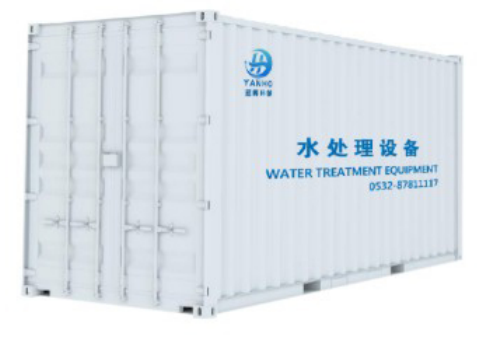
20-Foot Containerized Desalination Unit
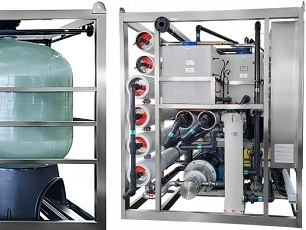
Compact Skid-Mounted Seawater RO System
System Model: 20-foot standard containerized SWRO system with a freshwater production capacity of 25 m³/day (1.05 m³/h), a desalination rate of >98.5%, and an ERD energy recovery device for improved energy efficiency. Product water TDS is approximately 250–380 ppm.
Process Configuration: Seawater Intake → Multimedia Sand Filtration + Activated Carbon Pretreatment → 5 μm Cartridge Filtration → SWRO Reverse Osmosis → Product Water Pressure-Stabilizing Tank
Power Supply: 220 V / 380 V options available, with support for solar PV integration to meet the power requirements of off-grid island locations.
Fully Automatic Backwash Pre-Filter: 6 m³/h flow rate, DN40 connection, and 316 stainless steel 40 μm filter screen for intercepting rust, sediment and other particulate impurities in the water piping system.
Alternative Well-Water Treatment: For locations without seawater intake facilities and relying on groundwater, an iron and manganese removal aeration system with a capacity of 3 m³/h can be combined with a 4 m³/h quartz sand multimedia filter to help address yellow water and elevated iron and manganese levels in well water.
Designed for showers, laundry, swimming pool makeup water and other general-purpose water applications throughout the property.
Central Activated Carbon Water Purifier: 4 m³/h automatic valve-head system with an FRP treatment tank, coconut-shell activated carbon and KDF media. Designed to reduce residual chlorine, odors and certain organic contaminants.
Smart Central Water Softener: 3.5 m³/h integrated system with a smart brine tank and Wi-Fi remote regeneration function. Designed to reduce hardness and scale buildup while helping protect bathroom fixtures, boilers and swimming pool equipment.
Commercial RO System for Kitchen / Bar: 600 GPD high-flow commercial RO water purifier for purified water production in back-of-house kitchens, bars and other drinking water points.
Guest Room Drinking Water: Wall-mounted UV ultraviolet sterilizers can be installed on each guest room floor to provide an additional disinfection step for guest-room drinking water.
Boutique Island Hotels | 10–30 Rooms — Standalone Island Villas & Exclusive Beachfront Cottages
When we design water treatment equipment for a boutique island hotel, we do not start with a standard machine and ask the customer to make the project fit it. We start with the island, the water source, the number of rooms, the daily water demand, the available installation space, and the way the hotel actually operates.
For a 10–30 room island hotel, standalone island villa, or exclusive beachfront cottage project, water supply is often one of the first practical issues to solve. There may be no municipal water network nearby. Fresh groundwater may be limited or have high mineral content. Rainwater can be seasonal, while bottled water alone is expensive and inconvenient for a property that needs water every day.
This is where our customized water treatment and Seawater Desalination Equipment becomes useful.
Qingdao Yanhui Environmental Protection Technology Co., Ltd. was established in 2015. We specialize in Seawater Desalination, high-salinity wastewater treatment, concentration and purification, and industrial wastewater treatment. For island hospitality projects, we provide equipment and integrated engineering services covering research and development, process design, manufacturing, installation, commissioning, operation, and maintenance.
Our goal is straightforward: help a small island property build a practical freshwater supply system that matches its real needs, rather than paying for an oversized system or struggling with equipment that was never designed for the site.
A boutique hotel with 10–30 rooms may look small from the outside, but its water demand can change significantly during the day. Guests take showers, flush toilets, wash hands, use kitchens, clean rooms, wash towels and sheets, maintain swimming pools, and use outdoor facilities. Restaurants and laundry areas can create additional demand.
More importantly, hotel water demand is not always evenly distributed. A property may be quiet in the morning, busy around breakfast, and experience another demand peak when guests return from the beach in the afternoon.
That means a good island water treatment system needs more than enough membrane capacity. We normally look at the complete water cycle: raw water intake, pretreatment, desalination, post-treatment, storage, distribution, wastewater handling, and Equipment Maintenance.
For seawater projects, reverse osmosis is one of the main technologies we consider. The U.S. Environmental Protection Agency explains that reverse osmosis is a pressure-driven membrane process that can remove many dissolved solids and can be used to remove salts from brackish water or seawater. The treated water passing through the membrane is called permeate, while the concentrated stream is called reject or concentrate.
In practical terms, this means seawater can become a usable freshwater source when the system is properly designed and operated.
| Water Source | Typical Challenge | Possible Treatment Direction | Suitability for Island Hospitality |
|---|---|---|---|
| Seawater | High salt content and marine impurities | Seawater pretreatment + SWRO + post-treatment | Very suitable where seawater is readily available |
| Brackish groundwater | Dissolved salts and minerals | Pretreatment + brackish water RO | Suitable after water analysis |
| Fresh groundwater | Hardness, iron, manganese or other local issues | Filtration, softening or other targeted treatment | Suitable when source quality is stable |
| Rainwater | Seasonal supply and variable quality | Collection + filtration + disinfection + storage | Useful as a supplementary source |
Source: Treatment directions are based on general water-treatment engineering practice and EPA descriptions of RO/NF membrane treatment. Actual process selection should be based on site-specific raw water analysis.
For our projects, we do not assume that every island has the same water problem. Two hotels only a few kilometers apart can still require different treatment systems because their seawater intake conditions, turbidity, temperature, power supply, water demand, and installation space may be different.
A seawater desalination system is not simply a high-pressure pump connected to an RO membrane. The membrane is important, but the equipment around it has a major influence on long-term operation.
Our typical seawater desalination process can include seawater intake, pretreatment, cartridge filtration, high-pressure pumping, seawater reverse osmosis, freshwater storage, and post-treatment. The exact configuration depends on the raw water quality and the required end use.
Seawater enters the system through a properly designed intake arrangement. The intake point should be considered carefully because coastal conditions can change. Sand, marine organisms, suspended solids, algae, and seasonal changes may affect the feed water.
For an island hotel, the intake design is especially important. A beautiful beach does not automatically mean that the seawater is easy to treat. We look at the actual site conditions before finalizing the equipment.
Pretreatment protects the RO membrane. Depending on the water quality, this stage may include multimedia filtration, ultrafiltration, cartridge filtration, dosing systems, or other suitable treatment units.
The basic idea is simple: remove or reduce materials that could cause membrane fouling, plugging, or unnecessary pressure increase before the water reaches the RO unit.
EPA notes that pretreatment is frequently required for RO and NF systems to help prevent membrane fouling or plugging.
After pretreatment, a high-pressure pump sends the water through the seawater RO membrane. The membrane allows part of the water to pass through while retaining much of the dissolved salt and other substances.
The freshwater side is called permeate. The remaining concentrated stream becomes reject water.
This is the core of seawater desalination.
RO water may require additional treatment depending on its final use. The final water quality target is different for guest drinking water, kitchen use, laundry, showers, equipment cleaning, and other hotel applications.
Storage tanks are also important because hotel demand changes during the day. Instead of designing the RO system to respond instantly to every peak, a properly sized freshwater storage tank can provide a buffer between production and consumption.
After treatment and storage, freshwater can be distributed to hotel rooms, kitchens, laundry facilities, service areas, or other designated points.
For a small island property, keeping the whole system simple is usually better than adding unnecessary equipment. We try to make operation understandable for the hotel team so routine inspection and maintenance do not become a burden.
Our seawater Desalination Equipment is designed around several practical requirements that matter to island hotel operators.
Seawater is naturally aggressive toward many materials. Equipment used around the coast also faces humid, salty air. Material selection is therefore an important part of system design.
Depending on the equipment position, water chemistry, pressure and project budget, we select suitable materials and components for wetted parts and supporting structures. The purpose is to reduce corrosion-related problems and maintain stable operation.
A hotel does not want a water plant that requires constant attention. Guests expect showers, toilets, kitchens, laundry and other services to work normally.
We therefore consider stable pressure, pretreatment performance, membrane protection, automatic control, water storage and alarm functions during system design.
Automation can reduce routine manual work. Depending on the project, the system can be configured with automatic start and stop functions, pressure monitoring, water-level control, protection devices, alarms and other control functions.
The exact automation level is not the same for every hotel. A remote island villa may benefit from a different control arrangement than a larger resort with its own engineering team.
We can customize the system according to raw water quality, required freshwater production, installation space, power conditions, operating method and other project requirements.
This flexibility is particularly useful for standalone island villas and small beachfront cottages where available plant-room space can be limited.
For small properties, every square meter can matter. We can consider skid-mounted and compact equipment arrangements according to the site.
Where required, equipment can also be arranged in a containerized configuration. This can simplify transportation and installation for some remote island projects, although the final choice depends on site access, climate, equipment size and project requirements.
One of the most common mistakes in a small hotel water project is choosing equipment only according to the number of rooms.
Room count is useful, but it is not enough.
We normally consider guest occupancy, staff numbers, restaurant operation, laundry, landscaping, swimming pools, cleaning frequency, local climate, seasonal occupancy and other water-consuming activities.
For example, a 15-room hotel with a full-service restaurant and laundry may require a very different water system from a 25-room property where laundry is handled off-site.
We therefore recommend starting with a water balance rather than simply selecting a machine model.
| Design Factor | Why We Consider It | Possible Impact on Equipment |
|---|---|---|
| Number of rooms | Provides a basic demand reference | Helps estimate daily freshwater requirement |
| Occupancy | Guest numbers change daily consumption | Influences production and storage capacity |
| Restaurant | Kitchen cleaning and food preparation consume water | May increase daily demand |
| Laundry | Washing towels and bedding can require significant water | May require additional production capacity |
| Swimming pool | Make-up water and cleaning add demand | May require separate water planning |
| Raw seawater quality | Controls pretreatment requirements | Influences filtration and membrane design |
| Available space | Island plant rooms may be limited | Influences skid, compact or containerized layout |
| Power supply | Remote islands may have limited electrical capacity | Influences pump and control selection |
There is another important point: RO systems produce a concentrate stream as part of the separation process. EPA notes that RO/NF systems reject part of the feed water, and the concentrate contains salts and other dissolved materials that need an appropriate discharge or disposal method.
For an island project, concentrate management should be considered during the design stage rather than after installation. Local environmental requirements, intake and outfall conditions, coastal regulations, and site characteristics can all affect the final solution.
We strongly recommend obtaining a raw water analysis before final equipment selection.
Important parameters may include salinity, TDS, turbidity, temperature, pH, hardness, iron, manganese, organic matter, microbiological indicators and other site-specific parameters.
For comparison, the USGS describes water hardness mainly in relation to calcium and magnesium compounds and classifies water as soft at 0–60 mg/L as CaCO3, moderately hard at 61–120 mg/L, hard at 121–180 mg/L, and very hard above 180 mg/L.
These hardness classifications are useful when discussing freshwater or groundwater treatment, but they should not be used as a substitute for a complete seawater analysis.
Seawater desalination is not automatically the right answer for every property. We prefer to compare available water sources before recommending a system.
| Option | Main Advantage | Main Limitation | Typical Role |
|---|---|---|---|
| Seawater RO | Can turn abundant seawater into freshwater | Requires energy, pretreatment and concentrate management | Primary freshwater source on many water-scarce islands |
| Brackish Water RO | Generally treats lower-salinity feed than seawater | Requires suitable brackish source | Groundwater or inland brackish sources |
| Groundwater Treatment | Can use an existing local freshwater source | Quality and quantity depend on the site | Where reliable groundwater is available |
| Rainwater Harvesting | Useful supplementary source | Dependent on rainfall and storage | Supplementary or non-potable applications |
| Delivered Bottled Water | Simple at very small scale | Logistics, storage and recurring cost can become difficult | Drinking water supplement |
Source: The technical role of RO in desalinating seawater is supported by U.S. EPA information on reverse osmosis and desalination.
For an exclusive island villa with only a few guests, delivered water may sometimes be enough. For a 10–30 room hotel operating throughout the year, however, the logistics can become much more complicated. This is one reason we often evaluate onsite seawater desalination as part of the overall water supply plan.
Although our focus here is boutique island hotels, the same engineering approach can be used in several related environments.
Small hotels often need a compact water supply system that can operate reliably without occupying too much valuable land. Our equipment can be configured around room count, occupancy, restaurant operation, laundry requirements and available plant space.
Luxury villas may have lower average water consumption than hotels but can still require reliable freshwater for showers, kitchens, toilets, cleaning and outdoor facilities. A Compact Seawater Desalination System can provide a local freshwater source when municipal supply is unavailable.
Beachfront cottages are often spread across a relatively large area. Pipe distance, equipment location and storage capacity need to be considered together. We can help plan a centralized or distributed arrangement depending on the project.
Resorts with restaurants, swimming pools, staff accommodation and laundry facilities may have significantly higher demand than the room count suggests. A complete water balance becomes especially important in these projects.
Our broader seawater desalination experience also covers applications where freshwater must be produced from seawater in marine or offshore environments. Equipment layout, vibration, power supply, corrosion protection and maintenance access require special consideration in these cases.
Our company also provides water treatment equipment for fisheries and industrial applications. Depending on the raw water and final use, the process may involve desalination, filtration, purification, concentration or wastewater treatment rather than one single treatment technology.
We believe a water treatment project should not end when the machine leaves the factory. Good preparation before shipment can save a lot of trouble later.
We begin by reviewing the customer's raw water information, required production capacity, water-use purpose, installation environment and project conditions.
For seawater desalination projects, the process may include pretreatment, high-pressure pumping, RO membrane units, control systems, storage and post-treatment. The final process flow depends on the actual project.
After the technical configuration is confirmed, we manufacture the equipment according to the approved design and component selection.
We pay attention to pipe connections, equipment arrangement, control cabinet layout, pump and membrane installation, valve accessibility and maintenance space. These details may sound small, but they become important when an operator needs to inspect the system months later.
Before delivery, the equipment is assembled and checked. We carry out commissioning and quality inspection according to the project requirements.
We also check the equipment structure, electrical control, pipeline connections and relevant operating functions before shipment.
Depending on the project scope, we provide technical documents, operating instructions and other relevant materials needed for installation and operation.
For overseas customers, clear documentation is particularly important because the people operating the equipment may not be the same people who purchased it.
Island projects often involve more complicated logistics than ordinary industrial deliveries. Equipment may travel by truck, container ship, ferry or a combination of transport methods.
We select packaging according to equipment dimensions and transportation conditions. Wooden cases, pallets and reinforced container packaging can be used as appropriate.
For larger equipment, internal fixing and external reinforcement are considered to reduce movement and impact during transportation.
| Project Stage | Our Main Work | Customer Receives |
|---|---|---|
| Initial inquiry | Review water source and application | Preliminary technical direction |
| Water analysis | Evaluate raw water parameters | Process design basis |
| Engineering design | Configure treatment process and equipment | Technical proposal and equipment configuration |
| Manufacturing | Fabricate and assemble equipment | Configured treatment system |
| Testing | Inspection and commissioning | Checked equipment before shipment |
| Delivery | Packaging and logistics coordination | Equipment prepared for transportation |
| Installation and commissioning | Provide installation and technical support as agreed | Operational water treatment system |
Production time is not fixed for every project. Standard equipment generally has a shorter delivery cycle, while customized systems require additional time for process design, component configuration, manufacturing and testing. We confirm the actual schedule according to the project scope and contract.
There are many companies selling water treatment equipment. From our point of view, the more important question is whether the supplier understands the actual water problem behind the equipment.
We have been working in water treatment since 2015, with experience covering seawater desalination, high-salinity wastewater treatment, concentration and purification, and industrial wastewater treatment.
This broader experience matters because an island water project is rarely just about an RO membrane.
The raw water may require pretreatment. The freshwater may require post-treatment. The reject stream needs a discharge plan. Storage may be needed because hotel demand changes throughout the day. The control system needs to match the customer's operating ability. The equipment needs to fit the available site.
We provide customized engineering services covering R&D, design, manufacturing, installation, commissioning, operation and maintenance.
We also understand that different customers have different project priorities. One customer may care most about compact dimensions. Another may need simple operation because there is no full-time water-treatment engineer on the island. Another may focus on freshwater production capacity or integration with an existing hotel utility system.
We therefore prefer to discuss the complete project before recommending the equipment configuration.
For island projects, site conditions are often more important than a catalog model. We consider available space, seawater intake conditions, power supply, transport access, installation location and maintenance access.
We try to keep operation clear and maintenance practical. A system that looks impressive on paper but is difficult for the local team to operate is not a good solution.
There is no single standard configuration that fits every boutique island hotel. We can adjust the treatment process and equipment arrangement according to raw water quality, required freshwater output and site conditions.
Our service scope can cover design, manufacturing, installation, commissioning, operation and maintenance according to the contract. This allows customers to discuss more of the project with one technical supplier instead of coordinating every stage separately.
Yes, a properly designed seawater RO system can be used as a freshwater source for a small island hotel. However, the required capacity should not be calculated from room count alone. Occupancy, restaurant operation, laundry, swimming pools, staff use and other consumption points should be included in the water balance.
We normally need information about the raw water source, water analysis, required daily freshwater production, peak demand, operating hours, installation space, power supply and intended water use. Based on this information, we can select a suitable treatment process and equipment configuration.
Yes. Small villas often have special requirements for equipment dimensions, noise, installation space, storage and operating method. We can customize the equipment arrangement according to the actual site and water demand.
In most seawater projects, pretreatment is an important part of protecting the RO membrane. The exact pretreatment process depends on seawater quality. EPA also notes that pretreatment is frequently required for RO/NF systems to reduce membrane fouling or plugging.
The RO process produces a concentrate or reject stream containing a higher concentration of salts and other retained substances. The discharge method should be planned according to local environmental rules, coastal conditions and the specific project. We consider concentrate handling during system design rather than treating it as an afterthought.
RO technology is widely used in drinking water treatment, but whether the final water is suitable for drinking depends on the complete treatment process, source water, post-treatment, disinfection, storage and applicable local requirements. NSF/ANSI 58 covers various requirements and test procedures for point-of-use RO drinking water treatment systems, including TDS reduction, efficiency, recovery, materials and certain contaminant-reduction claims.
We do not describe an individual system as NSF certified unless that specific system has actually been evaluated and certified under the applicable program.
There is no single delivery time for every project. Standard equipment can normally be delivered faster than a fully customized system. Customized projects require time for process design, equipment configuration, manufacturing, assembly, testing and inspection. We confirm the production schedule based on the final technical specification and contract.
Transportation can use land transport, sea freight or multimodal transportation. The method depends on the destination, equipment dimensions and available access. We select suitable packaging such as wooden cases, pallets or reinforced containers to protect the equipment during transportation.
Payment arrangements are normally agreed in the project contract. Depending on the project, payment can include an advance payment, shipment payment and final balance. The exact arrangement is confirmed before production.
Yes. Our service scope can include installation guidance, commissioning and technical support according to the project agreement. For larger or more customized projects, the installation and commissioning plan is discussed during the engineering stage.
A boutique island hotel is different from a large municipal water plant. The system has to fit the property, the people operating it and the environment around it.
For a 10–30 room hotel, standalone island villa, or exclusive beachfront cottage, we believe the best water treatment solution is not necessarily the biggest system. It is the system that produces the required water, fits the site, protects its key components, can be maintained locally, and has a sensible plan for storage, energy use and concentrate disposal.
Seawater desalination can be an effective way to create a local freshwater source where seawater is readily available and conventional freshwater supplies are limited. Reverse osmosis is an established membrane technology for seawater desalination, while proper pretreatment and post-treatment remain important parts of the complete process.
At Qingdao Yanhui Environmental Protection Technology Co., Ltd., we approach each island water treatment project from the engineering side. We look at the water first, then the demand, then the site, and finally the equipment configuration.
Whether the project is a small boutique island hotel, a group of standalone island villas, a beachfront cottage development, a small resort, a marine facility, or another remote water-supply application, we can develop a customized water treatment solution around the actual project conditions.
Our services cover R&D, design, manufacturing, installation, commissioning, operation and maintenance. We can also coordinate equipment packaging and transportation requirements for overseas projects.
If you are planning a new island hotel or upgrading the water supply of an existing property, the most useful starting information is usually the raw water analysis, expected daily water consumption, peak demand, number of rooms, occupancy, intended water uses, available installation space and local power conditions.
With these details, we can work backward from the actual water requirement and develop a seawater desalination or water treatment system that makes sense for the property.
U.S. Environmental Protection Agency — Overview of Drinking Water Treatment Technologies: reverse osmosis, nanofiltration, seawater desalination, pretreatment and concentrate considerations.
U.S. Geological Survey — Hardness of Water: calcium and magnesium, hardness classification and water-quality background.
NSF — NSF/ANSI 58: Reverse Osmosis Drinking Water Treatment Systems, including requirements and test procedures for RO drinking-water treatment systems.
This website uses cookies to ensure you get the best experience on our website.
 Portugues
 Pусский
 Français
 العربية
 ไทย
ไทย Indonesia
 Melayu
 Tiếng Việt
 中文
中文 қазақ
қазақ עִברִית
 မြန်မာ
 ພາສາລາວ
 Filipino
 o'zbek
 Кыргызча
 тоҷикӣ
 ខ្មែរ
ខ្មែរ Türkmenler



 Phone
Phone