

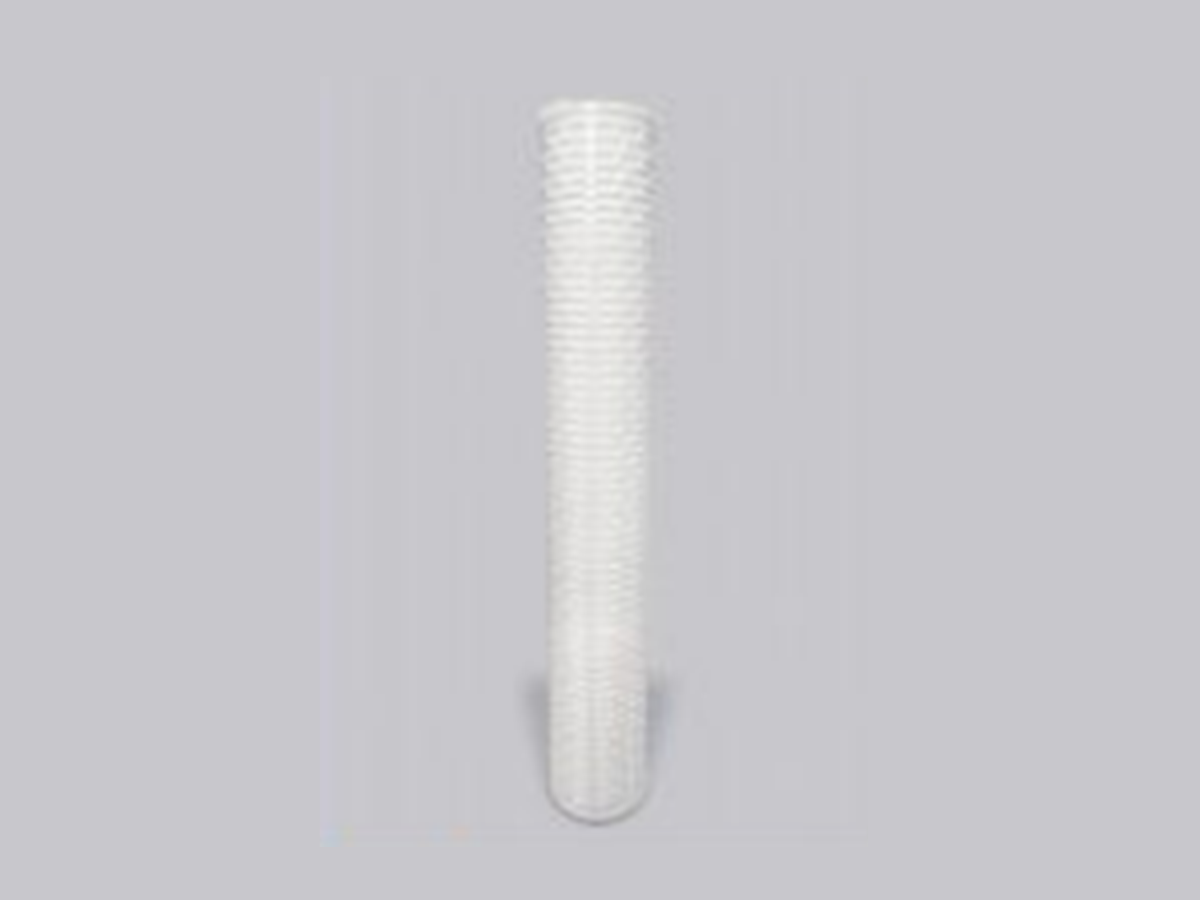
LFU high-flow pleated Filter Cartridges use a deep-layer fine polypropylene fiber membrane as the filter media, with a diameter of 6.5°/165mm.
The larger diameter increases the effective filtration area, reducing the need for larger filters and more filter cartridges during use.
The design significantly reduces equipment and labor costs, and is more convenient to operate. It features internal PP inner and outer frame support and a single opening.
The filter is specially designed with an outside-to-inside liquid flow direction to ensure that all pollutant particles are intercepted on the outside of the filter element, making it widely applicable.
It is widely used in different fields.
Design parameters
Specifications (diameter * length) | Design flow rate (m³/h) | Maximum flow rate (m³/h) | Filter area (m2) |
6.5"*20" | 15 | 40 | 3.5 |
6.5" * 40" | 30 | 80 | 6.5 |
6.5" * 60" | 45 | 120 | 8.5 |
Material Structure
model | PP | GF |
Filter media | Deeply folded polypropylene | Resin-based synthetic glass fiber/polyester |
Support/Guide Layer | polypropylene | Polyester |
End cap | Glass fiber reinforced polypropylene | Glass fiber reinforced polypropylene |
outer protective sleeve | polypropylene | Polyester |
Working characteristics
Maximum operating temperature | 80℃ |
Maximum working pressure difference | 0.38 MPa @ 20℃ |
Recommend replacing pressure difference | 0.15Mpa@20℃ |
Typical application scenarios
Filtration of power plant makeup water, condensate, and stator cooling water |
Reverse osmosis (RO) system pretreatment |
Seawater Desalination pretreatment |
Deionized water pre-filtration |
Filtration of process water in petrochemical and other industries |
LFU Series High-Flow Pleated Filter Cartridge
When I work on a water treatment system, I always look at filtration from a practical point of view. A filter cartridge may look like a small part of the whole system, but it can have a direct effect on water quality, equipment protection, maintenance work, and the stability of the process.
That is why I developed the LFU Series High-Flow Pleated Filter Cartridge around one simple idea: give the treatment system enough filtration capacity without making the filtration stage unnecessarily complicated.
The LFU Series is designed for liquid filtration applications where a relatively large amount of water or process liquid needs to pass through the filter. The pleated structure creates more usable filtration area within a compact cartridge format. Depending on the actual project, the cartridge configuration can be selected according to water quality, required flow, filtration target, equipment layout, and operating conditions.
For me, a good industrial filter is not simply a product with a long list of specifications. It needs to fit the whole treatment process. In Seawater Desalination, industrial wastewater treatment, pretreatment, process water filtration, and other applications, the filter has to work together with pumps, pipelines, valves, membranes, tanks, instruments, and other treatment units.
At Qingdao Yanhui Environmental Protection Technology Co., Ltd., we have been working in water treatment since 2015. Our work covers seawater desalination, high-salinity wastewater treatment, concentration and purification, and industrial wastewater treatment. Because we also provide system design, manufacturing, installation, commissioning, operation, and maintenance, we look at the LFU Series as part of the complete water treatment process rather than as an isolated filter element.
The LFU Series High-Flow Pleated Filter Cartridge is a high-flow liquid filtration element designed for water treatment and industrial filtration systems. Its main feature is the pleated filter structure, which increases the available filtration surface compared with a simple flat filter layer occupying the same general space.
In simple terms, think of a folded sheet of paper. If you keep it flat, you have one limited surface. If you fold it many times, you can put much more surface into a smaller space. A pleated filter cartridge uses a similar idea. The filter media is formed into multiple folds, allowing the liquid to contact a larger filtration area as it moves through the cartridge.
This structure is especially useful when the system needs to handle a substantial liquid flow. Instead of relying only on a large number of small conventional cartridges, a high-flow configuration can help simplify the filtration arrangement, depending on the required process capacity and housing design.
Publicly available industrial filtration data also shows why cartridge geometry matters. For example, Solventum's High Flow Series lists 10-inch, 40-inch, and 60-inch cartridge configurations, with published maximum design flow figures of approximately 85, 350, and 500 gallons per minute respectively under the manufacturer's stated conditions. These figures belong to that specific product family and should not be treated as LFU Series ratings. They are useful only as an industry reference showing how cartridge size and high-flow design can influence filtration capacity. Source: Solventum High Flow Series Filter Cartridge product information.
| Reference Item | Published Configuration | Published Flow Information | Source |
|---|---|---|---|
| High Flow Cartridge | 10 inch | Up to about 85 gpm for specified models | Solventum High Flow Series |
| High Flow Cartridge | 40 inch | Up to about 350 gpm for specified models | Solventum High Flow Series |
| High Flow Cartridge | 60 inch | Up to about 500 gpm for specified models | Solventum High Flow Series |
Source: Solventum, High Flow Filter Cartridge product information. Actual flow performance depends on the specific cartridge, filter media, fluid, temperature, pressure, contamination level, and system conditions.
For the LFU Series, I recommend selecting the cartridge only after the actual operating conditions are understood. Flow rate alone is not enough. Water quality, suspended solids, filtration accuracy, pressure, temperature, chemical compatibility, housing dimensions, and the role of the cartridge within the complete treatment process should all be considered.
The working principle is straightforward. Contaminated liquid enters the filter housing and flows through the filter cartridge. Suspended particles and other unwanted solids are retained by the filter media, while the filtered liquid continues into the next treatment stage.
The pleated structure provides a larger effective filtration area. This is one of the main reasons pleated cartridges are widely used in industrial liquid filtration.
In a typical water treatment process, the LFU Series may be installed as a pretreatment or polishing filtration stage, depending on the system design. For example, a Seawater Desalination System may include several treatment stages before reverse osmosis. The cartridge filter can be used to help reduce particulate loading before sensitive downstream equipment.
The exact filtration position depends on the raw water and the overall process design. If the incoming water contains a high concentration of large suspended solids, it may be better to use a coarse pretreatment stage first. The cartridge filter can then work as a later filtration step instead of receiving the entire solid load from the beginning.
This is an important point that I often emphasize: a filter cartridge should not be expected to solve every water quality problem by itself. Good filtration starts with matching the filter to the job.
The raw liquid enters the filter housing.
The liquid passes through the pleated filter media.
Particles are retained by the filter structure.
Filtered liquid exits the cartridge and continues to the next process stage.
As the filter accumulates contaminants, the pressure difference across the cartridge may increase.
The cartridge is replaced or serviced according to the actual operating condition and the system's maintenance requirements.
The actual service interval is not something I would recommend estimating from cartridge appearance alone. Water quality changes from one project to another. A cartridge used for relatively clean process water may operate very differently from one installed in a system treating water with a high suspended-solid load.
The first feature is the high-flow concept itself. The LFU Series is intended for applications where filtration capacity matters. By using a pleated filtration structure, the cartridge provides a larger filtration surface in a practical cartridge format.
This can be useful for water treatment systems that process significant liquid volumes and need to keep the filtration stage manageable.
The pleated design increases the available filtration area. This helps distribute the incoming liquid across a larger portion of the filter media rather than forcing the entire flow through a small flat surface.
A larger effective area can also be useful when the system needs to balance filtration performance with cartridge size and maintenance requirements. However, the actual service life still depends heavily on water quality and operating conditions.
Not every water treatment project uses the same filter configuration. That is why I prefer to discuss the application before recommending a cartridge configuration.
The LFU Series can be considered according to factors such as required water production, raw water characteristics, filtration target, housing arrangement, installation space, and downstream equipment requirements.
The product is positioned for industrial liquid filtration rather than only household water use. This makes it relevant to systems where filtration needs to work continuously as part of a larger process.
Typical application areas include seawater desalination, industrial water treatment, process water filtration, wastewater treatment, and other liquid filtration processes.
Cartridge filtration is also attractive because the filter element can be removed and replaced as part of routine maintenance. The exact replacement method depends on the filter housing and system design, but the basic idea is simple: once the cartridge reaches the defined replacement condition, maintenance personnel can replace it without rebuilding the entire treatment system.
When a water treatment plant becomes larger, filtration capacity becomes more important. A filter that works well at a small flow may not be practical for a larger system if too many cartridges, housings, valves, and connection points are required.
A high-flow cartridge approach can help reduce the number of filter elements needed for a given system arrangement. Whether it actually reduces the number of cartridges depends on the selected product and the process conditions, so I would always calculate this during system design rather than making a general promise.
There is another benefit that is easy to overlook: maintenance planning.
If the filtration stage is designed with the right capacity, operators can manage cartridge replacement, pressure monitoring, spare parts, and system shutdowns more efficiently. This is especially important for commercial and industrial water treatment systems where unplanned downtime can affect the entire production process.
For example, a hotel using a seawater desalination system needs a stable water supply for guests and daily operations. A factory may need treated water continuously for production. An offshore platform may have limited maintenance space and strict logistics requirements. In these cases, filtration equipment has to be considered from an operational perspective, not only from a catalog specification.
Seawater desalination is one of the applications where filtration has a clear role in the overall process.
Seawater contains suspended matter, microorganisms, salts, and other substances. A reverse osmosis desalination system does not simply take raw seawater and push it directly through an RO membrane. Pretreatment is normally required to reduce the load placed on downstream components.
Depending on the source water and process design, the treatment line may include intake screening, media filtration, cartridge filtration, chemical dosing, high-pressure pumping, reverse osmosis, post-treatment, and other units.
The LFU Series can be considered as part of this type of filtration arrangement where its specifications match the process requirements.
For coastal hotels, islands, vessels, offshore platforms, and other locations where freshwater resources are limited, system reliability is particularly important. In these projects, the filter cartridge is only one component, but it contributes to the protection and stability of the downstream process.
For industrial wastewater treatment, the situation is similar but often more complex. Wastewater characteristics can vary widely between industries. Metal processing, chemical production, food processing, textiles, power generation, and other industries can produce very different liquid streams.
For that reason, I do not recommend choosing a cartridge only by saying that the application is "wastewater." The actual wastewater composition needs to be understood first.
| Application | Typical Filtration Objective | Important Selection Factors | LFU Series Consideration |
|---|---|---|---|
| Seawater desalination | Reduce particulate loading before downstream treatment | Water quality, flow, pressure, downstream RO requirements | Evaluate as part of pretreatment or polishing filtration |
| Hotel and island water supply | Support stable treatment of seawater or other source water | Daily water demand, operating hours, maintenance access | Select according to project capacity and installation conditions |
| Industrial process water | Remove suspended particles from process liquids | Particle load, liquid characteristics, filtration target | Suitable configuration depends on process conditions |
| Industrial wastewater | Provide a filtration step within a larger treatment process | Wastewater composition, solids load, chemical compatibility | Requires application-specific assessment |
Source: Application guidance based on Qingdao Yanhui Environmental Protection Technology Co., Ltd.'s water treatment engineering scope and product application information. Final filtration configuration should be confirmed through process design and actual water quality data.
This is probably the section I would ask a buyer to read carefully.
Buying a filter cartridge should not start with the question, "Which cartridge is the cheapest?" It should start with, "What does my water treatment system actually need?"
First, identify what you are filtering. Is it seawater, freshwater, process water, wastewater, or another industrial liquid?
Different liquids place different demands on the filter. Seawater has a different chemistry from freshwater. Industrial wastewater can contain chemicals or suspended solids that are not present in normal municipal water.
The required flow rate is one of the basic design parameters. I need to know how much liquid the system must process per hour or per day.
For example, a small hotel water supply system and a large industrial plant may both use cartridge filtration, but their flow requirements can be completely different.
The required filtration accuracy should be determined from the downstream process. If the cartridge is protecting an RO system, the requirements may differ from a cartridge used for general process-water filtration.
I recommend defining the target based on the complete process instead of selecting the smallest nominal micron value simply because it sounds more precise.
Operating pressure and liquid temperature affect filter performance and material selection. These conditions should be provided before the final cartridge configuration is confirmed.
Think about how often the filter will be serviced, how easy it is to access the housing, how many spare cartridges should be kept on site, and how quickly replacement parts can be supplied.
For remote projects such as islands, offshore platforms, and vessels, logistics can be just as important as filtration performance.
The cartridge should match the filter housing, connection method, flow path, pump capacity, pipeline size, and downstream equipment. A good cartridge installed in an unsuitable system will not automatically deliver good results.
At Qingdao Yanhui Environmental Protection Technology Co., Ltd., I see manufacturing as only one part of the job. For industrial customers, the complete process matters just as much.
Our company was established in 2015 and focuses on seawater desalination, high-salinity wastewater treatment, concentration and purification, and industrial wastewater treatment. We provide services covering research and development, engineering design, manufacturing, installation, commissioning, operation, and maintenance.
For filtration equipment and related water treatment projects, our approach is to first understand the application. We look at the water source, required treatment capacity, site conditions, equipment configuration, and process requirements before confirming the final solution.
Before delivery, equipment is assembled and checked according to the project requirements. Testing and quality inspection are completed before shipment, and technical documents and operating instructions can be supplied with the equipment according to the contract.
Production time is project-dependent. Standard equipment normally has a shorter delivery cycle, while customized projects require additional time for process design, equipment configuration, fabrication, testing, and project coordination.
We also understand that international delivery can be very different from domestic delivery. Equipment may need to travel by road, sea, or multimodal transportation. Depending on equipment size and project requirements, wooden cases, pallets, or containerized packaging can be used for reinforcement and protection during transportation.
| Project Stage | What We Focus On | Customer Benefit |
|---|---|---|
| Requirement discussion | Water quality, flow, site and process requirements | More suitable equipment configuration |
| Process and equipment design | System layout, filtration stage and equipment selection | Better integration with the complete treatment process |
| Manufacturing | Equipment fabrication and assembly | Controlled production process |
| Testing and inspection | Assembly checks, commissioning and quality inspection | More complete preparation before shipment |
| Packaging and transportation | Wooden cases, pallets or containerized protection according to requirements | Reduced transportation risk |
| Installation and commissioning | Equipment installation, commissioning and operational support | Smoother project start-up |
| Operation and maintenance | Technical support and maintenance guidance | Longer-term project support |
Source: Qingdao Yanhui Environmental Protection Technology Co., Ltd. project delivery and service information provided for this product page.
When a customer buys a filter cartridge for an industrial system, the product itself is important, but I believe the engineering support behind the product matters too.
Our experience is not limited to selling individual water treatment components. We work with complete treatment systems and understand how different units need to cooperate.
For a seawater desalination project, for example, we can look beyond the cartridge and consider the relationship between pretreatment, filtration, reverse osmosis, water storage, pumps, controls, and final water use.
For a high-salinity wastewater project, the filtration requirement may be only one part of a larger concentration and purification process.
This system-level experience allows us to discuss the practical questions that often matter to engineering buyers:
What is the source water?
What is the required water production capacity?
What contaminants need to be reduced?
Where should cartridge filtration be installed?
What downstream equipment needs protection?
How much installation space is available?
How will the equipment be transported?
What maintenance access is available?
What documents are required for operation and maintenance?
These questions may sound basic, but they can prevent many problems later.
We can also support customized project requirements. For projects involving different water qualities, capacities, installation environments, or equipment arrangements, the final configuration can be discussed and confirmed according to the actual engineering conditions.
The LFU Series is designed for high-flow liquid filtration applications. It can be considered for seawater desalination, industrial water treatment, process water filtration, wastewater treatment, and other industrial filtration systems where its configuration matches the process requirements.
Yes, it can be considered as part of a seawater desalination filtration process. The exact position depends on the overall pretreatment design, seawater quality, required flow, downstream RO system, and other operating conditions.
It can be considered for industrial wastewater applications, but the wastewater characteristics need to be evaluated first. Chemical composition, suspended solids, temperature, flow, pressure, and the required filtration target all influence the final selection.
I recommend providing the liquid type, required flow rate, water quality information, filtration target, operating pressure, temperature, filter housing information, and installation conditions. With these details, the appropriate configuration can be evaluated more accurately.
Not necessarily. A larger filtration area can provide advantages, but cartridge life depends on the amount and type of contamination, flow conditions, filtration target, liquid characteristics, and system operation. The actual replacement interval should be determined from operating data rather than cartridge size alone.
The replacement point should normally be established according to the filtration system's pressure differential, flow performance, water quality requirements, and operating instructions. The exact replacement criteria depend on the application and system design.
Yes. Qingdao Yanhui provides customized water treatment equipment and integrated engineering services. We can discuss project requirements including water quality, capacity, equipment configuration, site conditions, manufacturing, installation, commissioning, and maintenance.
The production cycle depends on whether the equipment or filtration solution is standard or customized. Standard equipment normally has a shorter delivery cycle, while customized projects require time for process design, configuration confirmation, manufacturing, assembly, testing, and inspection.
Transportation can use road freight, sea freight, or multimodal transportation. Depending on equipment dimensions and project requirements, wooden cases, pallets, or containers can be used for reinforced packaging to protect the equipment during transportation.
Yes. Our service scope covers installation, commissioning, operation, and maintenance support for water treatment projects. The specific service arrangement can be confirmed according to the project contract and site requirements.
The LFU Series High-Flow Pleated Filter Cartridge is designed around a practical need: handling liquid filtration where flow capacity and filtration area are important.
The pleated structure provides an efficient way to create a larger filtration surface within a cartridge format. This makes the series relevant to many industrial water treatment situations, including seawater desalination, process water filtration, industrial wastewater treatment, and other liquid filtration applications.
At the same time, I do not believe that one filter configuration should be presented as the answer for every project. Water treatment is always application-specific. The right cartridge depends on the water, flow, filtration target, pressure, temperature, housing, downstream equipment, and operating environment.
That is why our approach starts with the project rather than the product catalog. Once we understand the actual conditions, we can discuss the filtration configuration and the wider treatment system together.
If you are looking for an LFU Series High-Flow Pleated Filter Cartridge for a Seawater Desalination Plant, industrial water treatment system, process filtration line, or wastewater treatment project, you can send us your water quality information, required flow rate, existing housing details, and application requirements.
We can then evaluate the filtration requirement and discuss a suitable configuration for your project.
Product: LFU Series High-Flow Pleated Filter Cartridge
Product Type: High-flow pleated liquid filtration cartridge
Application: Industrial water and liquid filtration
Typical Fields: Seawater desalination, industrial water treatment, process water, wastewater treatment, and related filtration systems
Selection Basis: Water quality, flow rate, filtration target, pressure, temperature, housing, and site conditions
Service: Product configuration, water treatment engineering, manufacturing, installation, commissioning, operation, and maintenance support
Customization: Available according to project requirements and confirmed technical specifications
Solventum: High Flow Series Filter Cartridge product information, including published cartridge configurations and flow data. The referenced figures are manufacturer-published values for specific products and are not LFU Series specifications. [Solventum High Flow Filter Cartridge Information](https://www.solventum.com/en-us/home/f/b49000219/?utm_source=chatgpt.com)
Pentair: Cartridge filter product information illustrating how published flow capacity can vary with filter area and system configuration. Actual system flow depends on plumbing and other system components. [Pentair Cartridge Filter Specifications](https://www.pentair.com/en-us/pool-spa/products/filters/clean-and-clear-cartridge-filters.html?utm_source=chatgpt.com)
Note: Public reference data is included for general industry comparison only. LFU Series product specifications should be confirmed according to the actual Qingdao Yanhui product model, technical documentation, water quality, and project requirements.
This website uses cookies to ensure you get the best experience on our website.
 Portugues
 Pусский
 Français
 العربية
 ไทย
ไทย Indonesia
 Melayu
 Tiếng Việt
 中文
中文 қазақ
қазақ עִברִית
 မြန်မာ
 ພາສາລາວ
 Filipino
 o'zbek
 Кыргызча
 тоҷикӣ
 ខ្មែរ
ខ្មែរ Türkmenler



 Phone
Phone