

BTR high-flow pleated Filter Cartridges utilize deep-layer fine materials and a multi-gradient pore size filtration structure design, achieving higher dirt and dust holding capacity. The single opening directs the filtered fluid flow from the outside in. The large 6.7" diameter effectively increases the filtration area and dirt holding capacity, reducing the number of filter cartridges needed and lowering costs. Suitable models can be selected based on different filtration needs.
Design parameters
Specifications (diameter * length) | Design flow rate (m³/h) | Maximum flow rate (m³/h) | Filter area (m3) |
6.7"*20" | 15 | 40 | 2.6 |
6.7" * 40" | 50 | 80 | 5.2 |
6.7" * 60" | 45 | 110 | 7.8 |
Material Structure
model | PP | GF |
Glass | Deep fold polypropylene | Resin-based synthetic glass fiber/polyester |
Support/Guide Layer | polypropylene | Polyester |
End cap | Glass fiber reinforced polypropylene | Glass fiber reinforced polypropylene |
outer protective sleeve | polypropylene | Polyester |
Working characteristics
Maximum operating temperature | 80℃ |
Maximum working pressure difference | 0.38 MPa @ 20℃ |
Filter replacement recommended pressure difference | 0.15Mpa@20℃ |
Typical application scenarios
Filtration of power plant makeup water, condensate, and stator cooling water |
Reverse osmosis (RO) system pretreatment |
Seawater Desalination pretreatment |
Deionized water pre-filtration |
Filtration of process water in petrochemical and other industries |
BTR Series High-Flow Pleated Filter Cartridge for Industrial Water Treatment
When I select a filter cartridge for a water treatment project, I do not look at the product name first. I look at the water, the flow rate, the amount of suspended solids, the equipment behind the filter, and the working conditions on site. A cartridge that works well in one system may not be the right choice for another.
That is why we developed our approach around practical filtration needs. The BTR Series High-Flow Pleated Filter Cartridge is designed for high-flow liquid filtration applications where stable particle removal, practical maintenance, and good system adaptability are important.
At Qingdao Yanhui Environmental Protection Technology Co., Ltd., we have been engaged in water treatment engineering since 2015. Our work covers Seawater Desalination, high-salinity wastewater treatment, concentration and purification, and industrial wastewater treatment. We provide customized solutions covering research and development, process design, equipment manufacturing, installation, commissioning, operation, and maintenance.
From my experience with water treatment projects, a filter cartridge is a small component with a very important job. It may sit quietly inside a filter housing, but its performance can affect the equipment that comes after it. In an RO system, for example, a properly selected cartridge can help reduce particulate loading before water reaches the membrane system.
The BTR Series High-Flow Pleated Filter Cartridge is intended to provide a practical filtration option for high-flow water treatment and industrial liquid filtration. Its pleated structure provides a large filtration surface in a compact cartridge design, while the final configuration can be selected according to the application and system requirements.
The BTR Series High-Flow Pleated Filter Cartridge is a large-flow filtration element designed to remove suspended particles and other unwanted solid contaminants from suitable liquid streams.
The basic idea is quite simple. Instead of using a flat sheet of filter material, the filter media is folded into many pleats. These folds create a much larger filtration area inside the cartridge. Water can then contact more filter media while moving through the element.
This design is particularly useful when the system needs to process a relatively large amount of liquid. A conventional small cartridge arrangement may require many individual elements to reach the same overall flow capacity. A high-flow cartridge can reduce the number of elements required in suitable system designs.
Published information from established filtration manufacturers shows the practical value of this approach. Parker's MegaFlow+ high-flow cartridge, for example, is listed with a flow capacity of up to 175 US gallons per minute, or approximately 662 L/min, per cartridge. Parker also states that one 6-inch cartridge can provide flow capacity comparable to eight standard 2.5-inch OD by 40-inch cartridges under its specified conditions. These figures are Parker's own product data and should not be treated as BTR Series specifications.
Pall publishes another high-flow example. Its Ultipleat High Flow range uses a 6-inch diameter cartridge and lists suggested maximum water flows of 175 gpm for a 20-inch cartridge, 350 gpm for a 40-inch cartridge, and up to 500 gpm for selected 60- and 80-inch configurations. Again, these are reference figures for Pall's products, not performance claims for the BTR Series.
| Published High-Flow Cartridge Example | Nominal Diameter | Length | Published Maximum or Suggested Flow |
|---|---|---|---|
| Parker MegaFlow+ | 6 in / 152 mm | Manufacturer-specific | Up to 175 gpm / 662 L/min per cartridge |
| Pall Ultipleat High Flow | 6 in / 152.4 mm | 20 in / 508 mm | 175 gpm / 663 L/min |
| Pall Ultipleat High Flow | 6 in / 152.4 mm | 40 in / 1016 mm | 350 gpm / 1325 L/min |
| Pall Ultipleat High Flow | 6 in / 152.4 mm | 60 in / 1524 mm | 500 gpm / 1900 L/min |
Source: Parker Filtration System Products Catalog and Pall Ultipleat High Flow product information. These figures are manufacturer-published reference data and are not BTR Series specifications. Actual flow depends on filter media, filtration rating, liquid properties, pressure drop, and operating conditions.
For this reason, I would not recommend choosing a BTR cartridge based on flow capacity alone. The actual operating point matters much more than a headline number.
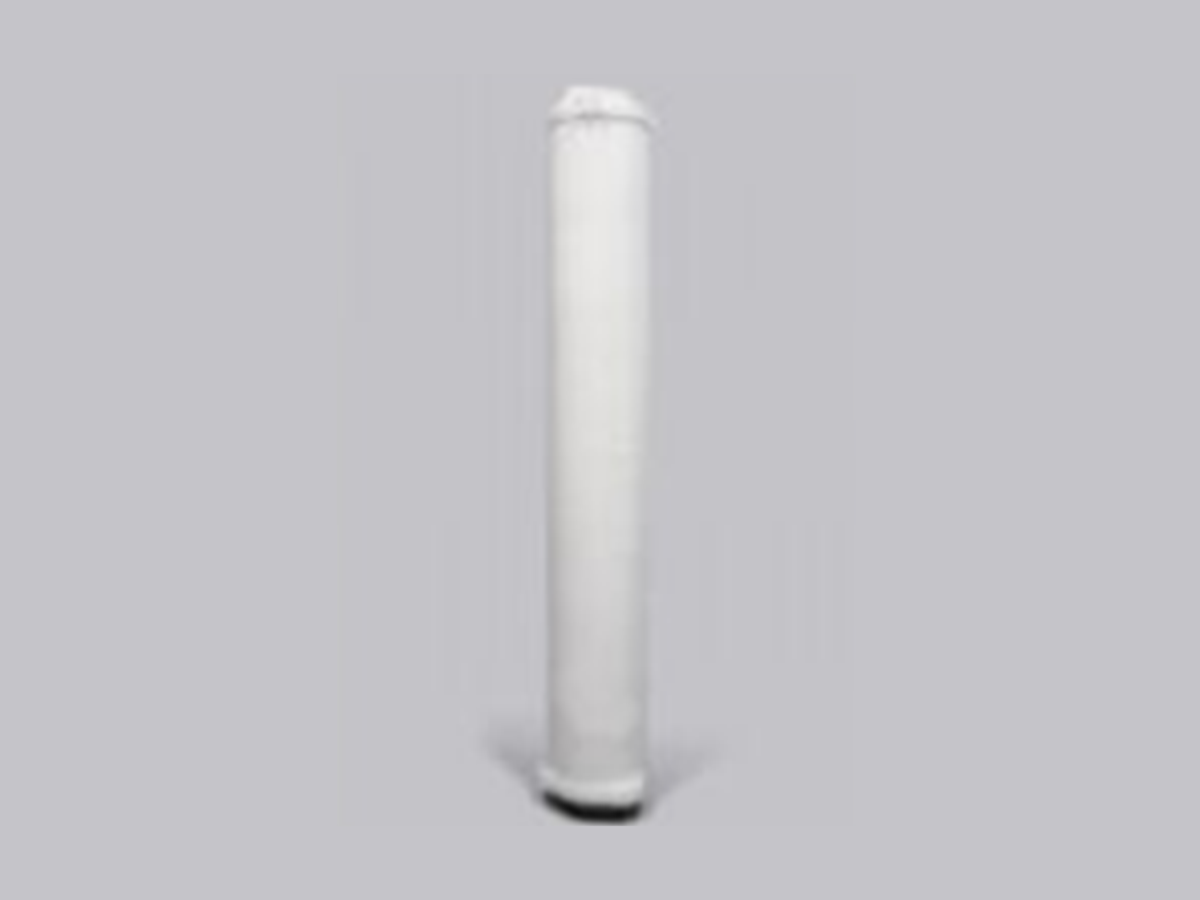
The working principle is easy to understand.
Liquid enters the filter housing and is directed through the filter cartridge. As the liquid passes through the pleated media, suspended particles are captured by the filter material. Cleaner liquid then moves through the internal support structure and leaves the housing.
The pleated shape is the key part of the design.
Imagine taking a large sheet of paper and folding it many times. If you put the folded sheet into a small box, you can fit much more surface area into the same space. A pleated filter works in a similar way.
More effective filter area can help the cartridge handle a larger amount of liquid without needing an extremely large housing. It can also provide more space for contaminant loading before the filter reaches its recommended change-out condition.
However, filtration performance is not determined by surface area alone.
The filter media, pore structure, filtration rating, liquid viscosity, temperature, particle concentration, flow rate, and pressure all matter. This is why we review the whole process when discussing a customized filtration requirement.
During operation, particles gradually accumulate on or within the filter media. As the filter loads with contaminants, the pressure difference between the inlet and outlet can increase. Operators can monitor this differential pressure to understand how the filter is performing.
A rising differential pressure does not automatically mean the filter has failed. It usually means that the filter is becoming loaded and should be checked against the recommended operating limits and replacement procedure.
This is a much more practical way to manage filter replacement than simply changing every cartridge after a fixed number of days.
The exact flow direction depends on the cartridge and housing design.
Some high-flow cartridge systems use an inside-to-outside flow path so that captured contaminants remain within the filter element. Pall, for example, describes this type of configuration for its Ultipleat High Flow products and notes that it helps prevent contaminants from escaping back into treated water during cartridge change-out.
For a BTR application, the flow direction should always match the specified cartridge and housing design. This is one of the technical details that should be confirmed before installation.
The pleated construction provides a large filtration area without requiring the entire filtration system to become extremely large.
This is useful when a customer has a high water demand but limited equipment space. Instead of installing a large number of conventional cartridges, a high-flow design may allow the system to use fewer larger elements, depending on the required flow and filtration conditions.
The BTR Series is positioned for applications where conventional cartridge arrangements may require many individual elements.
High-flow filtration can be useful in seawater desalination pretreatment, RO feed filtration, industrial process water, wastewater filtration, cooling water, and other suitable liquid filtration processes.
Still, I always make an important distinction between maximum flow and recommended operating flow.
A filter might physically pass a large amount of clean water, but the same cartridge may perform differently when the water contains a high level of suspended solids. Running close to the maximum published capacity may also shorten service life or increase pressure drop.
Our recommendation is therefore based on the actual process rather than simply the maximum number shown on a catalog.
Different projects have different requirements. Water quality, flow rate, filtration target, temperature, pressure, housing dimensions, and sealing materials all need to be considered.
Depending on the final BTR product configuration, suitable filter media, filtration rating, cartridge dimensions, connection type, and sealing materials can be selected according to the project.
This flexibility is especially useful for industrial customers because water treatment systems are rarely identical.
Cartridge filtration has another simple advantage: the filter element can be replaced without rebuilding the complete water treatment system.
Once the filter reaches the specified change-out condition, the operator can isolate the housing, release pressure, remove the used cartridge, inspect the housing and seals, install the new element, and restart the system according to the operating procedure.
For plants operating continuously, this can make routine maintenance easier to plan.
The BTR Series is not intended to operate as an isolated product. It can be integrated into a larger filtration or water treatment system.
For example, in a Seawater Desalination System, cartridge filtration may be placed after upstream pretreatment and before the RO membrane. In an industrial wastewater system, the cartridge may be used after another solids-removal stage as a polishing or protective filter.
The correct position depends on the process design.
When I talk with a customer about filtration, I try to move the discussion away from simple product specifications.
A filter cartridge should be judged by how well it fits the entire process.
Suspended solids can cause trouble for downstream equipment. They may increase membrane fouling, block narrow passages, affect valves, or increase wear on pumps and other components.
A properly selected high-flow cartridge can act as an additional barrier against particulate contamination before the next process stage.
This is particularly relevant in RO pretreatment.
Reverse osmosis membranes are designed for dissolved salt and contaminant separation, not for carrying a large load of suspended particles. Cartridge filtration can therefore serve as one of the final particulate-control stages before the membrane system.
One of the main reasons high-flow cartridge designs have become popular is the possibility of processing more liquid through each element.
Public manufacturer data illustrates this clearly. Pall states that its high-flow design can provide up to 40 times fewer elements to change out and can allow a filter system up to 50% smaller compared with certain conventional arrangements. These are Pall's published claims for its own Ultipleat system and are not claims for the BTR Series.
That concept is still useful when planning a new filtration system: fewer cartridges can potentially mean fewer replacement points, less maintenance work, and a smaller filtration footprint.
Maintenance becomes easier when operators understand what the filter is doing.
We recommend tracking operating flow, inlet pressure, outlet pressure, differential pressure, water quality, and cartridge replacement frequency where practical.
These simple records can help operators see whether a cartridge is working normally or whether something upstream has changed.
For example, if a filter normally operates for several weeks but suddenly reaches a high differential pressure after two days, the cartridge may not be the real problem. The upstream pretreatment process may have changed, or the raw water may contain more solids than usual.
That is why operating data is useful.
| Operating Factor | Why It Matters | What We Normally Check |
|---|---|---|
| Flow rate | Determines required filtration capacity | Normal flow, peak flow and future capacity |
| Suspended solids | Affects cartridge loading rate | Particle concentration and particle type |
| Filtration rating | Defines the target particle removal range | Required micron rating and rating method |
| Differential pressure | Shows increasing resistance across the filter | Inlet pressure and outlet pressure |
| Temperature | Can affect fluid properties and material compatibility | Normal and maximum operating temperature |
| Chemical composition | Can affect filter media and seals | pH, salinity and chemical exposure |
Source: General engineering selection factors based on cartridge filtration practice. Specific operating limits must be confirmed against the final BTR cartridge and housing specifications.
One reason I like high-flow cartridge filtration is its flexibility. The same basic filtration concept can support very different industries, provided the media and configuration are correctly selected.
Seawater desalination is one of our main areas of expertise.
Seawater can contain suspended solids, organic matter, microorganisms, and other contaminants. A complete desalination system therefore normally uses several treatment stages rather than depending on one filter.
The BTR Series can be considered as a particulate filtration component within an appropriate pretreatment or RO protection system.
Our engineers look at seawater quality, production capacity, pretreatment arrangement, RO operating conditions, site conditions, and maintenance requirements before confirming the filtration configuration.
RO pretreatment is another important application.
In many systems, cartridge filters are installed shortly before the RO membrane. Their job is to capture particles that remain after the upstream treatment stages.
The exact filtration rating depends on the membrane system, water quality, pretreatment design, and the customer's operating target. A finer cartridge is not automatically better if it becomes blocked too quickly.
Industrial wastewater is not one type of water.
A metal-processing plant may have one kind of suspended solids. A food-processing factory may have another. Chemical manufacturing, textile dyeing, electronics, and other industries can produce completely different water characteristics.
For this reason, we treat industrial wastewater filtration as an application-specific problem.
The BTR Series can be considered for particulate filtration where the liquid characteristics are compatible with the selected filter media. If the wastewater contains dissolved salts, heavy metals, oils, or other dissolved pollutants, additional treatment stages may be necessary.
High-salinity wastewater often requires membrane separation, concentration, evaporation, or other specialized treatment methods.
Cartridge filtration may be used as a supporting filtration stage to control suspended particles before sensitive downstream equipment.
The filter itself does not remove dissolved salt simply because it is a high-flow filter. This distinction is important when designing a real treatment system.
Manufacturing plants often need clean process water for production equipment, heat exchangers, cooling systems, washing processes, or other operations.
Where particulate control is required, a high-flow pleated cartridge can be considered as part of the filtration system.
High-flow filtration can also be used in larger water treatment systems where flow demand is high and maintenance efficiency matters.
Again, the cartridge should be selected according to the actual water quality and the required treatment target.
| Industry or Application | Possible Filtration Role | Main Selection Considerations |
|---|---|---|
| Seawater desalination | RO protection / pretreatment filtration | Seawater quality, SDI, flow, solids loading |
| RO pretreatment | Final particulate barrier before membranes | Micron rating, flow, pressure drop, membrane requirements |
| Industrial wastewater | Suspended solids filtration | Particle type, concentration, chemical compatibility |
| High-salinity wastewater | Supporting particulate filtration | Salinity, temperature, chemistry and downstream process |
| Process water | Particle control | Required cleanliness and production flow |
| Cooling water | Suspended solids reduction | Water chemistry, flow and equipment protection |
Source: Application categories reflect common industrial filtration practice. Public manufacturer information also identifies high-flow cartridge applications including desalination, process water, wastewater, utility water, boiler feed water and other industrial water duties.
A filter cartridge may look simple from the outside, but there are several details that affect its actual performance.
When we prepare a filtration solution, we start with the process rather than the cartridge.
First, we look at the liquid. What is it? Where does it come from? What particles are present? Is the water fresh, brackish, seawater, industrial wastewater, or process water?
Then we look at the required flow. We need to understand normal flow and, where relevant, peak flow. This helps determine how much filtration area is needed.
Next comes the filtration target. A filter intended to remove coarse suspended particles has a different job from a filter used for finer particulate control before an RO membrane.
After these basic questions are clear, the filter construction can be considered.
For a pleated cartridge, the media needs to be folded into a consistent structure. The support structure helps maintain the shape during operation. End caps, seals, and connections need to match the housing and installation arrangement.
Material compatibility is another point that we take seriously.
Water treatment can involve chlorine, acids, alkalis, salts, cleaning chemicals, and other substances. A material that works well in one application may not be suitable for another.
That is why I do not recommend choosing filter materials only by price.
The filter needs to survive the actual operating environment.
For a complete water treatment project, our equipment is assembled, commissioned, and inspected before delivery. Technical documents and operating information can also be provided according to the project requirements.
For customized projects, the production schedule is confirmed after process design and equipment configuration are finalized. Standard equipment can generally be arranged on a shorter schedule when the configuration is already defined.
We also pay attention to transportation.
Water treatment equipment may travel by truck, sea freight, or multimodal transportation. Depending on the size and structure, we can use wooden cases, pallets, or containerized packaging with suitable reinforcement.
This may sound like a logistics detail, but it matters. A filtration system that leaves the factory in good condition should also arrive at the project site in good condition.
There are many cartridge filter suppliers on the market. For a buyer, the difficult part is often not finding a product. It is finding a product that actually fits the system.
This is where our experience in complete water treatment projects becomes useful.
Qingdao Yanhui Environmental Protection Technology Co., Ltd. was established in 2015. We focus on seawater desalination, high-salinity wastewater treatment, concentration and purification, and industrial wastewater treatment.
Our service covers the complete project cycle, including:
Water treatment process analysis
Equipment and process design
Customized equipment manufacturing
Installation support
Equipment commissioning
Operation and maintenance support
This means we understand the conditions under which a filter cartridge actually works.
If a customer simply tells us, “I need a high-flow filter,” we will normally ask a few more questions.
What is the flow rate?
What is the water source?
What is the suspended solids level?
What filtration level is required?
What equipment is downstream?
What housing is already installed?
How often can the customer perform maintenance?
These questions help us avoid a common problem in industrial purchasing: buying a technically attractive product that does not match the actual process.
For customers working on seawater desalination projects, we can also look at the cartridge filter together with the broader pretreatment and RO process. For industrial wastewater projects, we can consider filtration as one stage within the overall treatment line rather than treating it as an isolated product.
We also understand that project buyers care about delivery, documentation, packaging, and after-sales support—not just the filter itself.
For customized equipment, production time is determined according to the project scale and configuration. Before shipment, we complete assembly, commissioning, and quality inspection and provide the relevant technical and operating documents.
Payment terms can be arranged according to the project contract, such as an advance payment, shipment payment, and final payment.
For international transportation, we can coordinate suitable packaging and logistics according to equipment dimensions and destination.
The BTR Series is designed for high-flow liquid filtration applications where particulate removal and practical system maintenance are required. Potential applications include seawater desalination pretreatment, RO pretreatment, industrial wastewater filtration, process water filtration, and other suitable industrial water treatment processes.
Yes, a suitable BTR configuration can be considered as a cartridge filtration stage before RO membranes. The exact filtration rating and configuration should be determined according to the upstream water quality, suspended solids, flow rate, membrane requirements, and existing pretreatment process.
There is no single rating that works for every application. We recommend considering the particle size distribution, required downstream protection, water quality, flow rate, and acceptable pressure drop. If you have a water analysis or existing filtration specification, we can use it to help determine the appropriate configuration.
Not automatically. Service life depends on contaminant loading, flow rate, filter area, media structure, water quality, and operating conditions. A high-flow cartridge can provide a large filtration area, but a heavily contaminated feed can still load the filter quickly.
Differential pressure is one practical indicator. Operators can monitor the pressure at the cartridge inlet and outlet and compare the result with the recommended operating limits. Replacement timing should also consider water quality, operating hours, flow, and the actual condition of the cartridge.
It can be considered for suitable seawater filtration applications, including pretreatment for desalination systems. However, seawater service requires attention to material compatibility, salinity, temperature, pressure, suspended solids, and the complete treatment process. The final configuration should be confirmed for the specific project.
No. A pleated cartridge filter is primarily a particulate filtration component. It should not be confused with reverse osmosis, ion exchange, evaporation, or other technologies designed to remove dissolved salts.
Yes, where the wastewater characteristics are compatible with the selected filter configuration. The cartridge can help control suspended particles, but industrial wastewater may contain dissolved chemicals, heavy metals, oils, organic pollutants, or salts that require additional treatment processes.
We normally recommend providing the water source, flow rate, filtration requirement, water analysis if available, operating temperature, pressure, existing housing dimensions, cartridge dimensions, connection type, and downstream equipment information. If you do not have all of these details, we can start with the information available and identify what is still needed.
Yes. Qingdao Yanhui provides customized water treatment equipment and integrated engineering services. Our work covers R&D, design, manufacturing, installation, commissioning, operation, and maintenance. The final configuration is developed according to water quality, required production capacity, site conditions, and project requirements.
Delivery depends on the project scale and configuration. Standard equipment can generally be delivered on a shorter schedule when the configuration is already confirmed. Customized systems require additional time for process design, manufacturing, assembly, testing, and inspection.
Depending on the equipment size and transportation method, we can use reinforced wooden cases, pallets, or containers. Land transportation, sea transportation, or multimodal transportation can be selected according to the destination and project requirements.
In real water treatment work, I believe a filter should be selected for the job it actually needs to do.
The BTR Series High-Flow Pleated Filter Cartridge is designed around this idea. Its pleated filtration structure provides a large effective filtration area, while the high-flow concept makes it suitable for applications where a conventional cartridge arrangement may require many individual elements.
It can be considered for industrial water filtration, seawater desalination pretreatment, RO pretreatment, wastewater filtration, process water treatment, and other high-flow liquid filtration applications.
But the most important step is still proper selection.
If you are purchasing filter cartridges for a new water treatment plant, replacing an existing cartridge, or designing a seawater desalination or industrial wastewater system, we recommend starting with the actual operating conditions.
Tell us your flow rate, water source, filtration requirement, existing housing information, and downstream equipment. If you have a water analysis or technical drawing, that is even better.
We can then review the application and discuss a suitable BTR Series configuration rather than simply sending you a generic product list.
For us, the goal is straightforward: make the filtration component fit the water treatment system, and make the system practical for the people who operate it.
Pall Corporation — Ultipleat High Flow Series product information and published cartridge flow data.
Pall Corporation — Ultipleat High Flow technical datasheet and published specifications.
Parker Hannifin — Filtration System Products Catalog, including MegaFlow+ high-flow pleated cartridges.
Solventum / 3M — High Flow HFR Series product information and published application data for high-flow pleated cartridges.
Technical note: The third-party flow rates and product specifications cited above are provided only as industry reference data. They are not specifications of the BTR Series High-Flow Pleated Filter Cartridge. Actual BTR Series dimensions, filtration ratings, flow capacity, pressure limits, media, seals, and connection types should be confirmed with Qingdao Yanhui according to the specific project.
This website uses cookies to ensure you get the best experience on our website.
 Portugues
 Pусский
 Français
 العربية
 ไทย
ไทย Indonesia
 Melayu
 Tiếng Việt
 中文
中文 қазақ
қазақ עִברִית
 မြန်မာ
 ພາສາລາວ
 Filipino
 o'zbek
 Кыргызча
 тоҷикӣ
 ខ្មែរ
ខ្មែរ Türkmenler



 Phone
Phone