

LFS high-flow pleated Filter Cartridges use a deep-layer fine polypropylene fiber membrane as the filter media, with a diameter of 6.5"/165mm.
The larger diameter increases the effective filtration area, reducing the requirements for filter size and the number of filter cartridges during use.
This design significantly reduces equipment and labor costs, and is more convenient to operate. It features internal PP frame support and a single opening.
The filter is specially designed with an outside-to-inside liquid flow direction to ensure that all pollutant particles are intercepted on the outside of the filter element, making it widely applicable.
It is widely used in different fields.
Design parameters
Specifications (diameter * length) | Design flow rate (m³/h) | Maximum flow rate (m³/h) | Filter area (m2) |
6.5**20" | 15 | 40 | 3.3 |
6.5**40" | 30 | 80 | 6.5 |
6.5**60" | 45 | 110 | 8.5 |
Material Structure
model | PP | GF |
Filter media | Deeply folded polypropylene | Resin-based synthetic glass fiber/polyester |
Support/Guide Layer | polypropylene | Polyester |
End cap | Glass fiber reinforced polypropylene | Glass fiber reinforced polypropylene |
outer protective sleeve | polypropylene | Polyester |
Interface type
LFS | 40 | PP | 0050 | E | S |
LFS | length | Material | accuracy | sealing ring | Interface |
20=20" | PP | 0010 = 1 μm | E = EPDM | S = skeleton | |
40=40" | GF | 0030 = 3 μm | S = Silicone rubber | W = Netting | |
60=60" | 0050 = 5 μm | F = Fluororubber | |||
0100 = 10 μm | N = Nitrile rubber | ||||
0.150 = 15 μm | |||||
0250 = 25 μm | |||||
0400 = 40 μm | |||||
0700 = 70 μm |
Working characteristics
Maximum operating temperature | 80℃ |
Maximum working pressure difference | 0.38 MPa @ 20℃ |
suggestion Replace differential pressure | 0.15Mpa@20℃ |
Typical application scenarios
Filtration of power plant makeup water, condensate, and stator cooling water |
Reverse osmosis (RO) system pretreatment |
Seawater Desalination pretreatment |
Deionized water pre-filtration |
Filtration of process water in petrochemical and other industries |
LFS Series High-Flow Pleated Filter Cartridge for Industrial Water Treatment
When I design or select a filtration component for a water treatment project, I do not start with the question, “Which filter looks better?” I start with a much more practical question: what does the water actually contain, how much water needs to pass through the system, and what should the filter protect?
That is the thinking behind our LFS Series High-Flow Pleated Filter Cartridge. It is designed for high-flow liquid filtration where stable particle removal, practical maintenance, and reasonable operating cost all matter. In a complete water treatment system, the filter cartridge may look like a small component, but its performance can affect pumps, membranes, valves, pipelines, and the stability of the whole process.
At Qingdao Yanhui Environmental Protection Technology Co., Ltd., we have been working in water treatment engineering since 2015. Our business covers Seawater Desalination, high-salinity wastewater treatment, concentration and purification, and industrial wastewater treatment. We provide customized equipment and engineering services from process design and manufacturing to installation, commissioning, operation, and maintenance.
For us, a filter cartridge is not simply a consumable product. It needs to fit the actual process.
The LFS Series High-Flow Pleated Filter Cartridge can be used as a high-flow prefilter or process filter in suitable water treatment systems. Depending on the application, filter media, micron rating, cartridge length, sealing material, connection type, and housing arrangement can be selected according to project requirements.
A high-flow pleated filter cartridge is a filtration element built with pleated filter media. Instead of using one flat piece of filter material, the media is folded into many pleats. This creates a much larger effective filtration area inside a relatively compact cartridge.
That simple design has an important advantage. More filtration area generally means that water can pass through the cartridge with less resistance while suspended particles are captured by the filter media.
In practical water treatment work, we often deal with sand, rust, pipe scale, suspended solids, colloids, and other particles. The exact contaminant depends on the water source and the upstream process. A properly selected pleated filter cartridge can help remove these particles before the water enters the next treatment stage.
High-flow designs take the same basic idea further. A larger filtration area and larger cartridge geometry can allow one element to handle a higher flow than a conventional small-diameter cartridge. This can reduce the number of individual cartridges needed in some systems and make filter replacement easier to organize.
Public product information from several established filtration manufacturers shows how widely high-flow cartridge designs are used. For example, Parker's MegaFlow+ series describes a 6-inch-diameter cartridge with flow capacity up to 175 gpm (662 L/min) per cartridge, while Pall's Ultipleat High Flow series lists suggested maximum water flows of 175 to 500 gpm depending on cartridge length. These figures are manufacturer-specific reference values, not specifications for our LFS Series cartridge. Actual capacity always depends on filter media, micron rating, pressure drop, fluid properties, and operating conditions.
| High-Flow Cartridge Reference | Published Cartridge Size | Published Water Flow Reference | Source |
|---|---|---|---|
| Parker MegaFlow+ | 6 in diameter | Up to 175 gpm / 662 L/min per cartridge | Parker filtration product catalog |
| Pall Ultipleat High Flow | 6 in diameter, 20 in length | 175 gpm / 663 L/min | Pall product information |
| Pall Ultipleat High Flow | 6 in diameter, 40 in length | 350 gpm / 1325 L/min | Pall product information |
| Pall Ultipleat High Flow | 6 in diameter, 60 in length | 500 gpm / 1900 L/min | Pall product information |
Source: Parker Filtration System Products Catalog and Pall Ultipleat High Flow product information. Values are published reference data for the named manufacturers and are not guaranteed LFS Series specifications.
This distinction is important. In filtration, there is no useful “one number fits every system” answer. A filter that works well in relatively clean water may behave very differently when the feed contains a large amount of suspended solids or when the liquid has a higher viscosity.
That is why we normally confirm the operating conditions before recommending a cartridge configuration.
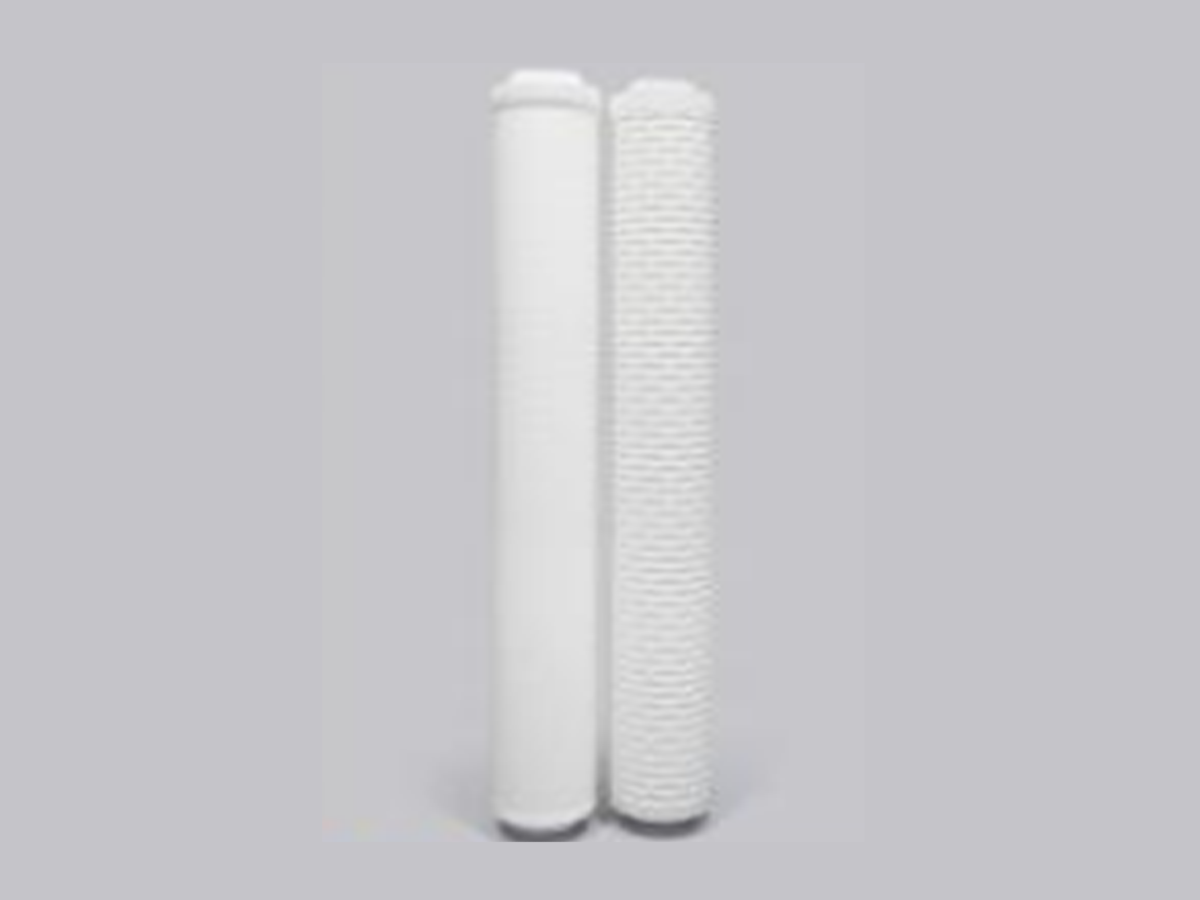
The working principle is straightforward.
Liquid enters the filter housing and flows through the pleated filter media. Particles larger than the effective filtration openings are retained by the media. Depending on the filter structure and rating, particles may also be captured within the depth of the media rather than simply sitting on the outer surface.
The clean liquid then passes through the internal support structure and leaves the housing.
The pleated structure is especially useful because it provides a large filtration surface within a compact footprint. If you unfold the media, the actual surface area can be much larger than the outside appearance of the cartridge suggests.
As filtration continues, particles gradually accumulate on and inside the media. The pressure difference between the inlet and outlet may increase. We normally call this differential pressure, or ΔP.
For operators, ΔP is one of the most useful signals for deciding when a cartridge should be inspected or replaced. Instead of changing a filter simply because a certain number of days has passed, operators can monitor the real operating condition.
Of course, the correct change-out pressure depends on the filter construction, housing, process design, fluid, temperature, and manufacturer's recommendations. It should not be copied from another system without checking the actual equipment.
In a Seawater Desalination System, for example, the cartridge may be positioned upstream of a reverse osmosis unit. In that case, the filter is not expected to perform the same job as the RO membrane. Its role is normally to reduce suspended particles and protect the downstream process.
That division of work is important. A cartridge filter and an RO membrane solve different filtration problems.
The pleated structure gives the cartridge a large effective filtration area. This is one of the main reasons pleated cartridges are widely used when fine particle filtration and practical flow capacity are both needed.
For a high-flow system, this design can help reduce the number of conventional cartridges required. Fewer individual elements can also mean fewer connection points and a simpler replacement process, depending on the housing design.
The name “high-flow” is not just a marketing phrase. The real purpose is to move a large volume of liquid through a practical filtration area without creating unnecessary resistance.
However, I would never recommend selecting a cartridge only by looking at its advertised maximum flow. Maximum flow is not the same as the recommended working flow.
For example, a filter operating with clean water at a low viscosity may have a very different pressure drop from the same filter handling wastewater containing a high concentration of suspended solids.
We therefore consider flow rate together with water quality, filtration rating, temperature, pressure, viscosity, and expected dirt loading.
Pleated cartridges can be produced with different media materials for different applications. Public information from LFS Filters, for example, lists PP, glass fiber, PES, nylon, hydrophobic PTFE, hydrophilic PTFE, PVDF, and other media options for pleated filter elements.
For water treatment applications, polypropylene is a common choice because it offers useful chemical compatibility for many aqueous processes. But it is not automatically the correct choice for every liquid.
For this reason, our recommendation is based on the actual fluid rather than simply selecting the cheapest media.
Micron rating tells us how fine the filtration target is, but the number alone does not tell the whole story.
Different manufacturers may define nominal and absolute ratings differently. A 5-micron nominal filter and a 5-micron absolute-rated filter should not automatically be treated as identical products.
We therefore recommend checking the manufacturer's test method, rating definition, media construction, and application conditions when comparing cartridges.
One of the practical advantages of a cartridge-based system is that the filter element can be replaced without rebuilding the entire filtration unit.
When the cartridge reaches its recommended change-out condition, the housing can normally be isolated, depressurized, opened, and the used cartridge removed. The new cartridge is then installed and the system returned to operation according to the equipment's operating procedure.
For industrial users, this simple maintenance process can be valuable because downtime often costs more than the filter itself.
I always prefer to judge a filter from the point of view of the complete process.
A filter cartridge does not operate by itself. It is part of a chain that may include a raw water tank, pump, dosing system, multimedia filter, cartridge filter, RO system, UV system, sterilization unit, or other treatment equipment.
When the cartridge is correctly selected, it can perform several useful jobs.
Protect downstream equipment: Suspended particles can be reduced before they reach pumps, membranes, valves, and other components.
Support stable operation: A properly sized filter can help maintain a more stable feed condition for downstream treatment.
Handle high-volume water: High-flow cartridge designs are suitable for applications where conventional small cartridges would require many elements.
Reduce maintenance complexity: A practical cartridge configuration can make inspection and replacement easier.
Adapt to different projects: Media, micron rating, dimensions, seals, and housing configuration can be selected according to process requirements.
There is also a cost point that is easy to overlook. The cheapest cartridge price does not necessarily produce the lowest filtration cost.
If a cartridge has to be replaced too frequently, the operator pays for more cartridges, more labor, more disposal, and more downtime. A cartridge with a higher purchase price may sometimes provide a lower total operating cost if it offers a suitable service life and stable pressure drop.
That is why we look at the complete filtration cycle rather than only the unit price.
| Factor | Conventional Small Cartridge Arrangement | High-Flow Cartridge Arrangement | Practical Consideration |
|---|---|---|---|
| Number of elements | Often more individual elements | Potentially fewer larger elements | Depends on required flow and cartridge design |
| Filtration area | Limited by cartridge dimensions | Large pleated area within larger geometry | Higher area can support higher flow |
| Maintenance | More individual elements may need replacement | Fewer large elements may simplify change-out | Depends on housing arrangement |
| System footprint | May increase as element count rises | Can be more compact for high-flow duties | Must be confirmed by system design |
| Operating cost | Depends on element price and replacement frequency | Depends on media life, flow and pressure drop | Total cost should include labor and downtime |
Source: Engineering comparison based on the operating principles of pleated high-flow cartridge systems. Cartridge count, footprint and operating cost vary by manufacturer, housing and process conditions. Published high-flow examples from Parker and Pall support the general design concept.
The right application depends on the selected filter media and filtration rating. In our water treatment work, we consider the cartridge particularly relevant to applications where particulate control is needed before or during a larger treatment process.
Seawater contains suspended solids and can have a demanding operating environment. A suitable cartridge filter can be used as part of pretreatment to reduce particulate loading before downstream membrane treatment.
Our company specializes in Seawater Desalination Equipment, so we understand that cartridge filtration is only one part of the complete desalination process. The final configuration should be determined according to seawater quality, turbidity, SDI requirements, pretreatment design, RO capacity, and operating conditions.
Reverse osmosis membranes need protection from excessive particulate loading. A properly selected cartridge filter can act as a final particulate barrier before the RO unit.
In an RO system, I pay close attention to the relationship between the cartridge filter and the upstream pretreatment. If the upstream multimedia or other filtration stage is not working properly, the cartridge filter may become overloaded quickly. Replacing cartridges more often does not solve the root problem.
Industrial wastewater can vary greatly from one factory to another. Metal processing, chemical production, food processing, electronics manufacturing, textile dyeing, and other industries can produce very different wastewater streams.
For this reason, cartridge selection must be based on actual water analysis and process requirements. A pleated cartridge can be useful for particulate filtration, but it should not be treated as a universal solution for dissolved pollutants, salts, heavy metals, or organic compounds.
High-salinity wastewater presents additional challenges because the dissolved salt concentration and chemical composition can affect the entire treatment process. Cartridge filtration may be used as one stage in a larger concentration, purification, or membrane process.
Where water demand is high, a high-flow cartridge design can be considered for polishing or pretreatment applications. The final selection depends on the required water quality, flow rate, housing capacity, and local operating conditions.
| Application | Typical Filtration Role | Key Selection Factors |
|---|---|---|
| Seawater desalination | Pretreatment / particulate protection | Seawater quality, turbidity, flow, downstream RO requirements |
| RO pretreatment | Final particulate filtration before membranes | SDI, particle loading, micron rating, flow |
| Industrial wastewater | Suspended solids reduction / process filtration | Solids type, concentration, chemical compatibility |
| High-salinity wastewater | Particulate control within a larger process | Salt concentration, temperature, chemistry, process pressure |
| Commercial water treatment | Polishing or pretreatment | Water quality, peak flow, maintenance cycle |
| Process water | Particle removal before production equipment | Required cleanliness, fluid compatibility, flow |
Source: Application categories are based on common industrial filtration practice and published manufacturer application information. Parker lists high-flow pleated cartridges for potable water, wastewater, food and beverage, coolants and petrochemical applications; Parker also lists pleated depth cartridges for RO/DI prefiltration and wastewater filtration.
A good filtration product is not created simply by putting filter media inside a plastic shell. The details matter.
When we prepare a cartridge or a filtration solution for a project, we first look at the application conditions. We want to know the liquid being filtered, expected flow, temperature, pressure, particle characteristics, required filtration level, housing arrangement, and downstream equipment.
The filter media is then selected according to the application. For pleated cartridges, the media is folded into a controlled pleat structure to increase the effective surface area.
The filter media must be properly supported. The core and outer support structure help maintain the shape of the element during operation. End caps and sealing components must also match the housing and connection arrangement.
For water treatment equipment, compatibility is particularly important. A filter that looks suitable on paper may not be suitable when exposed to a particular chemical, temperature, or pressure for a long period.
After assembly, the cartridge should be checked for dimensional consistency, sealing condition, appearance, and other relevant quality requirements. For a complete project, we can also coordinate cartridge selection with the filter housing and the overall water treatment skid.
This project-based approach is one of the differences between selling a generic filter and providing a filtration solution.
For standard equipment, production and delivery can normally be arranged according to the standard configuration. For customized projects, the schedule is confirmed after process design, technical specifications, quantity, and equipment configuration are finalized.
Before delivery of our water treatment equipment, we complete equipment assembly, commissioning, and quality inspection. Technical documents and operating information can be supplied according to project requirements.
There are many filter cartridge suppliers in the market. So why should a water treatment equipment buyer discuss the application with us?
My answer is simple: we look at the cartridge as part of the water treatment system.
Qingdao Yanhui Environmental Protection Technology Co., Ltd. was established in 2015. Our main business covers seawater desalination, high-salinity wastewater treatment, concentration and purification, and industrial wastewater treatment.
We provide services covering R&D, process design, equipment manufacturing, installation, commissioning, operation, and maintenance. This gives us a practical view of filtration that goes beyond the cartridge itself.
For example, if a customer tells us, “I need a 5-micron filter,” we do not stop there. We want to know why the 5-micron filter is needed.
Is it for RO protection?
Is it for removing visible suspended solids?
Is the feed water seawater, groundwater, process water, or industrial wastewater?
What is the flow rate?
What is the expected pressure drop?
How often can the operator replace the filter?
What is the available filter housing?
These questions may sound basic, but they often determine whether the final filtration system works smoothly.
We also support customized equipment based on water quality, required production capacity, site conditions, and project configuration. For larger projects, we can coordinate filtration requirements with the complete desalination or wastewater treatment system.
Equipment delivery is organized according to project requirements. Depending on equipment size, we can arrange reinforced wooden cases, pallets, or containerized packaging. Transportation may use land freight, sea freight, or multimodal transportation.
For international projects, packaging is not an afterthought. Equipment may travel a long distance before reaching the installation site. Proper reinforcement helps reduce the risk of damage during handling and transportation.
Our goal is not to sell the largest filter or the most expensive configuration. It is to match the filtration equipment to the actual process and make the final system practical to operate.
A high-flow pleated filter cartridge is a large-capacity filtration element that uses pleated media to create a large effective filtration area. It is designed for applications where a relatively high liquid flow needs to pass through a compact filtration system.
Yes, a suitable configuration can be used as part of a seawater desalination pretreatment or RO protection system. However, the cartridge should not be selected only because the application is seawater. We need to check salinity, suspended solids, flow rate, temperature, pressure, pretreatment design, and the requirements of the downstream RO system.
There is no universal micron rating for every project. The correct selection depends on the purpose of filtration and the characteristics of the water. A cartridge used for general particulate removal may require a different rating from one used as final RO pretreatment.
Not necessarily. A finer filter can provide tighter particle removal, but it may also create a higher pressure drop or load more quickly when the feed water contains a large amount of solids. The best filter is the one that meets the actual process requirement while maintaining practical flow and service life.
Pressure drop is one useful indicator. Operators can monitor the differential pressure between the inlet and outlet and follow the cartridge manufacturer's recommended change-out condition. Actual replacement timing also depends on feed water quality, operating hours, flow rate, and contaminant loading.
We can discuss customized filtration requirements based on the project. Possible factors include cartridge dimensions, filter media, filtration rating, sealing materials, connections, housing configuration, and system flow requirements. The exact configuration should be confirmed after reviewing the application.
It can be considered for particulate filtration in suitable industrial wastewater processes. However, industrial wastewater can contain dissolved chemicals, oils, heavy metals, organic matter, and other contaminants that may require different treatment technologies. Cartridge filtration is normally one process stage rather than a complete wastewater treatment solution.
The more information we have, the more accurately we can recommend the configuration. Useful information includes water source, flow rate, required filtration rating, temperature, operating pressure, water analysis if available, filter housing dimensions, cartridge size, connection type, and downstream equipment.
For standard equipment, the delivery period is normally shorter because the configuration is already defined. Customized projects require additional time for process design, technical confirmation, equipment configuration, production, testing, and inspection. We confirm the actual delivery schedule after the project specifications and quantity are finalized.
Depending on the equipment size and transportation method, we can use wooden cases, pallets, or containerized packaging with suitable reinforcement. Land transportation, sea transportation, and multimodal logistics can be arranged according to the destination and project requirements.
When a filtration project is running well, the cartridge often does not attract much attention. Water enters, particles are removed, pressure stays within the expected range, and the downstream equipment keeps working.
That is exactly what we want.
The LFS Series High-Flow Pleated Filter Cartridge is intended for applications where high-flow liquid filtration, practical maintenance, and flexible configuration are important. Its pleated structure provides a large filtration area, while the available media and configuration options allow the cartridge to be considered for different industrial water treatment duties.
But I would still make one point very clear: choosing a filter by product name alone is not enough.
The right cartridge depends on the water.
If you are working on a seawater desalination project, RO pretreatment system, industrial wastewater line, process water system, or another high-flow filtration application, send us the basic operating information. We can review the flow rate, water quality, filtration target, housing arrangement, and downstream requirements and then discuss a suitable LFS Series configuration.
At Qingdao Yanhui Environmental Protection Technology Co., Ltd., we focus on building filtration and water treatment solutions that work in real operating conditions—not just on a specification sheet.
Parker Filtration System Products Catalog — published information on MegaFlow+ high-flow pleated filter cartridges and application ranges.
Pall Ultipleat High Flow Series — published cartridge dimensions and suggested maximum water flow references.
Parker Polyflow Pleated Depth Filter Cartridge — published information on polypropylene pleated depth filtration and RO/DI prefiltration applications.
LFS Filters — published information on pleated filter elements, high-flow elements, available media, connections, and custom cartridge options.
Important technical note: Published flow rates, micron ratings, pressure limits, dimensions, and material options from third-party manufacturers are provided for comparison and engineering reference only. They should not be treated as specifications of the LFS Series High-Flow Pleated Filter Cartridge. Final product specifications and operating limits should be confirmed with Qingdao Yanhui according to the actual project.
Parker's published product information describes pleated polypropylene depth cartridges and high-flow MegaFlow+ cartridges, including application and flow references.
Pall publishes suggested maximum water flow figures for its Ultipleat High Flow cartridges, ranging from 175 gpm for a 20-inch element to 500 gpm for selected 60-inch configurations.
LFS Filters publishes information on pleated and high-flow filter elements, including PP, PES, nylon, PTFE and PVDF media options and custom cartridge configurations.
Parker also publishes applications for pleated depth cartridges including general water filtration, wastewater filtration, and RO/DI prefiltration, illustrating the role of pleated cartridges within broader water treatment systems.
This website uses cookies to ensure you get the best experience on our website.
 Portugues
 Pусский
 Français
 العربية
 ไทย
ไทย Indonesia
 Melayu
 Tiếng Việt
 中文
中文 қазақ
қазақ עִברִית
 မြန်မာ
 ພາສາລາວ
 Filipino
 o'zbek
 Кыргызча
 тоҷикӣ
 ខ្មែរ
ខ្មែរ Türkmenler



 Phone
Phone