

The LFPK series high-flow Filter Cartridges primarily use deep-layer fine polypropylene fiber membranes as the filter media, and are equipped with pull handles at both ends.
The LFPK series features easy removal from both ends of the filter, a large 6" diameter, a one-way opening, and a high flow rate design, reducing the number of filter cartridges and filters needed for the same flow rate. This significantly reduces equipment investment costs.
Flow filter cartridges offer a variety of processes and precision options to meet diverse filtration needs.
Design parameters
Specifications (diameter * length) | Design flow rate (m³/h) | Maximum flow rate (m³/h) | Filter area (m3) |
6"20" | 15 | 40 | 3.3 |
6"40" | 30 | 80 | 6.5 |
6"60" | 45 | 110 | 8.5 |
Material Structure
model | PP | GF |
Filter media | Deeply folded polypropylene | Resin-based synthetic glass fiber/polyester |
Support/Guide Layer | polypropylene | Polyester |
End cap | Glass fiber reinforced polypropylene | Glass fiber reinforced polypropylene |
outer protective sleeve | polypropylene | Polyester |
Interface type
| LFPK | 40 | PP | 50 | N | S |
| LFPK | length | Material | accuracy | sealing ring | Appearance |
| 20=20" | PP | 0010 = 1 渭m | E = EPDM | S = skeleton | |
| 40=40" | GF | 0030 = 3 渭m | S = Silicone rubber | B = wrapping tape | |
| 60=60" | 0050 = 5 渭m | F = Chlorinated rubber | |||
| 0100 = 10 渭m | N = Nitrile rubber | ||||
| 0.150 = 15 渭m | |||||
| 0250 = 25 渭m | |||||
| 0400 = 40 渭m | |||||
| 0700 = 70 渭m |
Working characteristics
Maximum operating temperature | 80℃ |
Maximum working pressure difference | 0.58 MPa@20℃ |
Recommend replacing pressure difference | 0.15Mpa@20℃ |
Typical application scenarios
Filtration of power plant makeup water, condensate, and stator cooling water |
Reverse osmosis (RO) system pretreatment |
Seawater Desalination pretreatment |
Deionized water pre-filtration |
Filtration of process water in petrochemical and other industries |
LFPK Series High-Flow Filter Cartridge for Industrial Liquid Filtration
When I look at an industrial water treatment system, I rarely start with one piece of equipment. I start with the water. Where does it come from? How much water needs to be treated? What is in it? What equipment comes next? And how often will the operator need to maintain the system?
These questions are especially important when a project uses a High-Flow Filter Cartridge. A cartridge filter may look like a small component compared with a complete Seawater Desalination Plant or industrial wastewater treatment system, but its position in the process can be very important. It may protect downstream equipment, help control suspended particles, and provide a more stable filtration step before membrane treatment or other processes.
The LFPK Series High-Flow Filter Cartridge is designed for this type of industrial liquid filtration application. I see it as a practical filtration component for systems that need to process a relatively large amount of liquid while keeping the filtration structure manageable. Depending on the selected configuration, it can be considered for water treatment, process water, wastewater pretreatment, desalination pretreatment, and other industrial filtration applications.
At Qingdao Yanhui Environmental Protection Technology Co., Ltd., we have been involved in water treatment projects since 2015. Our work covers Seawater Desalination, high-salinity wastewater treatment, concentration and purification, and industrial wastewater treatment. Because we work with complete treatment systems, I do not look at a filter cartridge as an isolated product. I look at how it fits into the whole process.
That is also how I approach the LFPK Series. The right filter is not simply the one with the biggest advertised flow number. It is the one that matches the water quality, flow requirement, filtration target, housing, operating conditions, and downstream equipment.
In a small water system, filtration can sometimes be handled with a standard cartridge housing and a few conventional filter elements. But when the water volume becomes much larger, the situation changes. More flow usually means more filtration area is needed. If the filtration area is too small, pressure loss can rise quickly and the filter may need frequent replacement.
This is why high-flow filtration has become an important part of many industrial water treatment designs. Instead of simply adding more and more small cartridges, engineers can use larger filtration elements designed to handle higher flow rates. The exact benefit depends on the filter design, media, water quality, and housing, but the basic idea is simple: make better use of the available filtration area.
I often compare filtration to a road. If a large amount of traffic has to pass through a narrow road, congestion appears. If the road has more usable lanes, traffic can be distributed more effectively. A filter works differently, of course, but the comparison helps explain why filtration area and flow distribution matter.
Public information from established filtration manufacturers provides useful industry reference points. Pall, for example, publishes a high-flow cartridge system with a stated maximum flow of up to 500 US gallons per minute, or about 1,900 L/min, for a specified 60-inch element. 3M also publishes a high-flow filter system designed for up to 500 gpm, approximately 113 m³/h, using a specified 60-inch cartridge. These are reference figures for those manufacturers' products, not LFPK Series specifications.
| Industry Reference | Published Flow Information | Configuration Mentioned | Source |
|---|---|---|---|
| Pall Ultipleat High Flow | Up to 500 gpm / 1,900 L/min | Specified 60-inch high-flow element | Pall published product information |
| 3M High Flow Filter System | Up to 500 gpm / approximately 113 m³/h | Specified 60-inch filter cartridge | 3M published technical information |
| LFPK Series | Project dependent | High-flow filter cartridge configuration | Qingdao Yanhui project configuration |
I prefer to keep this distinction clear. A published flow rate from another manufacturer should not be copied onto a new product page as if it were the LFPK Series specification. In actual engineering work, flow capacity depends on much more than cartridge length. Liquid viscosity, particle concentration, filter rating, pressure drop, media structure, temperature, and housing design can all change the result.
So when a customer asks me for a high-flow filter cartridge, my first response is usually not a price. I first ask what liquid is being filtered and how the filtration stage is being used.
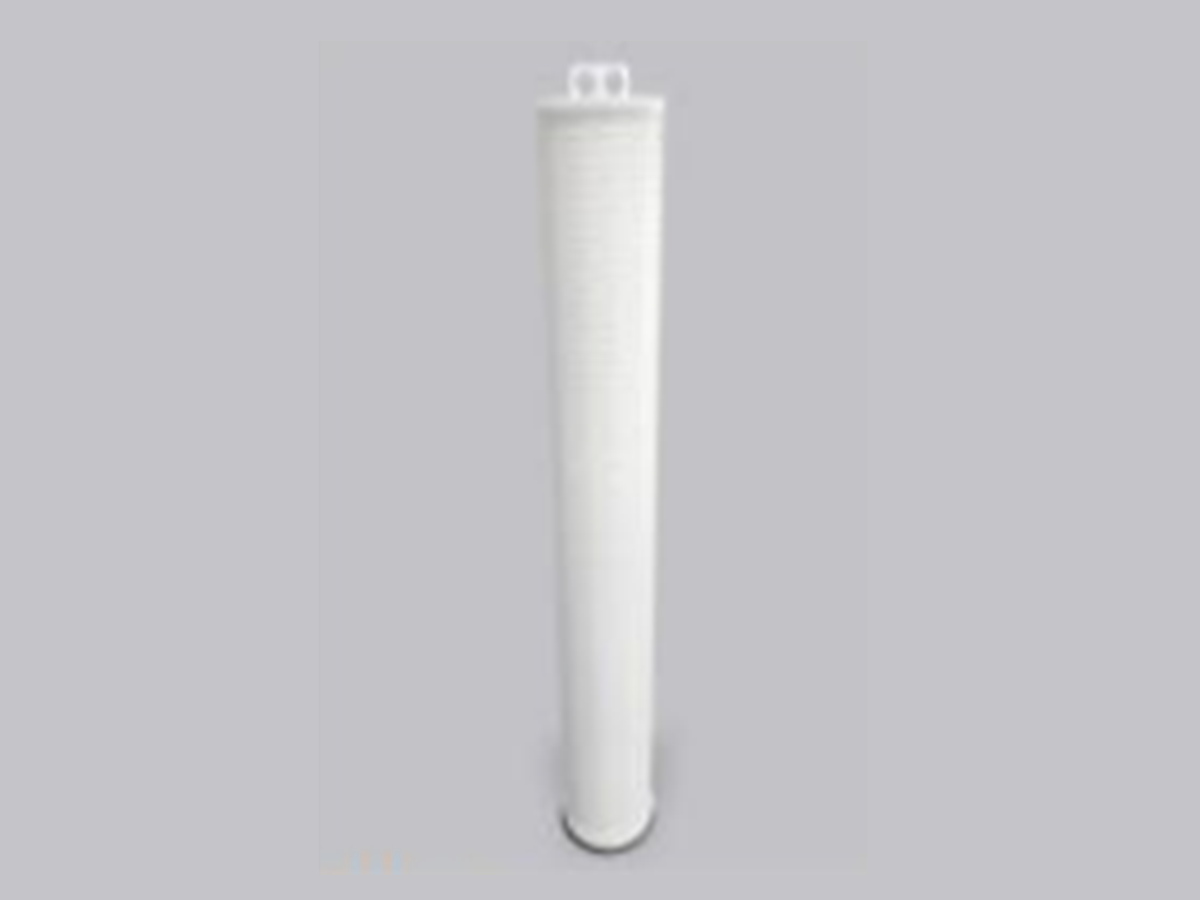
The basic working principle is easy to understand. Contaminated liquid enters the filtration housing, passes through the filter cartridge, and continues toward the next stage after unwanted particles have been retained by the filter media.
The filter media contains a large number of small passages. Depending on the media type and filtration design, particles can be captured through different mechanisms. Larger particles may be retained because they cannot pass through the filtration structure. Smaller particles may also be captured within the depth or surface structure of the media.
As the filter operates, more particles accumulate. This gradually increases resistance to flow. In engineering terms, we normally watch the differential pressure, which means the pressure difference between the upstream and downstream sides of the filter.
When the pressure difference increases significantly, the operator has a useful signal that the filter is carrying a larger contaminant load. Depending on the process, the cartridge may then need inspection, cleaning if the selected design allows it, or replacement.
One reason pleated and high-flow filter designs are useful is the amount of filtration surface that can be placed into a relatively compact space. The media is folded into a series of pleats rather than left as one flat sheet.
Think about folding a sheet of paper. The physical size of the folded object may stay relatively small, but the amount of paper inside it is much larger than the visible outer surface. A pleated filter uses a similar basic principle to increase the available filtration area.
Public information from Pentair provides a useful example at a different product scale. Its OMNIFILTER RS6 cartridges use pleated polyester media, and Pentair states that the 9.75-inch version contains more than four square feet of polyester fabric while the 20-inch version contains more than 16 square feet. Pentair also notes that the pleated structure is intended to increase dirt-holding capacity and extend the period between changes or cleaning. These figures describe the RS6 product and are not LFPK Series specifications.
| Reference Cartridge | Published Filter Area | Media / Structure | Published Flow Example | Source |
|---|---|---|---|---|
| Pentair OMNIFILTER RS6, 9.75-inch | More than 4 ft² | Pleated polyester | 10 gpm for the listed product | Pentair |
| Pentair OMNIFILTER RS6, 20-inch | More than 16 ft² | Pleated polyester | 10 gpm for the listed product | Pentair |
| LFPK Series | Configuration dependent | Project-selected filter configuration | Project dependent | Qingdao Yanhui technical confirmation |
The lesson I take from this is simple: filter area matters, but filter area alone does not determine performance. The media itself, the way liquid moves through it, the contaminant load, and the housing all need to work together.
Pressure drop is one of the most useful practical measurements in filtration. When a cartridge is new and the liquid is relatively clean, the resistance may be low. As contaminants build up, the resistance can increase.
If the filter is too small for the required flow, pressure loss may become a problem even before the cartridge has reached its full contaminant-holding capacity. That is why I prefer to consider flow and filtration area together.
At the same time, a lower pressure drop is not automatically better. A filter that removes very fine particles may create more resistance than a coarse filter. The correct choice depends on what the downstream process actually needs.
When I discuss the LFPK Series High-Flow Filter Cartridge with a customer, I focus on practical questions rather than marketing phrases. What does the filter need to remove? What is the flow rate? What comes after the filter? How often can the operator perform maintenance?
The LFPK Series is intended for applications where a higher liquid flow needs to pass through a filtration stage. The high-flow concept can be useful for industrial water treatment systems where standard cartridge arrangements would require a large number of elements.
I do not assume that fewer cartridges are always better. The number of cartridges should be selected according to actual flow, water quality, filtration rating, pressure drop, and required service interval. But when the application is suitable, a high-flow format can make the filtration arrangement more manageable.
A high-flow filter cartridge normally needs enough effective filtration area to distribute the incoming liquid properly. This helps reduce the load placed on a small portion of the media.
Pall describes its own high-flow filter as a large-diameter pleated cartridge and states that the design can reduce the number of elements required for a given flow rate. The company also reports that certain systems can be smaller than conventional arrangements. Again, I use this only to explain the general industry design approach, not as a performance claim for LFPK.
The LFPK Series can be considered for industrial water, process water, wastewater pretreatment, desalination pretreatment, and other liquid filtration applications where the selected cartridge configuration is compatible with the liquid.
I always emphasize the words “selected configuration.” Water treatment is not one-size-fits-all. Fresh water, seawater, cooling water, chemical process liquid, and industrial wastewater can have completely different filtration requirements.
Operators care about maintenance because maintenance takes time. A filter may perform well in the laboratory, but if changing it is difficult in the actual plant, the overall solution may not be practical.
I therefore consider the physical installation position, housing access, cartridge dimensions, sealing arrangement, replacement space, and cleaning procedure when discussing a project.
Another useful feature of an industrial filter is the ability to match it to the application rather than forcing every customer into one fixed setup. The final selection can be discussed around flow rate, water quality, filtration target, housing configuration, and operating conditions.
This is particularly useful for international customers because water treatment projects can vary greatly from one country or region to another. A Seawater Desalination System for a small island does not have the same operating conditions as a filtration system for a mainland factory.
The phrase “high-flow filter cartridge” is useful for search and product identification, but it does not tell the whole story. When I evaluate a filtration component, I usually look at five technical points.
Good filtration depends on how liquid moves through the media. If flow is concentrated in one small area, that part of the filter can become loaded faster. A properly designed high-flow filtration system aims to distribute liquid across the available filtration area.
This is one reason housing design is important. The cartridge and housing should be treated as a pair. In some industrial applications, a high-capacity cartridge installed in a poorly matched housing will not deliver the expected result.
I also look at the amount and type of particles entering the filter. Sand, rust, biological material, scale particles, and process residues do not behave exactly the same way.
A filter designed for relatively clean process water may not be the right first-stage filter for wastewater containing a heavy solids load. In such cases, upstream screening, settling, multimedia filtration, or another separation step may be needed before cartridge filtration.
Pressure drop affects the whole system. If the filter creates too much resistance, the pump may need to work harder to maintain the required flow. This can affect energy consumption and process stability.
On the other hand, a filter that is too open may not provide the required particle control. So I normally treat pressure drop and filtration performance as two sides of the same selection decision.
One of the main reasons to install a cartridge filter is to protect something after it. In a seawater desalination plant, that may include an RO membrane system. In an industrial process, it could be a pump, nozzle, heat exchanger, precision process unit, or another filtration stage.
Once I know what needs protection, I can better understand the filtration requirement. This is much more useful than simply asking for the smallest possible particle rating.
Filter media and sealing materials must be compatible with the liquid and operating temperature. This is especially important in industrial environments where water may contain salts, cleaning chemicals, acids, alkalis, oils, or other substances.
I never recommend choosing a filter based only on water flow when the liquid chemistry is unknown. The filter must survive the actual process conditions.
| Project Information | What I Need to Know | How It Affects Filter Selection |
|---|---|---|
| Flow requirement | Instantaneous and average flow | Determines required filtration capacity |
| Water quality | Suspended solids and particle characteristics | Influences media and filtration arrangement |
| Target filtration | Required particle removal level | Helps establish suitable filtration rating |
| Pressure | Normal operating pressure and allowable loss | Helps assess hydraulic compatibility |
| Temperature | Normal and peak operating temperature | Important for material compatibility |
| Liquid chemistry | Salinity, pH, chemicals, oils, etc. | Helps confirm media and seal compatibility |
| Downstream equipment | RO membrane, pump, process equipment, etc. | Defines the practical purpose of filtration |
This table reflects the way I approach technical discussions. It is not a fixed LFPK Series specification sheet. The final product configuration should always be confirmed against the actual project conditions.
The LFPK Series is relevant to a wide range of industrial liquid filtration applications. However, I would not describe every application as identical. The cartridge may perform a different role depending on the process.
Seawater desalination is one of our core business areas, so this is an application I know well. Reverse osmosis membranes are sensitive to fouling and suspended particles. Proper pretreatment helps reduce the load reaching the membrane system.
A high-flow filter cartridge can be considered as part of the pretreatment process when the water quality and filtration requirement are suitable. The exact arrangement depends on the seawater source, seasonal changes, suspended solids, biological activity, upstream treatment, and required water production.
I also pay attention to corrosion. Seawater contains a high concentration of salts, so the housing, piping, fittings, seals, and other components need to be selected with the marine environment in mind.
Hotels located on islands and coastal areas may need seawater desalination because local freshwater resources are limited. Water demand can change significantly between low and peak occupancy periods.
In these projects, I consider not only filtration performance but also ease of operation. Hotel staff may not be specialized water treatment engineers, so the equipment should be practical to operate and maintain. Clear operating documents are also useful.
Marine projects have limited space and special transportation conditions. A filtration system needs to fit the available area and allow operators to access the cartridge when replacement is required.
Salt spray, vibration, equipment movement, and difficult logistics can also affect the project. For offshore applications, I therefore consider the complete equipment package rather than selecting the cartridge alone.
Many factories use process water for cooling, washing, production, equipment protection, or other purposes. The required filtration level depends on the production process.
For example, water used for general cleaning may not require the same filtration level as water supplied to precision equipment. A high-flow filter cartridge can be useful when the water volume is large and stable particle control is required.
Wastewater is more complicated. I would not normally expect a cartridge filter to handle a very high solids load by itself. Upstream treatment may be necessary to reduce larger particles and heavy suspended solids first.
After that stage, a high-flow cartridge filter may provide a more controlled filtration step before membrane treatment, reuse, or another downstream process.
Commercial and municipal systems can also require cartridge filtration for polishing or pretreatment. The required flow can vary widely, so the filtration arrangement should be designed around actual demand rather than a generic cartridge count.
Fisheries and aquaculture operations may require controlled water filtration depending on the water source and production process. Suspended particles can affect equipment and water quality, so filtration can form one part of a broader treatment system.
| Industry | Potential Filtration Role | Key Point I Would Check |
|---|---|---|
| Seawater desalination | RO pretreatment | Seawater quality and membrane protection |
| Coastal hotels | Water pretreatment | Demand changes and maintenance simplicity |
| Ships | Compact liquid filtration | Space, vibration, corrosion, maintenance access |
| Industrial manufacturing | Process water filtration | Particle type and required water quality |
| Wastewater treatment | Later-stage filtration | Upstream solids removal and water chemistry |
| Fisheries | Water conditioning / filtration | Source water and biological load |
When customers buy an industrial filter product, they are not only buying filter media. They are buying consistency, compatibility, technical communication, and delivery reliability. This becomes even more important when the filter is part of an overseas water treatment project.
At Qingdao Yanhui Environmental Protection Technology Co., Ltd., our experience in water treatment gives us a practical understanding of how filtration products are used in the field. We provide services covering R&D, design, manufacturing, installation, commissioning, operation, and maintenance.
For a standard application, the product requirements may be straightforward. For a customized project, I prefer to confirm the process conditions first. This can include the water source, flow rate, filtration requirement, equipment arrangement, housing compatibility, and site conditions.
This step may seem slower at the beginning, but it can save time later. It is much easier to confirm a filter configuration before production than to discover a compatibility problem after the equipment reaches the project site.
Before delivery, the relevant equipment is assembled, commissioned, and inspected according to project requirements. Technical documents and operating information can also be supplied so that customers have useful information for installation and operation.
For a complete water treatment project, commissioning is particularly important. A filtration component needs to work with pumps, piping, valves, pressure instruments, and downstream equipment. Looking at one component separately does not always show whether the complete system is ready.
Production time depends on the project size and configuration. Standard equipment generally has a shorter delivery period, while customized projects require additional time for process design, equipment configuration, confirmation, manufacturing, assembly, testing, and inspection.
I prefer to give customers a schedule based on the confirmed project rather than using one fixed lead time for every order.
Water treatment equipment can travel thousands of kilometers before it reaches the final site. During that journey, vibration, impact, moisture, and repeated handling can create risks.
Depending on equipment dimensions and transportation conditions, we can use wooden cases, pallets, or reinforced container packaging. Road transport, sea freight, and multimodal transportation can be arranged according to the project.
Good packaging is especially important for international projects because a damaged component can create delays that are much more expensive than the packaging itself.
Payment can be arranged according to the project contract. Depending on the project, this may include an advance payment, shipment payment, and final payment. The specific terms are confirmed during commercial negotiation.
One thing I have learned from water treatment projects is that customers rarely need a filter cartridge simply because they like the product. They need it because something in their process needs to work better.
Maybe an RO membrane is being exposed to too many suspended particles. Maybe a process line needs cleaner water. Maybe an existing cartridge system requires too many filter elements. Maybe the customer is building a new desalination system and needs a practical pretreatment arrangement.
Once I understand the real problem, the filter selection becomes much easier.
Qingdao Yanhui Environmental Protection Technology Co., Ltd. was established in 2015. Our main areas include seawater desalination, high-salinity wastewater treatment, concentration and purification, and industrial wastewater treatment.
We provide customized equipment and integrated engineering services covering research and development, design, manufacturing, installation, commissioning, operation, and maintenance.
This means I can discuss a filter from both sides: the component itself and the process in which it will be used.
If a customer gives me only the daily water production, I still need more information. Two projects with the same production capacity can require completely different filtration systems.
For example, one project may treat relatively clean process water, while another may treat seawater with a high suspended solids load. The flow may be the same, but the filter loading and maintenance requirements can be very different.
Water treatment equipment can be customized according to water quality, required water production, site conditions, and process requirements. For filter applications, customization and technical confirmation may involve cartridge dimensions, filtration requirements, housing arrangement, media selection, and system configuration.
I would rather spend time confirming these details before production than make a quick recommendation that does not fit the real project.
Type and source of the liquid
Required flow rate and daily water volume
Suspended solids or basic water analysis
Required filtration rating
Operating pressure
Operating temperature
Liquid pH and chemical conditions
Existing filter housing dimensions
Downstream equipment, such as an RO system
Installation space and maintenance requirements
Project location and shipping requirements
Even if you do not have every item on this list, the information you already have can still be useful. A process flow diagram, equipment photograph, water analysis report, or existing cartridge model can help us understand the application.
The LFPK Series High-Flow Filter Cartridge is designed for industrial liquid filtration applications where a high-flow filtration arrangement is required. It can be considered for water treatment, process water, wastewater pretreatment, desalination pretreatment, and other suitable liquid filtration systems.
A high-flow filter cartridge is generally used when a filtration system needs to handle a relatively large liquid flow. Depending on the design, it can help reduce the number of individual filter elements needed and provide a practical filtration area within the available equipment space.
It can be considered for suitable seawater desalination pretreatment applications. The final selection depends on seawater quality, suspended solids, flow rate, required filtration level, housing configuration, and downstream RO requirements. Material compatibility should also be confirmed because seawater creates a demanding corrosion environment.
Yes, a high-flow filter cartridge can be considered as one stage of pretreatment before an RO system when the filtration configuration is suitable. The purpose is generally to control suspended particles and help protect downstream equipment. The complete pretreatment process may also include other separation and filtration stages.
It can be considered for suitable wastewater filtration or pretreatment applications. However, if the wastewater contains a very high solids concentration, I would normally recommend upstream treatment first. Screening, settling, multimedia filtration, or another separation process may be needed before a high-flow cartridge filter.
I recommend starting with the liquid type, flow rate, water quality, target filtration level, operating pressure, temperature, and downstream equipment. If an existing housing is being used, its dimensions and sealing arrangement are also important. These details help determine whether a particular LFPK configuration is suitable.
No. Filtration is a balance between flow, particle removal, pressure drop, filter area, and service life. A very high flow through an unsuitable filter can increase pressure loss or reduce practical service life. The correct flow should be based on the actual process rather than the product name alone.
Differential pressure is one useful operating indicator. When the pressure difference across the filter increases beyond the established operating range, the cartridge may need inspection or replacement. The exact replacement point should be determined according to the process and manufacturer's technical recommendations.
Yes. Our water treatment projects can be customized according to water quality, required production, site conditions, and process requirements. For a filter application, we can discuss the cartridge configuration together with the filtration housing and the complete treatment process.
The production schedule depends on the project quantity and configuration. Standard equipment generally has a shorter delivery period. Customized projects require additional time for technical design, configuration confirmation, manufacturing, assembly, commissioning, and quality inspection.
We can arrange road transportation, sea freight, or multimodal transportation according to the project. Depending on equipment size and shipping requirements, wooden cases, pallets, and reinforced container packaging can be used to help protect the equipment during transportation.
The most useful information includes the water source, flow rate, water quality, filtration requirement, operating pressure and temperature, existing housing information, and downstream equipment. If the application is related to seawater desalination or wastewater treatment, a basic water analysis is also very helpful.
The LFPK Series High-Flow Filter Cartridge is designed for an important but often underestimated part of industrial water treatment: controlled liquid filtration.
From my point of view, the value of a high-flow filter cartridge is not simply its ability to handle a large amount of liquid. What matters is whether the cartridge works well with the water quality, housing, pump, filtration target, downstream equipment, and maintenance plan.
This is why I recommend evaluating the LFPK Series as part of a complete filtration solution. For seawater desalination, it may form part of the pretreatment system before RO membranes. For industrial water treatment, it can provide a controlled filtration step for process water. For wastewater projects, it may be useful after upstream solids reduction. For coastal hotels, ships, offshore platforms, fisheries, and municipal or commercial systems, the final configuration should be based on the actual operating conditions.
At Qingdao Yanhui Environmental Protection Technology Co., Ltd., we bring our experience in seawater desalination, high-salinity wastewater treatment, concentration and purification, and industrial wastewater treatment into the product selection process. We can support projects from R&D and process design through manufacturing, installation, commissioning, operation, and maintenance.
If you are looking for an Industrial High-Flow Filter Cartridge, high-flow Water Filter Cartridge, process water filter cartridge, or a filtration component for seawater desalination pretreatment, I recommend sending us your basic process information first. With the flow rate, water quality, filtration target, existing housing, and downstream equipment information, we can discuss a configuration that is based on the actual project rather than a generic product description.
Industry reference note: The flow rates, filter areas, and product features from Pall, 3M, and Pentair cited in this article are publicly published data for their respective products. They are included to explain general high-flow filtration technology and industry design practices. They are not specifications, guarantees, or performance claims for the LFPK Series High-Flow Filter Cartridge. Actual LFPK performance and configuration should be confirmed according to the specific project conditions
This website uses cookies to ensure you get the best experience on our website.
 Portugues
 Pусский
 Français
 العربية
 ไทย
ไทย Indonesia
 Melayu
 Tiếng Việt
 中文
中文 қазақ
қазақ עִברִית
 မြန်မာ
 ພາສາລາວ
 Filipino
 o'zbek
 Кыргызча
 тоҷикӣ
 ខ្មែរ
ខ្មែរ Türkmenler



 Phone
Phone