

The LF series high-flow-rate pleated Filter Cartridges use a deep-layer, fine acrylic fiber membrane as the flow material. A single cartridge can have a maximum filtration area exceeding 8m², with a flow rate of up to 60m³/h. It features both internal and external pressure flow directions, and the stepped filtration system ensures that all contaminant particles are trapped inside the filter cartridge, making it widely applicable in various fields. This reduces the requirements for filter size and the number of cartridges needed, significantly saving on equipment and labor costs, and making operation more convenient.
Design parameters
Specifications (diameter * length) | Design flow rate (m³/h) | Maximum flow rate (m³/h) | Filter area (m3) |
6"×20" | 15 | 40 | 3.3 |
6"×40" | 30 | 80 | 6.5 |
6"×60" | 45 | 110 | 8.5 |
Material Structure
model | PP | GF |
Lacquerware | Deeply folded polypropylene | Resin-based synthetic glass fiber/polyester |
Support/Guide Layer | polypropylene | Polyester |
End cap | Glass fiber reinforced polypropylene | Glass fiber reinforced polypropylene |
outer protective sleeve | polypropylene | Polyester |
Interface type
LF | P | 40 | PP | 0050 | N | S | A |
LF | type | length | Material | accuracy | sealing ring | Appearance | Interface |
P | 20=20" | PP | 0010=1μm | E = EPDM | S = skeleton | A | |
K | 40=40" | GF | 0030=3μm | S = Silicone rubber | B = wrapping tape | B | |
M | 60=60" | 0050=5μm | F = Fluororubber | W = Sleeve | |||
0100=10μm | N = Nitrile rubber | ||||||
0150=15μm | |||||||
0250=25μm | |||||||
0400=40μm | |||||||
0700=70μm |
Working characteristics
Maximum operating temperature | 80℃ |
Maximum working pressure difference | 0.58Mpa@20℃ |
It is recommended to replace the differential pressure. | 0.15Mpa@20℃ |
Typical application scenarios
Filtration of power plant makeup water, condensate, and stator cooling water |
Reverse osmosis (RO) system pretreatment |
Seawater Desalination pretreatment |
Deionized water pre-filtration |
Filtration of process water in petrochemical and other industries |
LF Series High-Flow Pleated Filter Cartridge for Industrial Water Treatment
When I work on a water treatment project, I do not look at a filter cartridge as a small replaceable part. I look at it as one of the protective steps that can affect the whole system. If the cartridge becomes blocked too quickly, the pressure drop rises, the flow becomes unstable, and the equipment behind it may have to work harder. For an RO system, poor pretreatment can also increase the risk of membrane fouling.
That is why I developed the LF Series High-Flow Pleated Filter Cartridge with a practical focus: provide a large filtration area, support stable water flow, help reduce suspended particles, and make the cartridge suitable for different water treatment systems. The exact media, micron rating, dimensions, end-cap configuration, and operating conditions can be selected according to the customer's equipment and water quality.
At Qingdao Yanhui Environmental Protection Technology Co., Ltd., we have been working in water treatment since 2015. Our business covers Seawater Desalination, high-salinity wastewater treatment, concentration and purification, industrial wastewater treatment, and related engineering services. Because we work with complete systems rather than only individual components, I pay close attention to how a filter cartridge actually works inside the customer's process.
The LF Series is therefore designed for more than simple sediment removal. It can be used as a filtration stage in water purification, seawater desalination pretreatment, RO pretreatment, industrial process water, and other liquid filtration applications where a pleated cartridge with a high effective surface area is suitable.
A pleated filter cartridge is a filter element made by folding filtration media into many closely spaced pleats. Instead of forcing water through one flat sheet, the pleated structure creates a much larger working surface within a relatively compact cartridge.
In simple terms, imagine taking a large piece of filter material and folding it many times. You can fit much more material into the same housing. When water enters the cartridge, suspended particles are retained by the filtration media while the filtered water passes through the available flow paths.
This structure is particularly useful when the treatment system needs a reasonable filtration capacity without making the filter housing unnecessarily large.
The LF Series High-Flow Pleated Filter Cartridge can be configured for different filtration requirements. Depending on the application, the cartridge can be selected according to factors such as:
Required filtration rating
Raw water quality
Target flow rate
Filter housing dimensions
Water temperature
Operating pressure
Required chemical compatibility
End-cap and connection configuration
Upstream and downstream equipment
Expected dirt loading
I consider these factors together because a filter cartridge should never be selected only by looking at the micron number on a product label. A 5-micron cartridge, for example, can behave very differently depending on the media, flow conditions, water quality, filter area, and whether the rating is nominal or absolute.
For RO pretreatment, this point is especially important. DuPont's FilmTec technical guidance states that cartridge filtration below 10 μm is suggested as a minimum pretreatment step for RO systems, with 5 μm absolute filtration recommended in its guidance. It also explains that cartridge filters are intended as a protective device for membranes and high-pressure pumps rather than as the main equipment for removing large amounts of suspended solids.
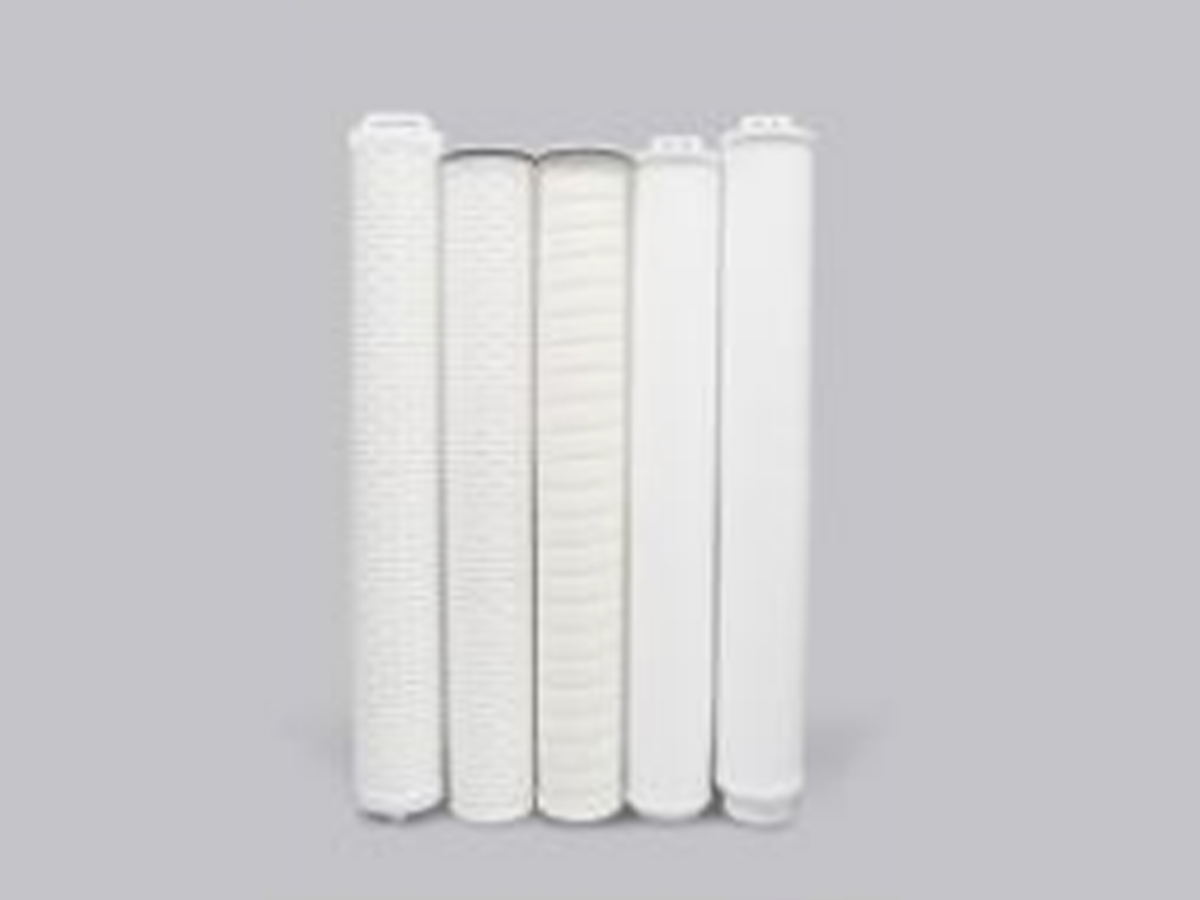
The working principle is straightforward, but the details matter.
First, untreated water enters the filter housing. The water is directed toward the outside or designated inlet side of the cartridge, depending on the housing and cartridge flow configuration. The water then travels through the pleated filtration media. Suspended solids and other particles that are larger than the effective filtration pathways are retained by the media. Filtered water continues through the cartridge core and exits the housing.
During normal operation, particles gradually accumulate on and within the filtration media. As the cartridge loads with contaminants, resistance to flow increases. This normally appears as a rising differential pressure across the cartridge.
This is why I recommend monitoring the pressure difference rather than simply replacing a cartridge according to an arbitrary calendar schedule. DuPont's technical manual also recommends sizing cartridge filters according to the manufacturer's flow recommendations and replacing them before differential pressure reaches the permitted limit.
The pleated structure plays a major role in this process. More usable media area can provide more space for particle capture. It can also help maintain flow with a lower pressure drop than a small-area filter would have under the same conditions, although the actual pressure drop always depends on cartridge construction, media, flow, viscosity, and contamination level.
| Factor | What It Means in Operation | Why I Check It |
|---|---|---|
| Filtration rating | The particle size range the cartridge is designed to retain | Helps match the cartridge to the treatment target |
| Effective filter area | The usable surface available for filtration | Affects dirt-holding and flow behavior |
| Flow rate | The amount of liquid passing through the cartridge | Directly affects pressure drop and service conditions |
| Differential pressure | Pressure difference before and after the cartridge | Useful for monitoring loading and replacement timing |
| Water quality | Amount and type of suspended material in the feed water | Determines how quickly the cartridge may become loaded |
Source: The operating considerations above are based on the filtration and RO pretreatment guidance published by DuPont FilmTec.
One of the main reasons I recommend a pleated cartridge for suitable applications is simple: surface area matters.
A flat filter has a limited working area. Once that area becomes loaded with particles, water has fewer easy paths through the media. A pleated filter folds the media repeatedly, allowing a larger amount of filtration material to fit into the same basic cartridge envelope.
Commercial filter manufacturers use the same basic principle. Pentair's OMNIFILTER RS6, for example, uses pleated polyester media around a polypropylene core. Its published specifications show more than four square feet of polyester fabric in a standard 9.75-inch cartridge and more than 16 square feet in the 20-inch version. Pentair states that the pleated construction is intended to increase dirt-holding capacity and extend the period between cleaning or replacement.
Another Pentair cartridge series, the ECP Series, uses a resin-impregnated cellulose and polyester media blend. Pentair describes the construction as providing wet strength, high flow, dirt-holding capacity, and low pressure drop, with the media pleated around a polypropylene core.
These examples also show an important point: “pleated filter cartridge” is not one single specification. Different media and constructions can produce different filtration behavior.
| Published Cartridge Example | Media / Construction | Published Flow Rate | Published Capacity |
|---|---|---|---|
| Pentair OMNIFILTER RS6-SS2-S18 | Pleated polyester around polypropylene core | 10 gpm | 30,000 gal |
| Pentair OMNIFILTER RS6-20-SC-S18 | Pleated polyester around polypropylene core | 10 gpm | 30,000 gal |
| Pentair OMNIFILTER RS1-DS3-S18 | Pleated cellulose around polypropylene core | 5 gpm | 15,000 gal |
Source: Pentair OMNIFILTER published product specifications. These figures are reference data from Pentair's listed products, not guaranteed performance values for the LF Series.
For the LF Series, I prefer to confirm the actual flow requirement, water condition, cartridge size, and filtration target before giving a project-specific performance figure. That approach avoids using a generic number that may not fit the customer's system.
The pleated design provides a larger working area than a simple flat-sheet configuration of similar size. This gives the cartridge more available media for particle capture and can be useful in applications where water flow is relatively high.
For an industrial water treatment system, flow stability matters. A filter that causes excessive resistance at the beginning of operation can increase energy demand and create problems for downstream equipment. The LF Series is designed around the balance between filtration area, flow, and pressure drop rather than focusing on only one number.
Different projects have different water conditions. Municipal water, seawater pretreatment, industrial process water, and wastewater polishing are not the same job.
For this reason, the LF Series can be discussed and configured around the customer's filter housing, required filtration rating, water quality, flow requirement, and system design.
The cartridge can be used as part of a larger filtration process. In an RO system, for example, it may serve as a final cartridge filtration step before the high-pressure pump and RO membrane, provided that the cartridge specification is suitable for the system.
DuPont specifically notes that cartridge filtration can act as a safety step for protecting RO membranes and high-pressure pumps from suspended particles.
Cartridge replacement is a normal part of operation. I recommend that operators monitor differential pressure, flow behavior, and feed-water conditions. If the differential pressure rises faster than expected, it is worth checking the upstream pretreatment process instead of simply installing a new cartridge.
DuPont notes that frequent cartridge replacement can indicate a problem with pretreatment and that cartridge filters should not be used as the main solution for high concentrations of filterable solids.
I normally look at the whole water treatment process before recommending a cartridge. The LF Series can be considered for applications where a pleated high-flow cartridge is appropriate, including:
Seawater desalination pretreatment
Reverse osmosis pretreatment
Industrial water purification
Process water filtration
Municipal water treatment
Commercial water purification
High-salinity water treatment processes
Wastewater polishing and filtration stages
Food and beverage process water
General industrial liquid filtration
Seawater is not an easy feed source. Salt is only part of the problem. Suspended solids, biological material, colloids, and other contaminants can place additional pressure on the pretreatment system.
In a seawater reverse osmosis plant, cartridge filtration is normally one part of a larger pretreatment train. Depending on the project, the upstream process may include screening, multimedia filtration, ultrafiltration, chemical dosing, or other treatment steps.
The LF Series can be considered as a cartridge filtration stage when its filtration rating, material compatibility, flow capacity, and housing configuration match the system.
Industrial water quality varies greatly from one factory to another. A metal processing plant, food factory, chemical plant, electronics facility, and pharmaceutical plant can have very different filtration requirements.
That is why I do not recommend choosing the cartridge from the application name alone. I prefer to understand the water first: what is in it, how much water needs to be treated, what equipment comes after the cartridge, and what operating pressure and temperature are expected.
Engineered filtration products are commonly used across industries such as chemicals, electronics, food and beverage, medical, pharmaceutical, and water treatment. Pentair's industrial Pureflex product information lists these application areas and also identifies RO pretreatment as an application.
| Application | Typical Filtration Role | Key Selection Considerations |
|---|---|---|
| Seawater desalination | Pretreatment / final cartridge protection | Feed quality, corrosion environment, flow, filtration rating |
| RO water treatment | Protective cartridge filtration before RO | Particle load, micron rating, differential pressure |
| Industrial process water | Suspended particle reduction | Process liquid, chemical compatibility, temperature |
| Municipal water | Fine filtration / polishing | Raw water quality and required downstream quality |
| Commercial water systems | General sediment filtration | Flow demand, cartridge size, replacement frequency |
Source: Application references are based on published filtration applications from Pentair and RO pretreatment guidance from DuPont FilmTec. Actual suitability depends on the specific project conditions.
For me, manufacturing a filter cartridge is not simply a matter of assembling filter media, a core, and end caps. The parts have to work together as one filtration element.
The basic manufacturing process can include media preparation, pleating, core assembly, end-cap connection, sealing, visual inspection, dimensional inspection, and final quality checking. The exact process depends on the selected cartridge construction and customer specification.
The connection between the filter media and end caps is particularly important. Any unwanted bypass path can allow untreated liquid to move around the filtration media instead of through it. Pentair describes sonic welding of the overlap seam and sealing of pleated ends to end caps in several of its cartridge designs to help reduce internal bypass.
Other industrial cartridges use thermal bonding. Pentair's Pureflex range, for example, describes a thermal-bonding process connecting the media, core, cage, and end caps, with the manufacturer stating that this glue-free construction is intended to support bypass-free filtration.
For our projects, the final cartridge specification should be connected with the actual water treatment system. Before production, I recommend confirming the cartridge dimensions, filtration rating, flow requirement, connection style, operating conditions, and required quantity.
Before shipment, the equipment and filtration components supplied for a project are checked according to the agreed technical requirements. For complete water treatment equipment, our delivery process can include equipment assembly, commissioning, quality inspection, technical documentation, and operating instructions.
For project-based orders, the production schedule is determined by the equipment configuration, quantity, engineering requirements, and customization level. Standard products can generally have a shorter production cycle, while customized projects need additional time for process confirmation and equipment configuration.
This matters because I would rather confirm a realistic delivery schedule at the beginning than promise a fixed date before the engineering details are settled.
Our main difference is that we understand the filter cartridge as part of a water treatment system.
Qingdao Yanhui Environmental Protection Technology Co., Ltd. was established in 2015. Our work covers seawater desalination, high-salinity wastewater treatment, concentration and purification, and industrial wastewater treatment. We provide services covering research and development, engineering design, equipment manufacturing, installation, commissioning, operation, and maintenance.
That gives me a practical way to look at cartridge selection. If a customer tells me only, “I need a high-flow cartridge,” that is not enough information for me to make a responsible recommendation. I need to know what the cartridge is protecting and what is coming into the cartridge.
For example, if the cartridge is being used before an RO membrane, I will look at the upstream pretreatment, feed-water quality, required flow, filtration rating, and membrane protection requirements. If it is being used for industrial process water, I will also consider the liquid characteristics and possible chemical exposure.
Our project support can cover:
Water treatment process consultation
Equipment and filtration configuration
Customized equipment design
Manufacturing and assembly
Installation and commissioning
Operation and maintenance support
Technical documentation
Packaging and export logistics
For international projects, equipment can be transported by land, sea, or multimodal transportation. Depending on the equipment dimensions, we can use reinforced wooden cases, pallets, or containers for export packaging.
For a customized water treatment project, payment terms can be arranged according to the contract, commonly involving an advance payment, shipment payment, and final payment. The exact terms are confirmed before production.
The suitable micron rating depends on the water quality and the position of the cartridge in the treatment process. We can discuss the required rating according to the application and equipment configuration rather than assigning one universal rating to every LF Series cartridge.
Yes, a properly selected cartridge can be used as part of RO pretreatment. Cartridge filtration is commonly used as a protective step before RO membranes. DuPont's FilmTec guidance recommends cartridge filtration below 10 μm as a minimum pretreatment step and identifies 5 μm absolute filtration as a recommended level in its guidance.
However, the cartridge should not be expected to replace upstream pretreatment when the feed contains a high load of suspended solids.
I normally need at least five pieces of information: required flow rate, water quality, filtration target, existing housing dimensions, and operating conditions. If the cartridge is protecting an RO system, information about the upstream pretreatment and membrane system is also useful.
No. A cartridge should be sized according to the actual system flow and the manufacturer's recommended operating conditions. Increasing flow through a cartridge without checking pressure drop, filtration performance, and contaminant loading can create an unsuitable operating condition.
There is no single replacement interval that works for every project. I recommend monitoring differential pressure, flow behavior, and feed-water quality. When the cartridge becomes loaded and the differential pressure reaches the agreed operating limit, replacement should be considered.
DuPont also notes that unusually frequent cartridge replacement can point to a problem in upstream pretreatment rather than simply indicating that a different cartridge is needed.
For project applications, we can discuss cartridge size, filtration rating, construction, end-cap configuration, and other requirements according to the customer's equipment and water treatment process. The final configuration should be confirmed before production.
Yes. Our core business includes seawater desalination and integrated water treatment engineering. We can provide customized equipment and engineering services covering design, manufacturing, installation, commissioning, operation, and maintenance. The cartridge can therefore be considered as one component within a complete treatment system.
The production period depends on whether the requirement is a standard cartridge order or a customized project. Standard equipment and products can generally be arranged on a shorter schedule, while customized orders need to account for technical confirmation, material selection, configuration, and production quantity. We confirm the delivery schedule after the specifications are finalized.
For water treatment equipment, we select packaging according to equipment dimensions and transportation requirements. Wooden cases, pallets, and reinforced container packaging can be used where appropriate. The goal is to keep the equipment and components secure during loading, sea transportation, unloading, and final delivery.
The more complete the information, the more accurately we can recommend the cartridge. I suggest sending:
Required flow rate
Feed-water source
Basic water analysis, if available
Required filtration rating
Existing filter housing model or dimensions
Operating pressure
Operating temperature
Connection or end-cap requirements
Quantity required
Final application and downstream equipment
A filter cartridge may look simple from the outside, but the correct selection depends on the system around it. Two cartridges with the same nominal micron number can have different flow characteristics, dirt-holding capacity, pressure drop, and service life.
That is why I prefer a project-based discussion. If you are building a seawater desalination system, upgrading an RO pretreatment line, or looking for a high-flow Industrial Filter Cartridge, send us the basic operating conditions first.
We can then review the required filtration rating, cartridge dimensions, flow requirement, water quality, housing configuration, and operating conditions before confirming the final product.
The LF Series High-Flow Pleated Filter Cartridge is designed to provide a practical filtration solution where compact construction, a large effective filtration area, stable flow, and flexible configuration are important. More importantly, it can be evaluated as part of the complete water treatment process rather than as an isolated replacement component.
For customers working on seawater desalination, RO pretreatment, industrial water treatment, or customized water treatment equipment, this system-level approach helps us select a cartridge that fits the actual application.
Contact Qingdao Yanhui Environmental Protection Technology Co., Ltd. with your water source, flow requirement, filtration rating, and existing housing information, and we can discuss the suitable LF Series configuration for your project.
The comparison data and filtration principles referenced on this page are based on publicly available manufacturer technical information. Pentair publishes cartridge examples showing pleated media construction, flow rate, capacity, and filter-area information, while DuPont FilmTec provides technical guidance on cartridge filtration as RO pretreatment. These published figures are reference values for the cited products and should not be interpreted as guaranteed performance specifications for the LF Series.
This website uses cookies to ensure you get the best experience on our website.
 Portugues
 Pусский
 Français
 العربية
 ไทย
ไทย Indonesia
 Melayu
 Tiếng Việt
 中文
中文 қазақ
қазақ עִברִית
 မြန်မာ
 ພາສາລາວ
 Filipino
 o'zbek
 Кыргызча
 тоҷикӣ
 ខ្មែរ
ខ្មែរ Türkmenler



 Phone
Phone