

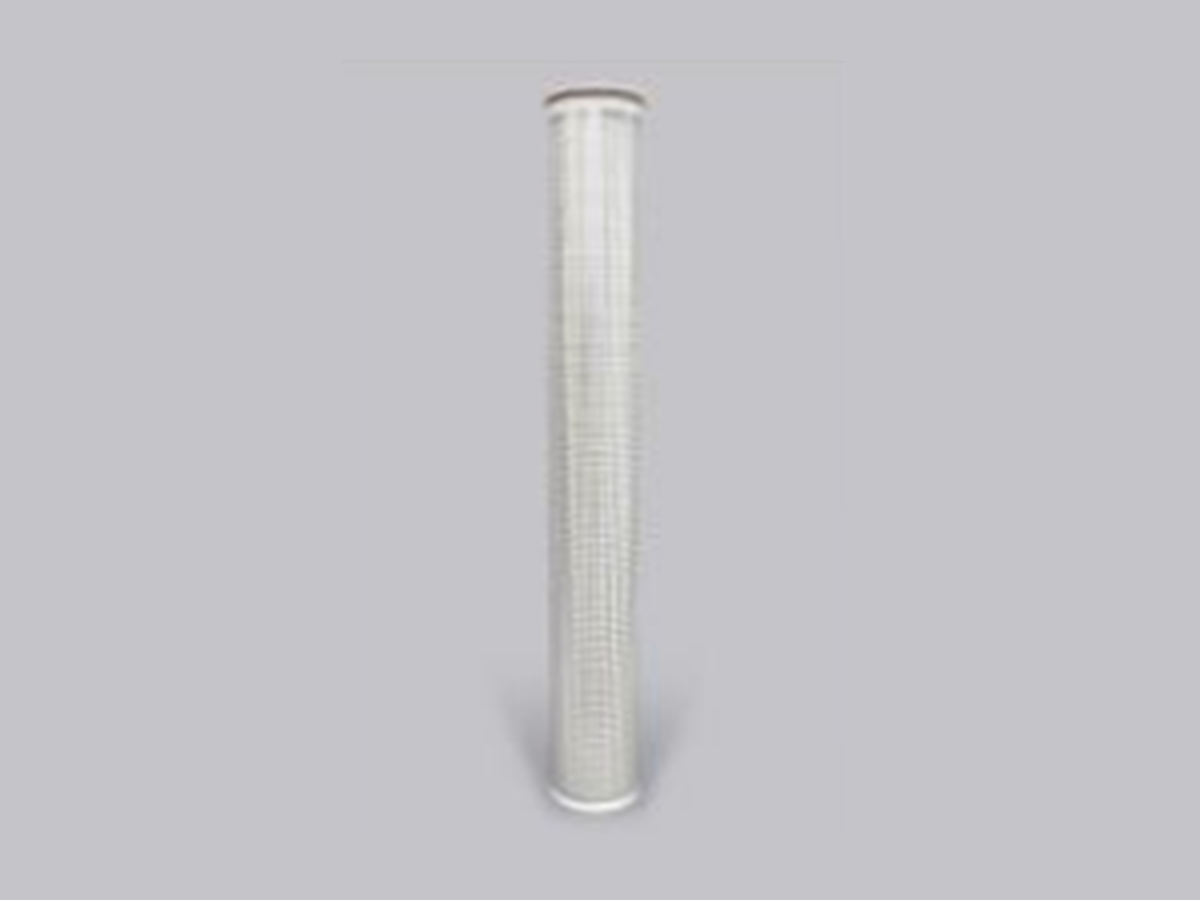
The LFPH high-temperature resistant, high-flow-rate pleated Filter Cartridge uses meltblown microfiber modified polyester (PET) as the filter media, with a diameter of 6 mm.
A single 1-inch filter cartridge can have a maximum filtration area exceeding 6m², with a flow rate of up to 60m³/h. It features a stainless steel outer frame, a single-opening design, and...
A specially designed inside-out liquid flow direction ensures that all contaminant particles are trapped inside the filter element. Suitable for power plants.
Oil removal and filtration of high-temperature condensate such as heat network drainage and chemical condensate.
Design parameters
Specifications (diameter * length) | Design flow rate (m³/h) | Maximum flow rate (m³/h) | Filter area (m3) |
6"*20" | 15 | 40 | 3.3 |
6"*40" | 30 | 80 | 6.5 |
6"*60" | 45 | 120 | 8.5 |
Material Structure
model | LFPH |
equipment | PET |
Support/Guide Layer | Modified polyester (PET) |
End cap | Glass fiber reinforced polypropylene |
outer protective sleeve | PET |
Interface type
LFPH | 40 | PET | 0050 | E | S |
LFPH | length | Material | accuracy | sealing ring | Outer ring |
20=20" | PET | 0010 = 1μm | E = EPDM | S = Stainless steel frame | |
40=40" | 0030 = 5μm | S = Silicone rubber | B = PET wrapping tape | ||
60=60" | 0050 = 5μm | F = Fluororubber | S = PBT skeleton | ||
0100 = 10μm | |||||
0150 = 15μm | |||||
0250 = 25μm | |||||
0400 = 40μm | |||||
0700 = 70μm |
Working characteristics
Maximum operating temperature | 120℃ |
Maximum working pressure difference | 0.58 MPa @ 20℃ |
Recommend replacing pressure difference | 0.15Mpa@20℃ |
Typical application scenarios
Power plant heating network drainage |
Chemical condensate |
Other locations for high-temperature condensate filtration |
LFPH Series High-Temperature Resistant Pleated Filter Cartridge
When a filtration system handles hot liquid, I do not look at the filter cartridge in the same way as I would for normal-temperature water. Temperature changes the working conditions of the filter, and it can affect the filter media, support structure, seals, housing, pressure drop, and service life. That is why I developed the LFPH Series High-Temperature Resistant Pleated Filter Cartridge around the practical needs of industrial filtration.
The LFPH Series is intended for applications where liquid filtration needs to be carried out under elevated temperature conditions. Its pleated structure provides a large filtration area in a compact cartridge format, giving engineers a practical option for industrial liquid filtration, process water treatment, hot liquid filtration, chemical processing, and other applications where temperature resistance needs to be considered.
At Qingdao Yanhui Environmental Protection Technology Co., Ltd., I prefer to discuss filtration from the whole process rather than from one product parameter. The right cartridge depends on the liquid, temperature, flow rate, filtration target, pressure, particle load, housing, and downstream equipment. These details help us determine whether the LFPH Series is suitable and what configuration should be considered.
If you are searching for a High-Temperature Pleated Filter Cartridge, Heat Resistant Filter Cartridge, high temperature liquid filter cartridge, or industrial high-temperature filter, this page explains how I approach the product, where it can be used, and what should be checked before ordering.
The basic idea behind the LFPH Series is quite simple. Liquid passes through a filter medium, while unwanted suspended particles are retained by the filtration layer. The cleaned liquid then moves to the next stage of the process.
What makes the product different from a standard pleated cartridge is the focus on elevated-temperature service. When a liquid becomes hot, the filter is exposed to more demanding conditions. A material that performs well at room temperature may not provide the same result at a much higher temperature. Seals can soften, polymer materials can change, and the strength of some components can be affected.
For this reason, I treat a high-temperature filter cartridge as a complete assembly rather than simply a piece of filter media. The filtration media, support layers, core, end caps, sealing materials, and housing all need to be compatible with the operating environment.
The pleated construction is another important part of the design. Instead of using a flat piece of filter media, the material is folded into multiple pleats. This creates a larger filtration surface within a relatively compact cartridge. In practical terms, more usable filter area can help a system handle liquid flow while keeping the equipment footprint manageable.
The actual performance of the LFPH Series depends on its final configuration. Since the specific product specifications can vary according to the selected material and application, I do not recommend using a general temperature or flow number without first confirming the working conditions.
| Manufacturer | Product / Technology | Published Temperature Information | Application / Design Reference |
|---|---|---|---|
| Pall | Ultipor HT Series | Up to 425°F / 218°C with compatible fluids | Pleated high-area filter elements for high-temperature liquid filtration |
| Pall | MCC1401 Filter Cartridge | Recommended changeout differential pressure listed at 275°F / 135°C | Pleated resin-bonded media with steel support components |
| Parker | FO Series Pleated Media Filter Cartridges | Maximum operating temperature listed at 250°F / 121.1°C | Industrial liquid filtration with resin-impregnated media |
These figures are public data from the named manufacturers and are provided only as industry references. They are not specifications for the LFPH Series. The actual maximum temperature of an LFPH configuration must be confirmed according to the selected filter media, sealing materials, housing, fluid, pressure, and operating conditions.
I usually explain cartridge filtration to customers in a very straightforward way: the liquid needs to pass through the filter, while unwanted particles need to stay behind.
In the LFPH Series, the pleated filter media creates the working filtration surface. As hot liquid enters the filter housing, it flows through the cartridge. Suspended particles are captured by the filter media, while the filtered liquid leaves the cartridge and continues through the treatment system.
As the cartridge collects particles, the resistance to flow gradually increases. This is normally monitored through differential pressure, which means the pressure difference between the upstream and downstream sides of the filter. A rising pressure difference can indicate that the cartridge is becoming loaded with contaminants.
Temperature adds another factor to this process. Hot liquid may have a different viscosity from cold liquid, and the physical properties of filter materials and sealing components can change as temperature increases. That is why the operating temperature should always be considered together with pressure and fluid chemistry.
For example, a cartridge used to filter relatively clean heated process water may have a very different service pattern from one filtering a hot liquid containing a high concentration of suspended solids. The first system may be limited mainly by filtration requirements, while the second may experience rapid loading.
A typical filtration arrangement may include several stages:
Raw or process liquid enters the pretreatment system.
Larger particles are removed by upstream equipment when required.
The LFPH Series provides a pleated cartridge filtration stage.
Filtered liquid moves toward the next treatment or production process.
Operators monitor flow, pressure, temperature, and filter condition.
The cartridge is replaced when the agreed maintenance condition is reached.
This is only a simplified example. Real systems can include pumps, heat exchangers, storage tanks, chemical dosing, membrane systems, polishing filters, and other treatment equipment. The cartridge should therefore be selected as part of the complete process.
The main advantage of pleating is surface area. A flat filter sheet has limited area. Folding the sheet into multiple pleats allows a larger amount of media to fit inside a compact cartridge.
Public product information from several filtration manufacturers uses this same principle. Pall, for example, describes pleated cartridges as a way to create efficient particle removal and large filtration areas, while its Ultipleat technology is designed to improve flow distribution through the pleat structure.
The important point is that more surface area does not automatically mean better performance in every application. The media type, pleat geometry, flow direction, liquid viscosity, contaminant load, and housing design all matter.
The LFPH Series is developed for applications where filtration takes place under higher-temperature conditions than ordinary water filtration. The exact temperature range should be confirmed according to the selected configuration and fluid.
The pleated structure creates a larger effective filtration surface inside a compact cartridge. This makes the format suitable for industrial systems where filtration capacity and equipment space both matter.
The product can be considered for industrial process liquids, heated water, hot liquid filtration, chemical processing, and other applications where temperature is an important selection factor.
Cartridge filters are relatively straightforward to maintain. Once the cartridge reaches its replacement condition, the operator can follow the housing manufacturer's procedure to isolate the equipment, remove the used cartridge, inspect the sealing area, and install a replacement.
Different industrial processes have different requirements. Cartridge dimensions, filtration ratings, materials, connections, seals, and support structures can influence compatibility. I therefore recommend confirming the complete application before finalizing the product configuration.
A pleated cartridge can provide a large filtration area without requiring a very large filter element. This can be useful in equipment where installation space is limited.
| Factor | Why It Matters | What I Recommend Confirming |
|---|---|---|
| Operating Temperature | Heat can affect media, seals, support parts, and housing compatibility. | Normal temperature, peak temperature, temperature cycling |
| Liquid Type | Chemical compatibility can vary between fluids. | Water, process liquid, chemical solution, oil-based liquid, etc. |
| Flow Rate | Determines the required filtration capacity. | Normal flow and peak flow |
| Particle Load | Higher contaminant loading can shorten cartridge service life. | Suspended solids, turbidity, particle concentration |
| Pressure | High temperature and pressure together can be more demanding. | Operating pressure and allowable differential pressure |
| Housing Compatibility | The cartridge must fit and seal correctly. | Length, diameter, connection, gasket or O-ring arrangement |
When customers ask me about the technical advantage of a high-temperature pleated cartridge, I usually avoid making the discussion too complicated. The basic goal is to maintain filtration performance while the liquid is hot and the operating conditions are more demanding.
The first question is not "How much flow can it handle?" It is "What temperature is it actually going to see?" There is a big difference between continuous operating temperature and a short temperature peak. There can also be a difference between a stable hot process and a system that repeatedly heats and cools the cartridge.
Public industry data illustrates this point clearly. Pall lists a maximum temperature of 425°F (218°C) for its Ultipor HT Series with compatible fluids, while its standard Ultipleat High Flow product lists a lower maximum operating temperature of 82°C (180°F).
That difference shows why I would never recommend selecting a cartridge simply because two products both have the word "pleated" in their names. Their materials and operating ranges may be completely different.
A filter needs to allow enough liquid to pass through without creating unnecessary pressure loss. If a filter is too small for the required flow, pressure drop may rise quickly. This can affect pumps and the overall process.
At the same time, a very high published flow number does not automatically mean the cartridge will deliver that flow in every application. Flow data is normally based on defined test conditions, often involving water at a specific temperature. Liquid viscosity, solids concentration, temperature, and filter loading can change the actual result.
A common mistake is to look only at the filter media. In a hot application, seals and structural components deserve equal attention. The cartridge may have a suitable filtration medium but still be limited by another component.
For example, Pall's high-temperature filter products show that different construction materials can be combined for demanding service. Its Ultipor HT Series uses resin-bonded glass fiber media with steel and other support components, while other high-temperature products use different media and hardware combinations.
Continuous temperature is only one part of the story. Repeated heating and cooling can place additional stress on filter components and seals. Public data for Pall's Ultipleat High Flow filter, for example, includes a note concerning temperature cycling in relation to its maximum continuous service temperature.
For this reason, I ask customers whether the equipment runs continuously, starts and stops frequently, or undergoes regular cleaning and thermal cycles. This simple question can affect the final selection.
| Product | Media / Construction Reference | Published Temperature | Published Pressure Information | Source |
|---|---|---|---|---|
| Pall Ultipor HT | Resin-bonded glass fiber with high-temperature construction | 425°F / 218°C | 40 psid maximum forward differential pressure at 425°F / 218°C | Pall |
| Pall MCC1401 | Pleated resin-bonded glass fiber / steel support | 275°F / 135°C at stated changeout condition | 60 psid / 4.13 bar recommended changeout differential pressure | Pall |
| Parker FO Series | Resin-impregnated pleated media | 250°F / 121.1°C maximum operating temperature | 75 psi collapse strength | Parker |
Important: the values above are manufacturer-published reference figures and do not describe the LFPH Series. Actual LFPH performance must be confirmed from the specific product configuration and operating conditions.
Many factories use heated water during cleaning, production, heat transfer, and other processes. When suspended particles need to be removed from a heated liquid stream, a high-temperature pleated filter cartridge can be considered as one filtration stage.
Some production processes cannot cool the liquid before filtration because doing so would slow the process or add another piece of equipment. In these situations, the filter must be selected for the actual operating temperature rather than assuming that a standard room-temperature cartridge will be sufficient.
Chemical liquids can create two challenges at the same time: temperature and chemical compatibility. A filter suitable for hot water may not automatically be suitable for a chemical solution. The media, seals, housing, and other wetted components should therefore be checked against the actual fluid.
Industrial water treatment systems can include different temperature conditions depending on the source and process. A high-temperature resistant pleated filter cartridge may be considered where a heated stream requires particulate filtration before the next treatment stage.
Some industrial wastewater streams enter treatment systems at elevated temperatures. Cartridge filtration may be used as part of a larger treatment process where the suspended solids and temperature conditions are compatible with the selected cartridge.
Our main business includes seawater desalination and industrial wastewater treatment. Most desalination systems are not simply a single filtration step. They normally include pretreatment and membrane treatment, with the exact arrangement depending on the source water.
The LFPH Series may be considered where a heated liquid filtration stage is needed within a broader water treatment process. However, seawater itself is not automatically a high-temperature application. If the liquid temperature is normal, a standard configuration may be more appropriate. I believe this distinction is important because selecting a high-temperature product when the process does not need it can add unnecessary cost.
Heated liquid filtration can also appear in food and beverage production. However, applications involving direct product contact, sterile filtration, sanitary processing, or regulatory requirements require additional review of materials, certification, cleaning procedures, and validation. The product configuration must be selected according to the actual application.
Public industry examples show that high-temperature filtration is used across different industries. Pall, for example, describes high-temperature cartridge filtration for oil fractions and other demanding liquid applications, while its Emflon HTPFRW range addresses high-temperature gas and hot-fluid tank venting applications in food and ingredient processing.
At Qingdao Yanhui Environmental Protection Technology Co., Ltd., I see filtration products as part of a larger engineering process. Our company was established in 2015 and focuses on seawater desalination, high-salinity wastewater treatment, concentration and purification, and industrial wastewater treatment.
This background matters when discussing a filter cartridge because filtration rarely works as an isolated operation. In a complete treatment system, the filter may sit between a pretreatment unit and an RO system, downstream equipment, a storage tank, or another production stage.
I first want to understand the actual application. What liquid are we filtering? What is the temperature? What is the normal flow? What is the peak flow? What particles are present? What equipment comes before and after the cartridge?
These questions are not just paperwork. They help avoid selecting a product based on incomplete information.
Once the process information is available, the cartridge configuration can be discussed. This may include filter media, filtration rating, dimensions, connections, sealing materials, and housing compatibility. For high-temperature service, material compatibility is especially important.
After the configuration and project requirements are confirmed, production can be arranged according to the agreed specifications. For complete water treatment projects, our engineering service can cover R&D, design, manufacturing, installation, commissioning, operation, and maintenance.
Before delivery, equipment is assembled, commissioned, and inspected according to the project requirements. Technical documents and operating instructions can also be provided as part of the agreed delivery package.
Good equipment still needs good protection during transportation. Depending on the equipment size and shipping method, we can use wooden cases, pallets, or reinforced containers. The goal is simple: the equipment should arrive at the project site safely and in complete condition.
Road transportation, sea transportation, or multimodal transportation can be arranged according to the project destination and equipment characteristics. For larger water treatment equipment, transportation planning is considered together with equipment dimensions and packaging requirements.
I do not give every project the same delivery promise because the actual schedule depends on the product and system configuration. Standard equipment generally has a shorter production cycle, while customized projects require additional time for process design, configuration confirmation, manufacturing, assembly, testing, and inspection.
The final delivery schedule is confirmed according to the project requirements and contract.
There are many companies that can supply a filter cartridge. For me, the more important question is whether the supplier understands how that cartridge fits into the customer's process.
Our work in seawater desalination and industrial wastewater treatment gives us a broader view of filtration. We are familiar with projects where filtration is only one part of a complete treatment line.
I prefer to start with operating conditions rather than simply recommending a standard product. Temperature, liquid chemistry, flow rate, suspended solids, pressure, and downstream requirements are all useful pieces of information.
Water quality and production conditions are different from one project to another. We can discuss customized equipment and filtration configurations according to the customer's water quality, production capacity, site conditions, and treatment process.
Our service scope covers R&D, design, manufacturing, installation, commissioning, operation, and maintenance. This allows us to support customers not only when they need a component, but also when they are planning a complete water treatment project.
Before shipment, equipment can be assembled, commissioned, and inspected according to the project requirements. Technical documents and operating files can be supplied according to the agreed scope.
Our customers may need equipment delivered to different regions. We can arrange road, sea, or multimodal transportation. Packaging is selected according to equipment size, with wooden cases, pallets, or reinforced containers used where appropriate.
Technical discussions do not need to be full of complicated words. If a customer can provide the liquid type, temperature, flow rate, pressure, filtration requirement, existing housing information, and water analysis data, we can quickly understand the basic situation.
For a complete water treatment project, drawings, process flow diagrams, equipment layouts, and site photographs can also help us review the application.
Payment arrangements can be agreed according to the project contract. Depending on the project, this may include an initial payment, shipment payment, and final payment. The exact terms are confirmed during the commercial negotiation.
The LFPH Series is a pleated filter cartridge designed for liquid filtration applications where elevated operating temperatures need to be considered. It can be used for industrial process liquids, heated water, chemical processing, wastewater treatment, and other suitable applications.
The maximum temperature should not be assumed from the product name alone. It depends on the actual configuration, filter media, support materials, seals, housing, fluid chemistry, pressure, and temperature profile. Please contact us with your operating conditions so the appropriate configuration can be confirmed.
It can be considered for hot-water filtration when the selected configuration is compatible with the actual water temperature, pressure, flow, and filtration requirement. The exact material combination should be confirmed before use.
Potentially, but chemical compatibility must be checked first. Temperature and chemical concentration can both affect filter materials and sealing components. Please provide the chemical name, concentration, operating temperature, pressure, and flow rate for evaluation.
It may be used as one filtration stage in suitable industrial wastewater treatment systems. However, wastewater can have a high solids load or complex chemistry, so upstream treatment and material compatibility should be evaluated before selecting the cartridge.
The cartridge can be considered for suitable filtration stages within a Seawater Desalination System, particularly where elevated-temperature liquid filtration is required. For normal-temperature seawater pretreatment, another cartridge configuration may be more suitable. The final selection depends on the complete process.
Temperature can affect filter media, seals, adhesives, support structures, and the filtered liquid itself. It can also influence viscosity and pressure drop. This is why I recommend checking temperature together with pressure, fluid chemistry, flow rate, and filtration requirements.
No. A high-temperature filter is designed for a particular service condition. If the application operates at normal temperature, a standard cartridge may be sufficient. Choosing a product based only on a higher temperature rating does not automatically improve filtration.
Please provide the liquid type, operating temperature, maximum temperature, flow rate, filtration rating, operating pressure, particle concentration if available, cartridge dimensions, housing model, and downstream equipment requirements. Water analysis data is also useful for water treatment applications.
Yes. Qingdao Yanhui provides customized water treatment equipment and integrated engineering services. The project scope can include R&D, design, manufacturing, installation, commissioning, operation, and maintenance depending on the customer's requirements.
The production period depends on the project scale and configuration. Standard equipment generally has a shorter delivery cycle. Customized systems need additional time for process design, configuration confirmation, manufacturing, assembly, commissioning, and inspection. The final schedule is confirmed before production.
Transportation can be arranged by road, sea, or multimodal transport. Packaging is selected according to equipment dimensions and transportation conditions. Wooden cases, pallets, or reinforced containers can be used to protect the equipment during shipment.
After working with industrial water treatment projects, I have learned that filter selection is rarely just about finding a cartridge with the right name. The actual process always matters more.
For the LFPH Series High-Temperature Resistant Pleated Filter Cartridge, temperature is an important starting point, but it is not the only one. I also look at the liquid, flow rate, pressure, filtration target, particle load, temperature cycling, filter housing, seals, and downstream equipment.
The pleated design provides a practical way to create a larger filtration area within a compact cartridge. For suitable applications, this can make the LFPH Series a useful option for industrial liquid filtration, hot water filtration, process filtration, wastewater treatment, chemical processing, and related applications.
At the same time, I do not recommend choosing a high-temperature cartridge based only on a published temperature number. Public industry products show that temperature capability can vary significantly between filter designs. Pall, Parker, and other manufacturers use different combinations of media, support structures, seals, and hardware for different temperature ranges and applications.
That is why we focus on the complete operating condition at Qingdao Yanhui Environmental Protection Technology Co., Ltd. If you are sourcing an LFPH Series High-Temperature Resistant Pleated Filter Cartridge, please provide the working temperature, liquid type, flow requirement, pressure, filtration target, and existing equipment information whenever possible.
With those details, we can discuss the application more accurately and work toward a filtration configuration that fits the actual project instead of simply selecting a cartridge from a general catalog.
Qingdao Yanhui Environmental Protection Technology Co., Ltd. provides customized water treatment equipment and integrated engineering services for seawater desalination, high-salinity wastewater treatment, concentration and purification, and industrial wastewater treatment. For LFPH Series applications, contact us with your liquid type, operating temperature, flow rate, pressure, filtration requirement, and equipment information for a practical product discussion.
Public technical references used for industry comparison: Pall Ultipor HT Series, Pall Ultipleat High Flow Series, Pall MCC1401, Parker FO Series industrial filtration information, and Parker high-temperature filtration references. All third-party specifications are attributed to their respective manufacturers and should not be interpreted as LFPH Series specifications.
This website uses cookies to ensure you get the best experience on our website.
 Portugues
 Pусский
 Français
 العربية
 ไทย
ไทย Indonesia
 Melayu
 Tiếng Việt
 中文
中文 қазақ
қазақ עִברִית
 မြန်မာ
 ພາສາລາວ
 Filipino
 o'zbek
 Кыргызча
 тоҷикӣ
 ខ្មែរ
ខ្មែរ Türkmenler



 Phone
Phone