

The LFN high-flow pleated Filter Cartridge uses a deep-layer fine polypropylene fiber membrane as the filter media, with a diameter of 6.5'/165mm.
The large diameter increases the effective filtration area, reducing the requirements for filter size and the number of filter cartridges during use.
This design significantly reduces equipment and labor costs, and is more convenient to operate. It features internal PP frame support and a single opening.
The filter is specially designed with an outside-to-inside liquid flow direction to ensure that all pollutant particles are intercepted on the outside of the filter element, making it widely applicable.
It is widely used in different fields.
Design parameters
Specifications (diameter * length) | Design flow rate (m³/h) | Maximum flow rate (m³/h) | Filter area (m3) |
6.5"*20" | 15 | 40 | 3.3 |
6.5" * 40" | 30 | 80 | 6.5 |
6.5" * 60" | 45 | 120 | 8.5 |
Material Structure
model | PP | GF |
Filter media | Deeply folded polypropylene | Resin-based synthetic glass fiber/polyester |
Support/Guide Layer | polypropylene | Polyester |
End cap | Glass fiber reinforced polypropylene | Glass fiber reinforced polypropylene |
outer protective sleeve | polypropylene | Polyester |
Interface type
LFN | 40 | PP | 0050 | E | S |
LFN | length | Material | accuracy | sealing ring | Interface |
20=20" | PP | 0010 = 1μm | E = EPDM | S = skeleton | |
40=40" | GF | 0030 = 5μm | S = Silicone rubber | W = Netting | |
60=60" | 0050 = 5μm | F = Fluororubber | |||
0100 = 10μm | N = Nitrile rubber | ||||
0150 = 15μm | |||||
0250 = 25μm | |||||
0400 = 40μm | |||||
0700 = 70μm |
Working characteristics
Maximum operating temperature | 80℃ |
Maximum working pressure difference | 0.38 MPa @ 20℃ |
suggestion Replace differential pressure | 0.15Mpa@20℃ |
Typical application scenarios
Filtration of power plant makeup water, condensate, and stator cooling water |
Reverse osmosis (RO) system pretreatment |
Seawater Desalination pretreatment |
Deionized water pre-filtration |
Filtration of process water in petrochemical and other industries |
LFN Series High-Flow Pleated Filter Cartridge
The LFN Series High-Flow Pleated Filter Cartridge is designed for industrial liquid filtration systems that need steady flow, practical maintenance, and dependable particle removal. I developed the way I present this product around a simple idea: a filter cartridge should not only remove unwanted particles, but also fit the real working conditions of the water treatment system.
In water treatment, small filtration problems can quickly become bigger operating problems. A filter that loads too quickly may increase maintenance work. A cartridge with too little effective filtration area may create unnecessary pressure loss. Poor selection can also affect pumps, membranes, valves, and other downstream equipment. That is why I look at the LFN Series from the complete system perspective rather than treating it as just another replacement filter.
For customers looking for a high-flow pleated filter cartridge, industrial Water Filter Cartridge, Large Flow Filter Cartridge, or pleated liquid filter cartridge, the LFN Series can be considered for a wide range of industrial filtration and water treatment applications. The final cartridge configuration can be selected according to the actual liquid, flow requirement, filtration target, equipment design, and operating conditions.
When I talk with customers about cartridge filtration, one of the first questions is usually simple: why use a pleated cartridge instead of a conventional filter element?
The answer starts with filtration area. A flat sheet of filter media has a limited surface area. By folding the media into many controlled pleats, the cartridge can place much more filtration material into a relatively compact space. This gives the filter more working area while keeping the overall equipment footprint practical.
The LFN Series High-Flow Pleated Filter Cartridge follows this basic filtration concept. The pleated structure is intended to provide a large effective filtration area for liquid filtration. Depending on the final configuration, the cartridge can be integrated into industrial filtration housings used for water treatment, process water, wastewater pretreatment, Seawater Desalination pretreatment, and other liquid filtration processes.
I do not treat "high flow" as simply a large number printed on a product sheet. Actual flow performance depends on many factors, including liquid viscosity, particle loading, filtration rating, temperature, cartridge construction, housing design, pressure conditions, and the cleanliness of the incoming water. For this reason, I recommend selecting the LFN Series based on the complete operating condition rather than using flow rate alone.
This approach is particularly useful for engineering projects. A cartridge may work well in clean process water but behave very differently when the same nominal filter is exposed to water containing large amounts of suspended solids. In practical terms, the right filter is the one that works with the whole system.
| Product / Series | Published Cartridge Length | Published Flow Information | Source |
|---|---|---|---|
| 3M High Flow Series | 60 in | Up to 500 gpm for certain configurations | 3M High Flow Filter System brochure |
| 3M High Flow HFR Series | 20 / 40 / 60 in | Maximum published flow up to 100 m³/h for 60 in configuration | 3M High Flow HFR Series technical information |
| Pentair Aqualine | 60 in | Published flow example of 150 gpm | Pentair Aqualine product information |
These figures are public manufacturer reference data and are included only to show the range of high-flow filtration technologies available in the market. They are not specifications of the LFN Series. The actual LFN Series configuration should be confirmed according to the customer's process requirements and equipment design.
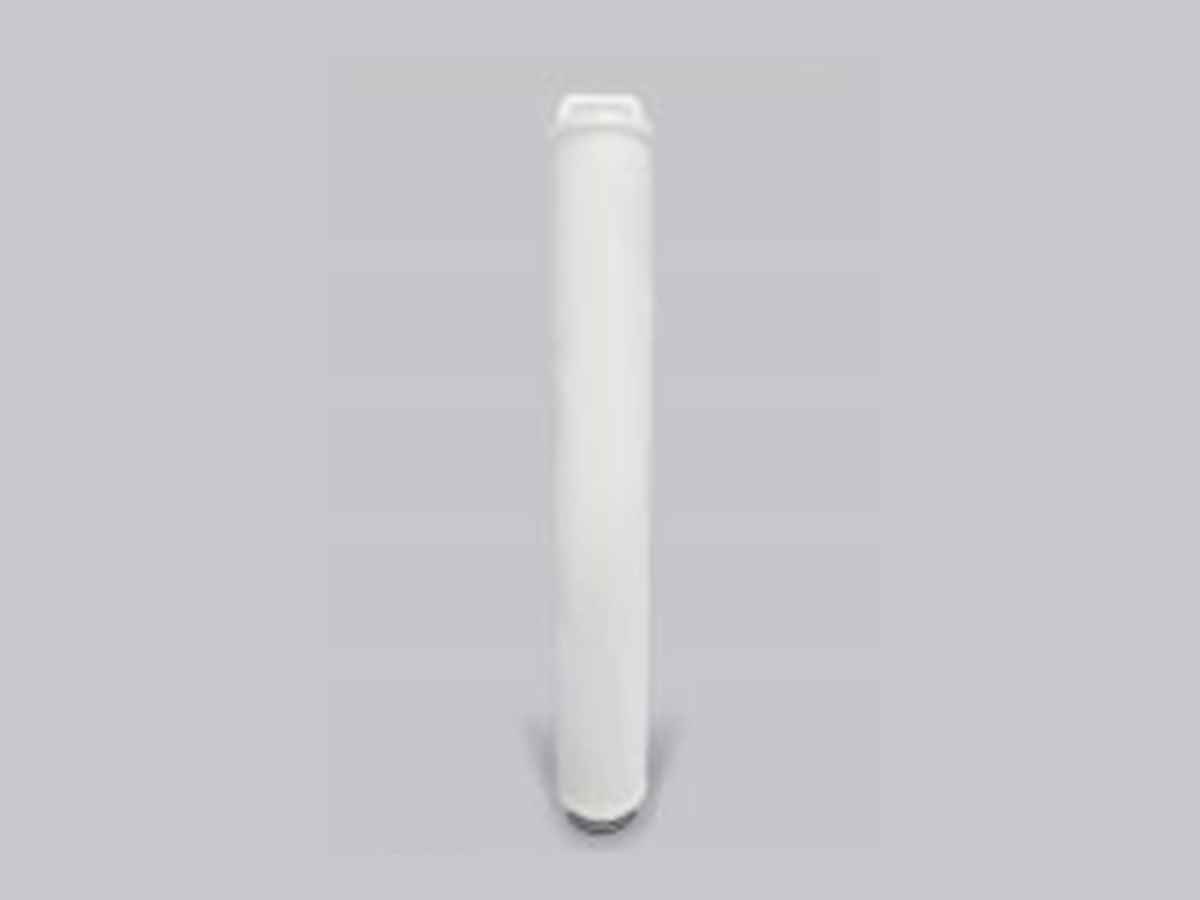
The working principle is easier to understand than it may sound. During filtration, untreated liquid enters the filter housing and passes through the filter media. Suspended particles and other unwanted solids are retained by the media, while the filtered liquid continues toward the next stage of the treatment process.
The pleated design is important because it increases the available filtration surface. Imagine folding a large sheet of paper many times and placing it inside a small box. The box does not become much larger, but it contains much more sheet area. A pleated cartridge uses a similar idea.
As filtration continues, particles gradually collect on or within the filter media. The resistance to liquid flow can then increase. This is why differential pressure is an important operating indicator in cartridge filtration. When pressure loss becomes too high, the cartridge may need to be replaced or serviced according to the system's operating procedure.
In a properly designed system, the cartridge does not work alone. Upstream equipment may remove larger particles before the cartridge stage, allowing the pleated filter to focus on smaller suspended solids. Downstream equipment may include reverse osmosis membranes, ion exchange units, polishing filters, or other treatment stages.
This is especially important in seawater desalination. Reverse osmosis membranes are sensitive to fouling and suspended matter. A suitable pretreatment process can reduce the load reaching the membrane system. The exact filtration arrangement depends on the raw water quality, but cartridge filtration is commonly considered as one part of a wider pretreatment strategy.
For example, a simplified process may look like this:
Raw water enters the pretreatment system.
Larger suspended particles are removed by upstream filtration.
The LFN Series High-Flow Pleated Filter Cartridge provides an additional liquid filtration stage.
Filtered water moves toward the next treatment unit.
Operators monitor pressure difference and water quality during operation.
The cartridge is replaced when the operating condition reaches the agreed maintenance limit.
The actual process can be more complex, but this basic structure shows why cartridge selection matters. The goal is not simply to make water pass through a filter. The goal is to make the whole treatment system operate in a stable and manageable way.
The pleated construction allows a relatively large amount of filter media to be arranged in a compact cartridge structure. This can help meet filtration requirements without making the filtration equipment unnecessarily large.
The LFN Series is intended for applications where liquid flow requirements are higher than those normally handled by small conventional cartridges. High-flow filtration can be useful when the system needs to process large amounts of water without using an excessive number of individual filter elements.
Cartridge filtration is popular partly because maintenance is straightforward. Once the cartridge reaches its replacement condition, the used element can be removed and a new cartridge installed according to the housing manufacturer's procedure. For industrial plants, simple maintenance is important because every unnecessary maintenance step takes time.
The LFN Series can be considered for industrial water filtration, process water, wastewater pretreatment, seawater desalination pretreatment, and related liquid filtration applications. The final selection should always be based on the actual liquid and process conditions.
Not every customer needs the same filtration solution. Some projects have relatively clean feed water, while others have high suspended-solid loads. Some systems operate continuously, while others work intermittently. For this reason, I prefer to discuss the complete process before recommending a cartridge configuration.
| Selection Factor | Why It Matters | Information to Confirm |
|---|---|---|
| Liquid Type | Different liquids can have different filtration and material requirements. | Fresh water, seawater, wastewater, process liquid, chemical solution, etc. |
| Flow Requirement | Determines how much filtration capacity the system needs. | Normal flow, peak flow, continuous or intermittent operation |
| Particle Load | High solids loading can shorten cartridge service life. | Suspended solids, turbidity, particle characteristics |
| Filtration Target | The filtration stage must match the treatment process. | Required filtration rating and downstream equipment requirements |
| Operating Conditions | Temperature and pressure can affect material selection and system performance. | Temperature, pressure, differential pressure limits |
| Housing Compatibility | The cartridge must fit the existing filtration equipment correctly. | Dimensions, connection, sealing arrangement, installation method |
These factors are more useful than choosing a cartridge based only on a product name. In industrial filtration, small differences in operating conditions can change the actual result.
Seawater contains suspended solids, organic matter, microorganisms, and other contaminants. A desalination system therefore normally requires several treatment stages before and after reverse osmosis. The LFN Series High-Flow Pleated Filter Cartridge can be considered as part of a pretreatment or polishing filtration stage when its configuration matches the process requirements.
For island communities, coastal hotels, ships, offshore platforms, and other locations where freshwater resources are limited, stable filtration is particularly important. A cartridge that is correctly matched to the pretreatment process can help protect downstream equipment from unnecessary particle loading.
Industrial plants often use water for cooling, washing, production, equipment protection, and other processes. The quality requirement can vary greatly from one production line to another. High-flow cartridge filtration can be used when a plant needs to process a relatively large volume of liquid within a controlled filtration stage.
Wastewater can contain a mixture of suspended particles and other substances. Cartridge filtration should not be expected to solve every wastewater problem by itself. Instead, it is usually part of a larger treatment system. Depending on the wastewater characteristics, upstream sedimentation, clarification, biological treatment, chemical treatment, membrane treatment, or other processes may be needed.
Manufacturing plants may need filtered water at different points in the production process. A pleated filter cartridge can be used as a practical filtration stage where removal of suspended particles is required before another process step.
Water treatment requirements in municipal and commercial facilities can vary according to the water source and intended use. The LFN Series may be considered where a high-flow cartridge filtration stage is technically appropriate.
Marine systems have additional challenges because equipment may be exposed to salt water, vibration, limited installation space, and difficult maintenance conditions. The overall system must therefore be designed carefully, including housing materials, sealing, piping, access space, and cartridge replacement procedures.
Public manufacturer information also shows that high-flow pleated cartridge technology is used in applications such as desalination, industrial RO pretreatment, chemicals, electronics, pharmaceuticals, hospitality, food and beverage, and other liquid filtration processes. Pentair's Aqualine product information, for example, identifies desalination and industrial RO pretreatment among its application fields.
In my experience, customers sometimes start with the wrong question. They may ask, "Which filter cartridge has the highest flow rate?" I usually suggest starting with the water instead.
First, I want to know what liquid is being filtered. Is it seawater? Fresh water? Process water? Wastewater? A chemical liquid? The answer affects material compatibility and filtration design.
Next, I look at the flow requirement. Normal flow is important, but peak flow can be just as important. A system that normally runs at a moderate rate may experience higher demand during certain production periods. The cartridge and housing should be selected with the real operating range in mind.
Then I look at the particle load. Two water sources can have the same flow rate but very different filtration requirements. Clean process water and muddy surface water are obviously not the same challenge. If the incoming water contains a large amount of solids, upstream treatment may be needed to prevent the cartridge from loading too quickly.
I also consider the downstream equipment. If the filtered water is going into an RO system, the pretreatment target may be different from a simple cooling-water application. If the cartridge is protecting a precision component, the filtration requirement may also be different.
Finally, I check the housing and installation conditions. Cartridge length, diameter, connection style, sealing arrangement, pressure conditions, and available maintenance space all matter. A technically suitable filter still needs to fit the equipment correctly.
| Application Condition | Typical Concern | Recommended Evaluation Focus |
|---|---|---|
| Clean process water | Stable filtration and operating cost | Flow, filtration rating, service interval |
| High suspended solids | Fast cartridge loading | Upstream pretreatment, dirt-holding capacity, replacement frequency |
| RO pretreatment | Protection of downstream membrane equipment | Feed-water quality, filtration target, differential pressure |
| Seawater filtration | Salt exposure and variable raw water quality | Material compatibility, pretreatment design, maintenance access |
| Continuous industrial operation | Maintenance downtime | Flow capacity, cartridge service life, replacement procedure |
There is no single filter cartridge that is automatically suitable for every application. Good filtration design starts with the process conditions and works backward to the cartridge.
At Qingdao Yanhui Environmental Protection Technology Co., Ltd., I approach filtration products as part of a complete water treatment project rather than as isolated components. Since our company was established in 2015, our work has covered seawater desalination, high-salinity wastewater treatment, concentration and purification, and industrial wastewater treatment.
For an LFN Series High-Flow Pleated Filter Cartridge project, the first step is understanding the customer's application. We need to know the water source, required flow, treatment process, filtration position, operating conditions, equipment configuration, and expected use. This information gives us a practical basis for discussing the appropriate product configuration.
We communicate with the customer about the actual filtration requirement instead of relying only on a general product description. Drawings, equipment information, water analysis reports, process flow diagrams, or existing cartridge information can be useful when available.
For customized water treatment projects, configuration is confirmed according to the overall process. The filter cartridge must work together with the housing, piping, pumps, valves, pretreatment equipment, and downstream treatment units.
After the product and project requirements are confirmed, production is arranged according to the agreed configuration. For complete water treatment equipment projects, we also carry out equipment assembly and system commissioning before delivery.
Before shipment, equipment and relevant components are checked according to the project requirements. For integrated systems, we complete assembly, commissioning, and quality inspection before delivery where applicable. Technical documents and operating instructions can also be provided according to the project agreement.
Water treatment equipment and filtration components may travel long distances before reaching the final project site. We therefore select packaging according to equipment size and transportation requirements. Wooden cases, pallets, or reinforced containers can be used depending on the shipment. Road transportation, sea transportation, or multimodal transport can be arranged according to the project location.
Production time is not presented as one fixed number because project requirements vary. Standard equipment generally has a shorter delivery cycle, while customized systems require additional time for process design, configuration confirmation, manufacturing, assembly, and testing. The final lead time is confirmed with the customer before the order is placed.
When evaluating a filtration product, I believe public technical information from established manufacturers can be useful as a reference. It should not be copied directly into another product's specification sheet, but it can help customers understand how the technology is used in real industrial systems.
For example, 3M's published High Flow Series information describes a compound radial pleat design intended to increase usable surface area. Its published product data includes certain 60-inch cartridges with flow rates up to 500 gpm.
3M's High Flow HFR Series information gives another useful reference. It lists maximum flow rates of up to 100 m³/h for a 60-inch configuration, with shorter 40-inch and 20-inch configurations listed at lower maximum flow rates. Again, these are 3M product figures and should not be treated as LFN Series specifications.
Pentair's Aqualine information describes 60-inch pleated cartridges and states that the design provides high flow with low pressure drop. Pentair also publishes a 150 gpm flow example for its Aqualine system.
These examples show why cartridge size, pleated surface area, housing design, flow path, and filtration media all need to be considered together. Simply increasing the cartridge size does not automatically guarantee the same performance in every liquid.
Another useful public reference comes from Pentair's OMNIFILTER RS6 range. Pentair states that its standard 9.75-inch cartridge contains more than four square feet of polyester fabric, while the 20-inch version contains more than 16 square feet. The manufacturer also explains that the pleated media is designed to maximize dirt-holding capacity.
This is a good example of why filtration area matters. More usable media area can provide more space for particle loading, although actual cartridge life still depends heavily on water quality, particle concentration, flow rate, and operating conditions.
| Manufacturer | Technology / Product | Published Information | What It Illustrates |
|---|---|---|---|
| 3M | High Flow Series | Up to 500 gpm for certain 60-inch cartridges | High-flow cartridge filtration can handle large liquid volumes. |
| 3M | High Flow HFR Series | Up to 100 m³/h for a published 60-inch configuration | Cartridge length and design affect flow capability. |
| Pentair | Aqualine | 60-inch pleated cartridge; published 150 gpm example | Pleated high-flow filtration can be used for industrial RO pretreatment and desalination. |
| Pentair | OMNIFILTER RS6 | More than 4 ft² for 9.75-inch and more than 16 ft² for 20-inch cartridge | Pleating increases available filtration surface area. |
Sources: 3M High Flow Series technical information; 3M High Flow HFR Series technical information; Pentair Aqualine product information; Pentair OMNIFILTER RS6 product information. These public figures are for technology comparison and market reference only. They do not represent the specifications of the LFN Series.
For a simple replacement cartridge, product compatibility may be the main concern. For an industrial water treatment project, I believe the discussion needs to go further.
Qingdao Yanhui Environmental Protection Technology Co., Ltd. provides water treatment solutions covering research and development, design, manufacturing, installation, commissioning, operation, and maintenance. Our experience in seawater desalination and industrial wastewater treatment allows us to look at filtration from the perspective of the entire treatment process.
Instead of asking customers to select a filter from a catalog without enough information, we can first discuss the actual application. Water quality, production capacity, installation conditions, equipment layout, and downstream treatment requirements all influence the selection.
Different projects require different configurations. An island desalination system is not the same as an industrial wastewater treatment line. A coastal hotel may have different operating patterns from a factory that runs continuously. We can adjust the equipment and filtration configuration according to the project requirements.
For complete equipment projects, our service does not stop at manufacturing. We can support process design, equipment manufacturing, assembly, commissioning, technical documentation, installation guidance, operation, and maintenance according to the project scope.
Water treatment equipment often needs to travel long distances. Packaging is therefore part of project delivery. Depending on the equipment size and transportation method, we can use wooden cases, pallets, or reinforced containers to help protect the equipment during road, sea, or multimodal transportation.
Technical discussions do not have to be difficult. If a customer can provide water analysis data, required flow, existing equipment information, photographs, drawings, or process details, we can use those materials to understand the project more clearly. When information is incomplete, we identify the missing points before confirming the final configuration.
For payment, project contracts can be arranged according to the agreed commercial terms, including an initial payment, shipment payment, and final payment where applicable. The exact payment structure is confirmed during contract negotiation.
The LFN Series is designed for industrial liquid filtration applications. Depending on the selected configuration, it can be considered for water treatment, process water filtration, wastewater pretreatment, seawater desalination pretreatment, and other industrial filtration systems.
It can be considered for seawater desalination pretreatment when the cartridge configuration matches the water quality, flow requirement, filtration target, housing, and overall process design. The cartridge should be selected as part of the complete pretreatment system rather than as an isolated component.
Not necessarily. Service life depends on particle concentration, water quality, flow rate, filtration rating, operating conditions, and upstream treatment. A high-flow design can provide greater filtration capacity, but actual replacement intervals need to be determined from real operating data.
I recommend starting with the liquid type, flow rate, filtration target, particle load, operating pressure, temperature, housing dimensions, and downstream equipment requirements. If available, a water analysis report and process flow diagram can make the selection much more accurate.
The final configuration can be discussed according to the application and equipment requirements. For customized water treatment projects, we confirm the process and equipment configuration before production.
There is no universal replacement interval. I recommend monitoring differential pressure, water quality, flow performance, and the actual condition of the cartridge. The replacement point should be established according to the system's operating procedure and the requirements of the downstream equipment.
Yes, high-flow cartridge filtration can be considered as part of an RO pretreatment process. The exact filtration stage depends on the raw water quality and the complete pretreatment design. RO systems require careful pretreatment because membrane fouling can affect operating stability and maintenance requirements.
The most useful information includes the liquid type, water source, required flow rate, filtration target, existing housing model, cartridge dimensions, operating pressure, temperature, water analysis data, and intended application. If you are planning a complete water treatment project, a process flow diagram or equipment layout is also helpful.
Production time depends on the project scale and configuration. Standard equipment generally has a shorter delivery cycle, while customized projects require time for process design, configuration confirmation, manufacturing, assembly, commissioning, and inspection. The final schedule is confirmed according to the project requirements.
Packaging depends on the product and transportation method. Wooden cases, pallets, or reinforced containers can be selected according to equipment size and shipment requirements. Road, sea, or multimodal transportation can be arranged according to the destination and project schedule.
After working with water treatment projects, I have found that filtration performance is rarely determined by one component alone. The cartridge, housing, pump, piping, pretreatment process, water quality, operating conditions, and maintenance plan all influence the final result.
The LFN Series High-Flow Pleated Filter Cartridge is designed around the practical needs of high-flow liquid filtration. Its pleated structure provides a large filtration area in a compact format, making it a useful option for industrial water filtration, process water, wastewater pretreatment, seawater desalination pretreatment, and other liquid filtration applications.
At the same time, I believe product selection should remain realistic. A high-flow filter is not automatically suitable for every project, and published flow figures from one manufacturer should never be treated as specifications for another product. The right configuration depends on the actual liquid, flow, filtration target, pressure, temperature, particle load, housing, and downstream process.
That is why we focus on application-based communication at Qingdao Yanhui Environmental Protection Technology Co., Ltd. If you are sourcing an LFN Series High-Flow Pleated Filter Cartridge for an industrial filtration system, RO pretreatment line, Seawater Desalination Plant, wastewater treatment project, or process water application, providing the actual operating conditions is the best starting point.
With the right information, we can work from the process requirement backward and help determine a practical filtration configuration for the project.
This website uses cookies to ensure you get the best experience on our website.
 Portugues
 Pусский
 Français
 العربية
 ไทย
ไทย Indonesia
 Melayu
 Tiếng Việt
 中文
中文 қазақ
қазақ עִברִית
 မြန်မာ
 ພາສາລາວ
 Filipino
 o'zbek
 Кыргызча
 тоҷикӣ
 ខ្មែរ
ខ្មែរ Türkmenler



 Phone
Phone