

LFC all-polyester high-flow pleated Filter Cartridges use deep-layer fine polyester fiber membranes as filter media, which have good temperature resistance.
Its pressure resistance allows it to withstand continuous operation at 120℃ for one week and nearly two weeks at 90℃. Filter element diameter.
A single 7"/180mm filter cartridge has a maximum filtration area exceeding 8m². Flow rate can reach 60m³/h. It features a polyester outer frame and a single opening.
The filter is specially designed with an inside-out liquid flow pattern to ensure that all pollutant particles are trapped inside the filter element, making it widely applicable.
Widely used in various fields. It reduces the requirements for filter size and the number of filter cartridges during use, significantly saving costs.
Reduced equipment and labor costs, and easier operation.
Design parameters
Specifications (diameter * length) | Design flow rate (m³/h) | Maximum flow rate (m³/h) | Filter area (m2) |
7"*20" | 15 | 40 | 3.5 |
7"*40" | 30 | 80 | 6.5 |
7"*60" | 45 | 110 | 8.5 |
Structural materials
model | LFC |
Filter media | PBT |
Support/Guide | PBT |
End cap | PBT |
outer protective sleeve | PBT |
Interface type
LFC | 40 | PBT | 0050 | F | S |
LFC | length | Material | accuracy | sealing ring | Interface |
20=20" | PBT | 0010 = 1μm | F+ Fluororubber | S+ Frame | |
40=40" | PBT | 0050 = 3μm | |||
60=60" | 0050 = 5μm | ||||
0100 = 10μm | |||||
0150 = 15μm | |||||
0250 = 25μm | |||||
0400 = 40μm | |||||
0700 = 70μm |
Working characteristics
Maximum operating temperature | 120℃ |
Maximum working pressure difference | 0.38 MPa @ 20℃ |
It is recommended to replace the differential pressure. | 0.15Mpa@20℃ |
Typical application scenarios
Chemical condensate |
Power plant heating network drainage |
hydrogen peroxide workshop |
High-temperature liquid filtration |
Precision filtration of liquids containing aromatic hydrocarbon solvents such as benzene and toluene. |
LFC Series All-Polyester High-Flow Pleated Filter Cartridge
When I work on an industrial water treatment project, I pay close attention to filtration before I think about the larger treatment equipment. A filter cartridge may look like a small component, but it can have a direct effect on system stability, maintenance work, and the service life of equipment installed downstream.
The LFC Series All-Polyester High-Flow Pleated Filter Cartridge is designed for this practical purpose. It combines an all-polyester filter media structure with a pleated design to provide a large filtration area in a compact cartridge format. I use this type of filtration solution when a project needs reliable liquid filtration and a practical way to handle continuous process flow.
At Qingdao Yanhui Environmental Protection Technology Co., Ltd., I look at filter cartridges from the perspective of the complete water treatment system rather than treating them as an isolated replacement part. Since our company was established in 2015, our work has covered Seawater Desalination, high-salinity wastewater treatment, concentration and purification, and industrial wastewater treatment. This experience has taught me that the right filter needs to match the actual water quality, flow requirement, equipment arrangement, and operating conditions.
For that reason, I do not recommend choosing a high-flow pleated filter cartridge simply because the name sounds suitable. The filtration target, cartridge dimensions, micron rating, housing, flow condition, pressure drop, and replacement method all need to be considered together.
In a simple filtration system, it is easy to think that the filter only needs to stop visible particles. Industrial water treatment is rarely that simple. Water can contain suspended solids, sand, rust, process particles, organic matter, or other unwanted material. The exact contaminants depend on where the water comes from and what happened to it before filtration.
This is particularly important in seawater desalination and wastewater treatment. A cartridge filter is often used as one part of a larger treatment process. For example, in a reverse osmosis system, pretreatment is important because unwanted particles can increase fouling and affect the performance of downstream equipment. The cartridge filter does not replace the entire pretreatment process. Instead, it performs a specific filtration task within the overall system.
I therefore see the LFC Series All-Polyester High-Flow Pleated Filter Cartridge as a practical filtration component for industrial liquid filtration rather than a universal solution for every water problem.
The high-flow concept is also important. When a system processes a large amount of liquid, using many small conventional cartridges can increase the number of filter elements that need to be installed, inspected, and replaced. Large-format and high-flow filter designs are intended to address this problem by providing more usable filtration area in each element.
Publicly available industry products show how different manufacturers approach this concept. For example, 3M publishes a High Flow filter system designed for flow rates up to 500 gpm, or about 113 m³/h, with a single 60-inch cartridge in its specified configuration. This is an industry reference figure for that particular 3M product, not a specification of our LFC Series cartridge.
Pentair's Aqualine range is another example of high-capacity pleated filtration. Its published product information describes 6.5-inch-diameter, 60-inch-long pleated cartridges and highlights high flow with reduced pressure drop as part of the system design. Again, these figures describe the referenced Pentair system rather than the LFC Series.
| Industry Reference Product | Published Configuration | Published Flow / Area Information | Source |
|---|---|---|---|
| 3M High Flow Filter System | 60-inch filter cartridge | Up to 500 gpm / approximately 113 m³/h in the stated configuration | 3M product brochure |
| Pentair Aqualine | 6.5-inch diameter × 60-inch pleated cartridge | Designed for high flow and reduced pressure drop | Pentair product information |
| Pentair OMNIFILTER RS6 | 9.75-inch and 20-inch polyester pleated cartridges | More than 4 ft² and more than 16 ft² of polyester fabric respectively | Pentair product information |
The comparison above helps explain why filter area matters. It does not mean that a larger filter automatically performs better in every application. I always match the filter design to the housing, liquid characteristics, required filtration level, and actual operating conditions.
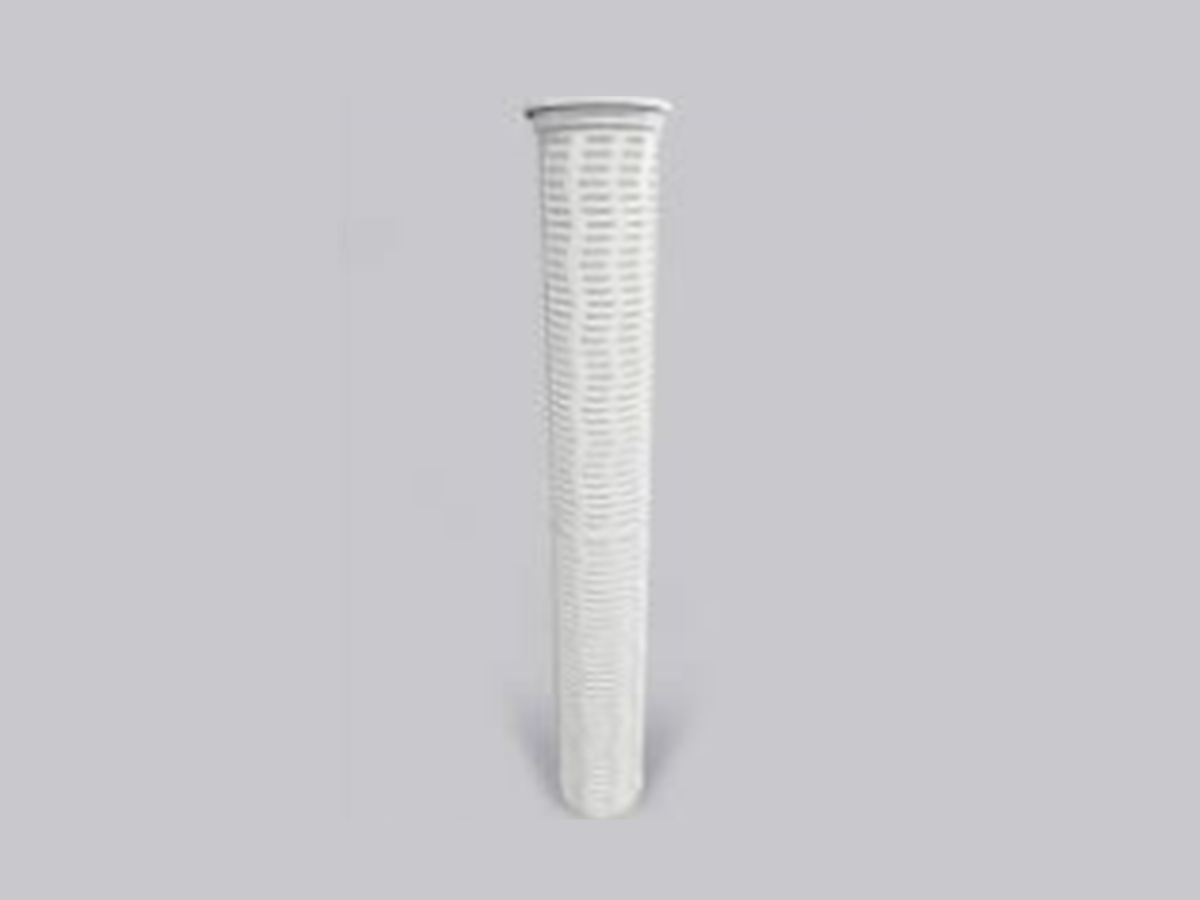
The working principle is straightforward. Liquid enters the filter housing and passes through the pleated filter media. Particles that are larger than the effective filtration pathways are retained by the media, while the filtered liquid continues through the cartridge and into the next stage of the process.
The pleated structure is one of the most useful features of this type of cartridge. If a flat piece of filter material were used inside the same basic cartridge envelope, the available filtration area would be limited. By folding the media into multiple pleats, the manufacturer can place more filter surface into a relatively compact space.
This is not a complicated idea, but it is important in real industrial systems. More usable media area can help the cartridge handle a greater particle load before replacement becomes necessary, depending on the filter media, water quality, flow rate, and operating conditions.
Public Pentair information provides a useful example. Its OMNIFILTER RS6 cartridges use durable non-woven polyester fabric with a pleated structure, and Pentair states that its standard 9.75-inch cartridge contains more than four square feet of polyester fabric while the 20-inch version contains more than 16 square feet. Pentair also explains that pleating is used to maximize dirt-holding capacity.
I use this principle when discussing cartridge selection with customers: the cartridge should not simply be judged by its outside appearance. The useful filtration area, media characteristics, flow path, sealing structure, housing compatibility, and operating conditions all matter.
Micron rating is an important selection point, but it is not the only one. Two cartridges with the same nominal micron value can behave differently because their media structures, surface areas, construction methods, and operating conditions are different.
I therefore recommend that customers provide actual process information before confirming a cartridge. Useful information includes the liquid being filtered, expected flow rate, particle characteristics, temperature, pressure, existing housing dimensions, required filtration level, and whether the cartridge is used as pretreatment, polishing filtration, or another process stage.
This approach is especially useful for seawater desalination and industrial wastewater projects. A cartridge that works well in one water source may not provide the same service life in another source with a much higher solids load.
The LFC Series uses an all-polyester filtration concept. Polyester is widely used in pleated filtration because it can be formed into durable filter media and used in a broad range of liquid filtration applications. Public Pentair documentation also lists non-woven polyester as the filter media in several pleated cartridge products.
I consider the media material together with the actual liquid. It is not enough to say that a filter is made from polyester and assume it will be suitable for every chemical or temperature condition. Compatibility should always be checked against the actual process fluid and operating environment.
The pleated structure gives the cartridge a larger effective media area than a simple flat filter arrangement within the same general footprint. This makes pleated cartridges useful where a compact element needs to provide substantial filtration area.
The LFC Series is positioned for high-flow liquid filtration applications. In practice, I look at high-flow filtration as a system design issue. The cartridge, housing, inlet and outlet piping, pump, valves, and other treatment stages all influence the actual flow that can be achieved.
Maintenance is another point that I never overlook. A filter that performs well but takes too long to replace can create unnecessary downtime in a working plant. Cartridge dimensions, housing arrangement, access space, sealing method, and replacement procedure should therefore be considered during the initial design stage.
Water treatment projects are rarely identical. One customer may need seawater pretreatment, another may need industrial process water filtration, while another may be dealing with wastewater containing a different particle load. We therefore approach filter selection according to the actual project rather than offering one fixed solution for every application.
When I explain filtration technology to a customer, I try not to hide behind complicated terminology. A filter cartridge has to do a simple job: allow the required liquid to pass through while retaining unwanted particles at the intended filtration stage.
The engineering challenge is making that process stable over time.
A pleated filter cartridge places a relatively large amount of filter media into a compact element. When solids accumulate on the media, the available flow path gradually changes. The rate of this change depends on water quality, particle concentration, flow velocity, filter rating, and other factors.
This is why I avoid giving customers a universal replacement interval. A cartridge working with relatively clean process water may last much longer than the same cartridge used on water with a high solids concentration.
Pressure drop is one of the most useful operating indicators for cartridge filtration. As particles build up, resistance through the filter can increase. Monitoring the pressure difference across the cartridge helps operators understand when the filter is becoming loaded.
Public manufacturer information demonstrates how pressure drop and filter area are commonly considered together. Pentair describes pleated cartridge designs with high dirt-holding capacity and low pressure drop in certain product families, while its Aqualine information emphasizes high flow and reduced pressure drop. These are manufacturer-specific product claims and should be used as industry references rather than LFC Series performance specifications.
| Selection Factor | Why I Check It | Typical Project Question |
|---|---|---|
| Liquid type | Different liquids can require different media compatibility | What liquid is being filtered? |
| Flow rate | Determines the required filtration capacity | How much liquid must pass through per hour? |
| Particle load | Affects cartridge loading and service interval | How much suspended material is present? |
| Filtration rating | Defines the intended filtration level | What particle size needs to be controlled? |
| Housing dimensions | Ensures physical compatibility | What cartridge length and connection arrangement are required? |
| Temperature and pressure | Influence material selection and safe operation | What are the normal and maximum process conditions? |
I believe filtration data should be connected to test conditions. Flow rate, micron rating, pressure drop, dirt load, liquid viscosity, temperature, and filter housing configuration can all influence actual performance.
That is why I do not copy a flow number from another manufacturer's cartridge and present it as the LFC Series specification. Public products can provide useful industry benchmarks, but they are not substitutes for project-specific testing and configuration.
Seawater desalination is one of the main areas connected with our company. In a seawater reverse osmosis system, pretreatment is an important part of the process. Depending on the complete system design, cartridge filtration can be used as a downstream pretreatment step to reduce remaining suspended particles before water reaches sensitive equipment.
I always stress that cartridge filtration is only one stage. It should work together with intake screening, pretreatment, multimedia or other filtration stages, chemical treatment where required, and reverse osmosis rather than being expected to solve every water quality issue by itself.
Hotels on islands and in coastal areas may need to produce usable water from seawater or another limited water source. These projects often have space, maintenance, and operating constraints. A compact cartridge filtration stage can be integrated into the larger water treatment system according to the project's flow and equipment layout.
Ships, offshore platforms, and marine facilities have their own equipment and space limitations. Filtration components need to be selected according to the actual system arrangement, liquid conditions, and maintenance plan. Our project experience in water treatment allows us to consider the cartridge as part of the complete equipment package.
Industrial plants often circulate or consume significant amounts of process water. The exact filtration requirement depends on the production process. In some systems, cartridge filtration may be used for pretreatment. In others, it may be used as a polishing step after another filtration process.
Wastewater is usually more complicated than clean water because the solids and contaminants can vary greatly. The LFC Series can be considered for suitable liquid filtration stages, but I recommend testing the actual wastewater before selecting the final cartridge configuration.
Cartridge filtration can also be incorporated into certain municipal or commercial water treatment arrangements. The right cartridge depends on the water source, treatment target, flow requirement, and local system design.
| Application | Typical Filtration Role | What I Check First |
|---|---|---|
| Seawater desalination | Cartridge pretreatment before downstream equipment | Suspended solids, flow, RO system requirements |
| Industrial process water | Process filtration or polishing filtration | Liquid quality and process sensitivity |
| Wastewater treatment | Suitable liquid filtration stage | Solids concentration and fouling tendency |
| Coastal hotels | Water treatment system pretreatment | Daily water demand and site conditions |
| Ships and offshore platforms | Compact filtration within marine water systems | Available space, flow and maintenance access |
| Municipal water systems | Polishing or process filtration where applicable | Source water and treatment objectives |
A filter cartridge is a relatively small product, but I still believe its manufacturing process deserves attention. The media, support components, sealing areas, dimensions, and assembly quality all affect how the cartridge works inside a housing.
During production, I focus on consistent assembly and correct sealing because an imperfect seal can create an unwanted bypass path. In filtration, bypass is a serious practical issue: even if the filter media itself is suitable, liquid that avoids the intended media path cannot be properly filtered.
Public Pentair documentation provides an example of how manufacturers address this point. Its RS6 and R Series information describes the use of pleated polyester media, support cores, endcaps, thermoplastic adhesive sealing, and sonic welding at the overlap seam to reduce internal bypass. These details illustrate common engineering considerations in pleated cartridge construction.
For the LFC Series, I treat production as part of the overall project process. Before delivery, we carry out assembly, commissioning where applicable, and quality inspection according to the agreed product and project requirements. Technical information and operating documents can also be prepared for the customer.
We do not use one fixed delivery period for every order. Production time normally depends on project quantity, product configuration, customization requirements, and the overall equipment arrangement.
Standard products generally require a shorter production cycle. For customized projects, I first need to confirm the process design and equipment configuration before giving a reliable delivery schedule. This is more useful to the customer than promising an unrealistic fixed number of days before the project details are known.
After production and inspection, transportation becomes the next concern. Depending on the product size and shipment method, we can use wooden cases, pallets, or reinforced containers. Road transportation, sea transportation, and multimodal transportation can be arranged according to the destination and project requirements.
My goal is simple: the filtration products should arrive in the same usable condition in which they left the production facility. Packaging therefore needs to consider protection against impact, movement, moisture, and other risks during transportation.
For project orders, payment terms can be arranged according to the contract. Depending on the project, this may include an advance payment, shipment payment, and final payment. The exact arrangement is confirmed before production begins.
When a customer contacts us for a filter cartridge, I do not want the discussion to stop at the product name. The more useful question is: what is the cartridge expected to do inside the customer's system?
This is where our background in water treatment makes a difference. Qingdao Yanhui Environmental Protection Technology Co., Ltd. was established in 2015, and our business covers seawater desalination, high-salinity wastewater treatment, concentration and purification, and industrial wastewater treatment.
We provide services covering research and development, process design, equipment manufacturing, installation, commissioning, operation, and maintenance. This allows us to look at filtration from both the component level and the complete system level.
I prefer to start with the water quality and process requirements. If I know the liquid, flow rate, filtration target, operating pressure, temperature, existing housing, and downstream equipment, I can give a much more useful recommendation.
A filter cartridge does not work alone. It works inside a housing and as part of a process line. Pump selection, piping size, valves, pressure, flow distribution, and the following treatment stages all influence actual operation.
For this reason, our engineering team can discuss the filtration component together with the larger water treatment project when the customer needs an integrated solution.
Different customers may require different dimensions, filtration levels, connection arrangements, or installation conditions. We can evaluate customization according to the actual project rather than assuming that every site can use exactly the same configuration.
Industrial purchasing is often about reducing uncertainty. Customers need to know what they are buying, whether it fits their equipment, when it can be delivered, how it will be packaged, and what technical information will be provided.
I therefore prefer clear technical communication before production. If information is missing, I would rather ask for it than make assumptions that could cause problems later.
Review the customer's liquid filtration requirement.
Confirm water quality, flow rate, filtration target, and operating conditions.
Check cartridge dimensions and housing compatibility.
Discuss standard or customized configuration.
Confirm technical details and commercial terms.
Arrange production according to the confirmed project configuration.
Complete assembly, inspection, and required testing before delivery.
Prepare technical documents and operating information.
Package and reinforce the products according to the transportation method.
Provide follow-up support according to the project requirements.
The LFC Series is designed for industrial liquid filtration applications. Depending on the confirmed configuration, it can be considered for water treatment, process water filtration, wastewater treatment, seawater desalination pretreatment, and other suitable industrial filtration processes.
Pleating allows more filter media to be placed into a compact cartridge structure. This increases the available filtration area and can help the cartridge handle particle loading efficiently. Polyester is also a commonly used material in pleated liquid filtration products.
It can be considered for suitable seawater desalination filtration stages, particularly where cartridge filtration is part of the pretreatment arrangement. However, I do not recommend selecting a cartridge only from the product name. Actual seawater quality, suspended solids, flow rate, downstream RO requirements, and system design should be reviewed first.
It can be considered for suitable wastewater filtration applications. Wastewater characteristics can vary greatly, so I recommend providing information about suspended solids, particle characteristics, flow rate, temperature, and other relevant conditions before confirming the cartridge.
We can evaluate customized requirements according to the project. The specific customization options depend on the required dimensions, filtration configuration, housing, process conditions, and order quantity. I recommend sending drawings, cartridge dimensions, existing housing information, or project specifications when available.
I normally recommend starting with the actual filtration objective rather than selecting a micron rating in isolation. We need to understand what particles need to be removed, what the downstream equipment requires, how much water must be treated, and how much solids loading the cartridge is expected to handle.
There is no single service-life number that applies to every project. Cartridge life depends on water quality, particle concentration, flow rate, filtration rating, pressure drop, and operating conditions. In practice, monitoring differential pressure and actual filtration performance is more useful than relying on a fixed calendar replacement period.
The production schedule depends on order quantity and configuration. Standard products generally have a shorter delivery cycle, while customized projects require additional time for process design, configuration confirmation, production, inspection, and preparation for shipment. We confirm the schedule after the project details are finalized.
Packaging is selected according to product size, quantity, and transportation method. Depending on the shipment, we can use pallets, wooden cases, or reinforced containers. The purpose is to reduce movement and protect the products during road, sea, or multimodal transportation.
Yes. Technical documents and operating information can be prepared according to the product and project requirements. The exact documentation package is confirmed during the order process.
Yes. Our business covers more than individual filtration components. We provide customized water treatment equipment and integrated engineering services, including research and development, design, manufacturing, installation, commissioning, operation, and maintenance. Our main areas include seawater desalination, high-salinity wastewater treatment, concentration and purification, and industrial wastewater treatment.
From my experience with water treatment projects, the most important point is simple: a filter cartridge should be selected according to the process it needs to serve.
The LFC Series All-Polyester High-Flow Pleated Filter Cartridge combines an all-polyester media concept with a pleated structure for industrial liquid filtration. Its intended application range includes suitable water treatment, process filtration, wastewater treatment, and seawater desalination filtration stages.
At the same time, I believe responsible product information should have clear boundaries. The exact filtration rating, flow capacity, pressure drop, service life, temperature range, and other operating parameters should be confirmed according to the actual LFC configuration and project conditions rather than copied from another manufacturer's product.
That is also how we approach customer projects at Qingdao Yanhui Environmental Protection Technology Co., Ltd. We begin with the water and process requirement, then work toward the appropriate equipment and filtration configuration.
If you are looking for an all-polyester High-Flow Filter Cartridge, a Polyester Pleated Filter Cartridge for industrial water treatment, or a filtration component for a seawater desalination or wastewater treatment system, you can provide us with your flow rate, water quality, existing housing information, required filtration level, and project conditions. I can then help evaluate a suitable LFC Series configuration for your application.
Industry reference sources used for comparison: 3M High Flow Filter System product documentation; Pentair OMNIFILTER RS6 and Pentek R Series product documentation; Pentair Aqualine and industrial filtration product information. The published figures from these sources are reference data for their respective products and are not specifications of the LFC Series All-Polyester High-Flow Pleated Filter Cartridge.
This website uses cookies to ensure you get the best experience on our website.
 Portugues
 Pусский
 Français
 العربية
 ไทย
ไทย Indonesia
 Melayu
 Tiếng Việt
 中文
中文 қазақ
қазақ עִברִית
 မြန်မာ
 ພາສາລາວ
 Filipino
 o'zbek
 Кыргызча
 тоҷикӣ
 ខ្មែរ
ខ្មែរ Türkmenler



 Phone
Phone