

LFP all-polyester pleated Filter Cartridges use deep-layer refined polyester fiber membranes as filter media, exhibiting excellent temperature and pressure resistance.
Yes, it can withstand continuous operation at 120℃ for a week. It can operate for nearly two weeks at 90℃. Filter element diameter...
The maximum filtration area of a single 6°/152mm filter cartridge exceeds 8m², and the flow rate can reach 60m³/h. It features a polyester outer frame and a single opening.
The filter is specially designed with an inside-out liquid flow direction to ensure that all pollutant particles are intercepted within the filter element, thus enabling its wide application.
Widely used in various fields. It reduces the requirements for filter size and the number of filter cartridges during use, resulting in significant savings.
Reduced equipment and labor costs, and easier operation.
Design parameters
Specifications (diameter * length) | Design flow rate (m³/h) | Maximum flow rate (m³/h) | Filter area (m2) |
6"*20" | 15 | 40 | 3.3 |
6"*40" | 30 | 80 | 6.5 |
6"*60" | 45 | 110 | 8.5 |
Material Structure
model | PBT |
Filter media | Polyester |
Support/Guide Layer | Polyester |
End cap | Polyester |
outer protective sleeve | Polyester |
Interface type
LFP | 40 | PBT | 0050 | F | S |
LFP | length | Material | accuracy | sealing ring | Appearance |
20=20" | PBT | 0010 = 1μm | F+ Fluororubber | S+ Frame | |
40=40" | PBT | 0030=3μm | |||
60=60" | 0050 = 5μm | ||||
0100 = 10μm | |||||
0150 = 15μm | |||||
0250 = 25μm | |||||
0400 = 40μm | |||||
0700 = 70μm |
Working characteristics
Maximum operating temperature | 120℃ |
Maximum working pressure difference | 0.58 MPa @ 20℃ |
Recommend replacing pressure difference | 0.15Mpa@20℃ |
Typical application scenarios
Chemical condensate |
Power plant heating network drainage |
hydrogen peroxide workshop |
High humidity liquid filtration |
Precision filtration of liquids containing aromatic hydrocarbon solvents such as benzene and toluene. |
LFP Series All-Polyester High-Flow Pleated Filter Cartridge
When I look at an industrial water treatment system, I rarely consider a filter cartridge as just a small replacement component. In practice, a cartridge filter can have an important role in protecting downstream equipment, controlling suspended particles, and keeping a treatment process running in a more stable way.
The LFP Series All-Polyester High-Flow Pleated Filter Cartridge is designed around this practical requirement. It combines all-polyester filter media with a pleated structure to provide a large filtration area in a compact cartridge format. I see this type of filter as a useful choice for industrial liquid filtration where flow handling, filtration area, installation, and maintenance all need to be considered together.
At Qingdao Yanhui Environmental Protection Technology Co., Ltd., we have been working with water treatment projects since 2015. Our business covers Seawater Desalination, high-salinity wastewater treatment, concentration and purification, and industrial wastewater treatment. Because of this background, I normally look at a filter cartridge from the perspective of the entire process rather than judging it only by its appearance or product name.
For me, a good filtration solution starts with a simple question: what does the water actually need? The answer depends on the water source, suspended solids, flow rate, filtration target, equipment arrangement, and the conditions of the next treatment stage.
Industrial filtration can look simple from the outside. Water enters a housing, passes through the filter, and comes out cleaner. But once a system becomes larger, the practical details become much more important.
A high-flow system may need to process a large amount of liquid every hour. If conventional small cartridges are used, the system may require many filter elements, a larger housing arrangement, more connections, and more maintenance work. A high-flow pleated filter cartridge approaches the problem differently by placing a larger amount of usable filter media into one cartridge.
The basic idea behind the LFP Series is straightforward. Its pleated filter structure creates more filtration surface within the available cartridge space. When liquid passes through the media, suspended particles are retained according to the selected filtration characteristics, while the filtered liquid continues into the next stage.
I want to make one point clear here: “high flow” does not mean that every cartridge can handle any flow rate. Actual flow depends on the cartridge configuration, filtration rating, liquid properties, pressure drop, housing, piping, pump, and the amount and type of contaminants in the liquid.
Public products from established filtration manufacturers show how much these factors can vary. For example, 3M states that its High Flow Filter System can accommodate up to 500 gpm, or approximately 113 m³/h, in a single 60-inch cartridge in the specified configuration. This is useful industry reference data, but it is not a specification for our LFP Series.
Pentair's Aqualine system provides another example. Its published information describes 6.5-inch-diameter, 60-inch-long pleated cartridges and highlights high-flow filtration with reduced pressure drop. Pentair also states that the cartridges are designed for pretreatment in industrial reverse osmosis applications and lists desalination and several other industries among the application areas.
| Industry Reference | Published Configuration | Published Information | Source |
|---|---|---|---|
| 3M High Flow Filter System | 60-inch cartridge | Up to 500 gpm / approximately 113 m³/h in the specified configuration | 3M published product brochure |
| Pentair Aqualine | 6.5-inch diameter × 60-inch pleated cartridge | High-flow filtration with reduced pressure drop | Pentair product information |
| Pentair OMNIFILTER RS6 | 9.75-inch and 20-inch polyester cartridges | More than 4 ft² and more than 16 ft² of polyester fabric respectively | Pentair product information |
The figures above are provided only to explain the range of high-flow and pleated filtration designs available in the industry. They should not be used as the technical specification of the LFP Series.
For an actual project, I always recommend confirming the required flow rate and filtration performance against the complete system design.
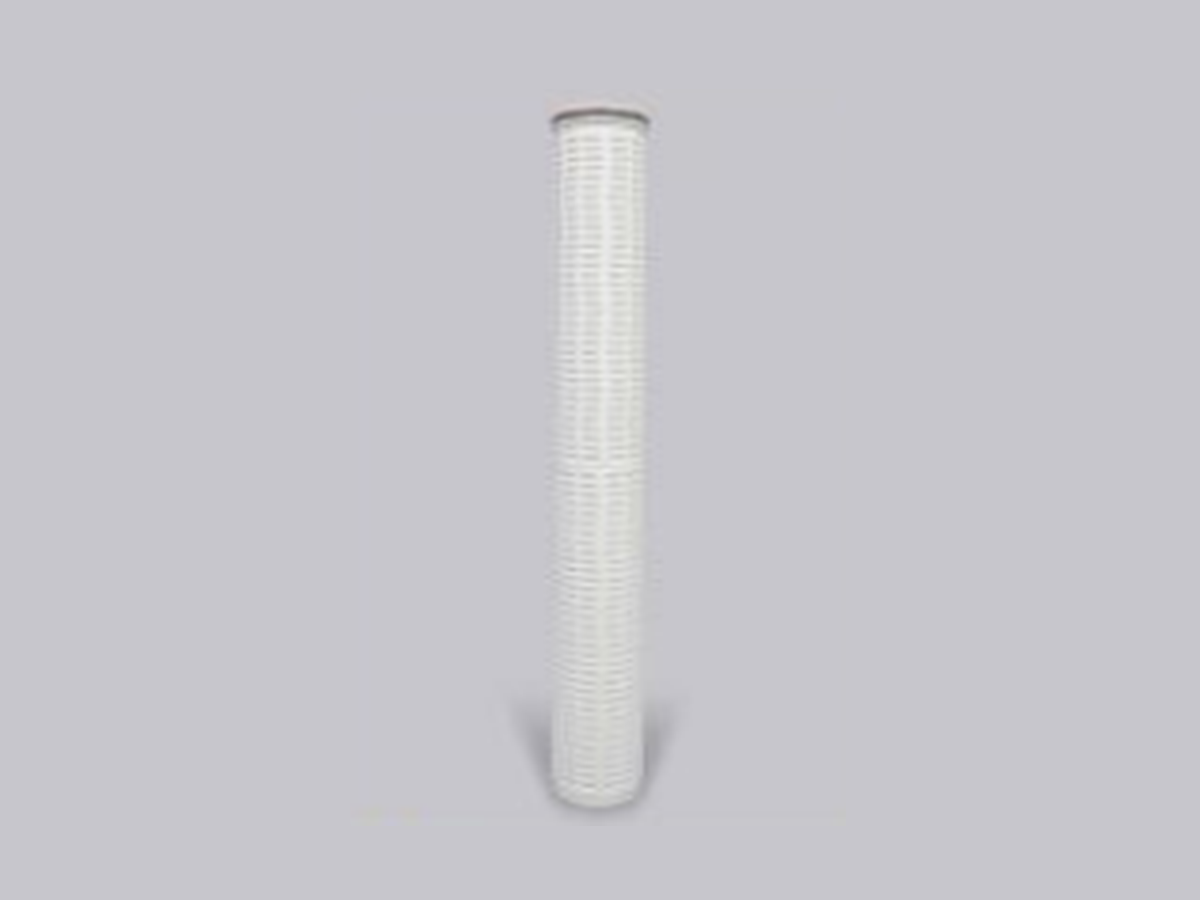
The working principle of the LFP Series is easy to understand. The cartridge is installed inside a compatible filter housing. The process liquid enters the housing and is directed through the pleated filter media. Particles are retained by the media according to the selected filtration characteristics, and the filtered liquid exits through the outlet side.
The important part is the pleated structure.
Imagine a flat sheet of filter material. If the sheet is placed inside a small cylindrical space, only a limited amount of surface area can be used. Now imagine folding that same sheet into many closely spaced pleats. The available filter surface becomes much larger without making the cartridge equally larger.
That is the simple reason pleated filtration is widely used.
The larger filtration area can be useful when a process needs to handle a considerable amount of liquid or when the liquid contains a meaningful amount of suspended material. However, I never describe filter area as the only factor that determines service life. Particle concentration, particle size, flow velocity, filtration rating, liquid viscosity, and other conditions can all affect actual cartridge performance.
The LFP Series uses an all-polyester filtration structure. Polyester is widely used in pleated filtration products because it can be formed into practical filter media and used in different liquid filtration applications.
As an industry example, Pentair's OMNIFILTER RS6 cartridges use durable non-woven polyester fabric and a pleated structure. Pentair states that its 9.75-inch cartridge contains more than four square feet of polyester fabric, while its 20-inch version contains more than 16 square feet. The company also explains that the pleated design is intended to maximize dirt-holding capacity.
Again, these figures belong to the Pentair product and are not LFP Series specifications. I use them here simply to show why polyester pleated media is a familiar approach in liquid filtration.
One mistake I often see in product selection is focusing too heavily on the cartridge while ignoring the system around it.
A cartridge needs a suitable housing. The housing needs proper flow distribution. The pump must provide the required operating conditions. The piping must be able to deliver the intended flow. The downstream equipment may also have its own filtration requirements.
So, when I help a customer select an industrial Water Filter Cartridge, I want to understand the complete process. This makes the recommendation much more useful than simply choosing a cartridge based on one number.
The first feature is the all-polyester construction. The filter media is based on polyester rather than combining unrelated media materials simply for marketing purposes. This gives the product a clear material identity and makes it easier to discuss material compatibility according to the customer's process conditions.
Of course, material compatibility should always be confirmed against the actual liquid. I would not recommend assuming that any polyester filter is automatically suitable for every chemical, temperature, or process condition.
The pleated structure allows more filter media to be placed inside the cartridge. This is one of the key reasons pleated filter cartridges are widely used in industrial and commercial filtration.
A larger media area can help distribute the contaminant load over a wider surface. This can be useful when the liquid contains suspended solids and the system needs practical filtration capacity.
The LFP Series is positioned for high-flow liquid filtration. I consider this particularly useful for industrial water treatment systems where the liquid flow is too large for a simple small-cartridge arrangement to be convenient.
However, I always connect the phrase “high flow” with actual process data. The correct flow rate must be confirmed through the selected cartridge configuration and system design.
The LFP Series can be considered for various filtration stages, including water treatment, process water filtration, wastewater pretreatment, and suitable seawater desalination pretreatment systems.
It is important to distinguish filtration from complete purification. A cartridge filter is designed for a specific filtration task. It does not replace reverse osmosis membranes, ion exchange, disinfection, evaporation, or other treatment technologies when those processes are required.
Maintenance is often where a filtration product proves its value in everyday operation. Operators need to know when a cartridge requires replacement and how quickly it can be serviced.
I recommend monitoring differential pressure across the filter where the system design allows it. As the filter loads with particles, resistance can increase. This gives operators a practical indication that the cartridge is approaching its replacement point.
When someone searches for an “All-Polyester High-Flow Filter Cartridge,” it is tempting to compare products by title alone. I think that is too simple.
In real industrial filtration, several factors need to be considered together.
More filter media can provide more available filtration surface, but the actual benefit depends on the media structure and application. A larger surface area is not automatically better if the cartridge is installed in a system that cannot use it properly.
Pressure drop describes the difference in pressure before and after the filter. A clean filter normally creates less resistance than a loaded filter. As particles accumulate, the pressure difference can increase.
This is why I recommend considering pressure drop during filter selection instead of looking only at the nominal flow rate.
Different water sources behave very differently. Clean process water may place relatively little particle load on the cartridge. Raw water or wastewater may contain much more suspended material.
A cartridge used on high-solids water may need to be changed more often than the same cartridge used on cleaner water. There is no responsible way to promise one universal service interval without knowing the actual process conditions.
The cartridge must physically and functionally match the housing. Length, diameter, end configuration, sealing method, and flow direction all matter.
This is one reason I encourage customers to send drawings, photographs, existing cartridge specifications, or housing information when they are available. A small dimensional difference can make a product unsuitable even when the filter media itself is appropriate.
The filter media should be compatible with the liquid being processed. Water, seawater, industrial process liquids, and wastewater can have very different characteristics.
Temperature and chemical concentration also matter. Compatibility should therefore be reviewed based on the real operating conditions rather than a general statement about polyester.
| Selection Factor | Why It Matters | Information I Ask Customers For |
|---|---|---|
| Liquid type | Determines material compatibility and filtration approach | Water, seawater, wastewater, process liquid, etc. |
| Flow rate | Helps determine the required filtration capacity | m³/h, L/min, GPM, or daily production |
| Particle load | Influences cartridge loading and replacement frequency | Suspended solids and contaminant characteristics |
| Filtration target | Defines the required filtration level | Required micron rating or downstream requirement |
| Housing | Ensures physical compatibility | Housing model, dimensions, end connection |
| Operating conditions | Affects cartridge selection and safe use | Temperature, pressure, and flow conditions |
These factors are more useful for technical selection than simply asking which cartridge has the highest advertised flow rate.
Seawater desalination is one of the areas where our company has practical project experience. Reverse osmosis desalination systems are sensitive to feedwater quality, so pretreatment is an important part of the overall process.
A cartridge filter can be used as one of the filtration stages before downstream equipment, depending on the complete process design. Its role is to help control remaining suspended particles after earlier treatment stages.
I do not treat cartridge filtration as a replacement for complete seawater pretreatment. Screening, media filtration, chemical treatment, ultrafiltration, cartridge filtration, and reverse osmosis can each have different roles depending on the water quality and project requirements.
Hotels on islands and coastal areas may have limited freshwater resources and may need Seawater Desalination Equipment to produce usable water.
In these projects, the filtration system needs to be matched to the required water production, seawater quality, equipment layout, and available maintenance space. The LFP Series can be considered as part of a suitable liquid filtration stage within such a system.
Marine projects often have limited equipment space. They also need systems that can operate reliably while being easy to inspect and maintain.
For shipboard or offshore water treatment, I look at more than the filter itself. The housing, pump, piping, vibration environment, installation position, access for replacement, and transportation requirements should all be considered.
Factories can use water in many different production stages. Depending on the industry, the water may need filtration before it enters production equipment, after a process stage, or before being reused.
The LFP Series can be considered for appropriate process water filtration applications where an all-polyester pleated filter structure meets the process requirements.
Wastewater is one of the more demanding filtration applications because the liquid composition can change from one factory to another.
For wastewater treatment, I recommend checking suspended solids, particle size, oil content, organic loading, chemical conditions, and other relevant characteristics before selecting a cartridge. A filtration product should be chosen around the actual wastewater rather than around a generic application label.
Cartridge filtration can also be used in suitable municipal, commercial, hospitality, and other water treatment systems. The exact role depends on the treatment process and required water quality.
| Application | Potential Filtration Role | Main Selection Considerations |
|---|---|---|
| Seawater desalination | Pretreatment or downstream particle filtration | Seawater quality, RO requirements, flow rate |
| Coastal hotels | Filtration within water production systems | Daily demand, site conditions, maintenance access |
| Ships and offshore platforms | Compact filtration within marine systems | Space, flow, vibration, replacement access |
| Industrial process water | Process or polishing filtration | Process sensitivity, particle load, flow |
| Industrial wastewater | Suitable filtration stage | Suspended solids, chemistry, fouling tendency |
| Municipal and commercial water | Polishing or process filtration | Source water and treatment target |
Pentair's published Aqualine information provides an industry example of pleated cartridge filtration being used for industrial RO pretreatment and applications including desalination, electronics, oil and gas, chemicals, pharmaceuticals, hospitality, and food and beverage. These are applications stated by Pentair for its own product system, not a guarantee that the LFP Series is suitable for every one of those processes without project evaluation.
For me, manufacturing quality starts before the cartridge reaches the inspection area. The filter media, support structure, end connections, sealing areas, dimensions, and assembly method all need to work together.
One small problem in a sealing area can create an unwanted bypass path. If liquid finds an easier route around the filter media, the filtration result may not match what the filter media itself could provide.
That is why cartridge assembly should not be treated as a simple packaging job.
The polyester filter media needs to be prepared according to the confirmed product configuration. The material should be handled consistently so that the finished pleated structure has the intended form.
The filter media is formed into pleats and assembled with the required support and end components. The purpose is to create a stable flow path while making effective use of the available filter area.
Sealing is an important part of cartridge construction. The media and end components need to form a suitable barrier so that liquid is directed through the intended filtration path.
Industry products show different approaches to this problem. Pentair states that its RS6 cartridges use thermoplastic adhesive to seal pleated ends to the endcap and sonic welding at the overlap seam to reduce internal bypass. This is an example of a manufacturer's construction method and is not necessarily the construction method used for every LFP configuration.
Before delivery, we complete product assembly and quality inspection according to the confirmed requirements. For complete water treatment projects, equipment can also be assembled, commissioned, and inspected before shipment, with technical information and operating documents prepared as required.
I believe this final stage is important because the customer should not have to discover basic product problems after the shipment arrives.
Once inspection is completed, packaging becomes part of product protection. Depending on product size and shipment conditions, we can use wooden cases, pallets, or reinforced containers.
For larger water treatment equipment, transportation may involve road freight, sea freight, or multimodal transportation. The packaging method is selected according to the dimensions, weight, quantity, and destination so that the products can remain secure during transportation.
There is a practical reason I like to discuss filter cartridges together with the larger treatment process: the cartridge rarely works alone.
Qingdao Yanhui Environmental Protection Technology Co., Ltd. was established in 2015. Our main business areas include seawater desalination, high-salinity wastewater treatment, concentration and purification, and industrial wastewater treatment.
We provide customized water treatment equipment and integrated engineering services covering R&D, design, manufacturing, installation, commissioning, operation, and maintenance.
This means we can approach a filtration requirement from two directions. We can discuss the individual cartridge, but we can also understand how that cartridge needs to fit into a larger water treatment process.
I prefer to ask about the liquid first. What is it? Where does it come from? What is the suspended solids level? What flow rate is required? What equipment comes after the filter?
These questions may sound basic, but they often prevent unnecessary mistakes.
If the customer is replacing an existing cartridge, I recommend providing the existing model, dimensions, housing information, photographs, or drawings whenever possible.
This helps us understand whether the requirement is simply a replacement or whether the customer is trying to improve the filtration arrangement.
Different projects may have different cartridge dimensions, filtration ratings, end configurations, or installation requirements. We can evaluate customized requirements according to the actual project conditions.
I do not believe customization should mean changing a product without understanding the process. The process requirement should come first, followed by the appropriate product configuration.
Production time depends on the project scale and configuration. Standard products generally have a shorter delivery cycle, while customized projects need additional time for technical confirmation and equipment configuration.
Before delivery, we can complete the required assembly, commissioning, and inspection and provide technical documentation according to the project requirements.
For international customers, a product is not truly delivered until it arrives safely. We therefore select packaging according to the product and transportation method, using wooden cases, pallets, or containers where appropriate.
Commercial terms can also be arranged according to the project contract, including advance payment, shipment payment, and final payment where applicable.
For me, these details are not separate from product quality. They are part of delivering an industrial product that the customer can actually use.
The LFP Series is an industrial liquid filtration cartridge using an all-polyester pleated filter structure. It is designed for suitable high-flow filtration applications and can be considered for water treatment, process water, wastewater filtration, and seawater desalination pretreatment systems.
The all-polyester construction provides a clear filter media material for the cartridge. Polyester is widely used in pleated liquid filtration products. However, actual chemical and temperature compatibility should always be checked against the specific process liquid and operating conditions.
The pleated structure allows a larger amount of filter media to be placed within a compact cartridge. This creates more filtration surface and can help distribute contaminant loading across the available media.
The LFP Series can be considered for suitable filtration stages within Seawater Desalination Systems. The final selection should be based on seawater quality, suspended solids, required flow, existing pretreatment, RO requirements, housing configuration, and other project conditions.
It can be considered for suitable wastewater filtration applications. Because wastewater characteristics vary significantly, I recommend checking the actual water quality and particle load before confirming the cartridge configuration.
I recommend starting with the filtration objective. We need to know what particles need to be removed, the flow rate, the downstream equipment requirements, and the expected contaminant load. A micron rating should be selected as part of the overall filtration design rather than in isolation.
There is no universal service-life value. The actual replacement interval depends on water quality, particle concentration, flow rate, filtration rating, pressure drop, and operating conditions. Differential pressure monitoring can provide a practical way to judge cartridge loading in a properly designed system.
We can evaluate customized requirements based on project conditions. Customers can provide existing cartridge dimensions, housing information, drawings, photographs, filtration requirements, flow rate, and other available technical information for evaluation.
I recommend providing the liquid type, required flow rate, filtration rating, operating pressure, temperature, cartridge dimensions, housing model, end configuration, quantity, and application. If you have an existing cartridge, a photograph and dimensional drawing can also be very helpful.
The production schedule depends on order quantity and product configuration. Standard products generally require a shorter production period, while customized products require technical confirmation and configuration before the schedule can be finalized.
Packaging is selected according to the product size, quantity, and transportation method. We can use wooden cases, pallets, or reinforced containers as appropriate. Road, sea, and multimodal transportation can be arranged according to the project and destination.
Yes. Our business covers customized water treatment equipment and integrated engineering services, including R&D, design, manufacturing, installation, commissioning, operation, and maintenance. Our main areas include seawater desalination, high-salinity wastewater treatment, concentration and purification, and industrial wastewater treatment.
After working with water treatment projects, I have found that filtration problems are often easier to solve when we stop looking at the cartridge as an isolated product.
The LFP Series All-Polyester High-Flow Pleated Filter Cartridge is built around a simple but useful concept: use an all-polyester pleated media structure to provide practical filtration area for industrial liquid filtration applications.
It can be considered for water treatment, process water filtration, wastewater treatment, seawater desalination pretreatment, and other suitable industrial filtration systems. But the correct configuration still needs to be determined from actual process conditions.
I do not believe in using a single flow number or a generic service-life claim for every project. The real performance of a filter depends on the liquid, filtration rating, flow rate, particle loading, housing, pressure, temperature, and the rest of the treatment system.
That is why our approach at Qingdao Yanhui Environmental Protection Technology Co., Ltd. starts with the customer's process requirement. Once we understand the water and the equipment, we can work toward a practical filtration configuration and, when needed, a complete customized water treatment solution.
If you are looking for an all-polyester high-flow pleated filter cartridge, a polyester pleated filter cartridge for industrial water treatment, or a filtration component for a seawater desalination or industrial wastewater treatment system, you can send us your flow rate, water quality, existing housing information, required filtration level, and project conditions.
We can then evaluate the LFP Series according to your actual application instead of asking you to fit your process around a generic product.
Industry reference sources: 3M High Flow Series product documentation; Pentair Aqualine product information; Pentair OMNIFILTER RS6 and Pentek R Series documentation. The published figures and application information cited above refer to the respective manufacturers' products and are provided only as industry reference data, not as specifications or guaranteed performance values for the LFP Series.
This website uses cookies to ensure you get the best experience on our website.
 Portugues
 Pусский
 Français
 العربية
 ไทย
ไทย Indonesia
 Melayu
 Tiếng Việt
 中文
中文 қазақ
қазақ עִברִית
 မြန်မာ
 ພາສາລາວ
 Filipino
 o'zbek
 Кыргызча
 тоҷикӣ
 ខ្មែរ
ខ្មែរ Türkmenler



 Phone
Phone