

Ultrapure Water Treatment Equipment for High Purity Industrial Water
When ordinary filtered water is not clean enough for a production process, the water treatment system has to do more. This is where Ultrapure Water Treatment Equipment becomes important. Ultrapure water is not simply water that looks clear. It is water that has been treated to remove very small amounts of dissolved salts, organic matter, particles, microorganisms, and other impurities that can interfere with sensitive industrial processes.
At Qingdao Yanhui Environmental Protection Technology Co., Ltd., we have been working in the water treatment field since 2015. Our business covers Seawater Desalination, high-salinity wastewater treatment, concentration and purification, and industrial wastewater treatment. We also provide customized water treatment equipment and engineering services covering research and development, process design, manufacturing, installation, commissioning, operation, and maintenance.
For an ultrapure water project, we do not start by asking which machine should be used. We start with a more basic question: What kind of water does the customer's production process actually need?
That sounds simple, but it makes a big difference. A laboratory, pharmaceutical plant, semiconductor factory, electronics manufacturer, and chemical plant may all ask for “high-purity water,” yet their water-quality requirements can be very different.
Our approach is therefore to study the raw water, required production capacity, target water quality, application process, installation conditions, and operating requirements before determining the treatment process.
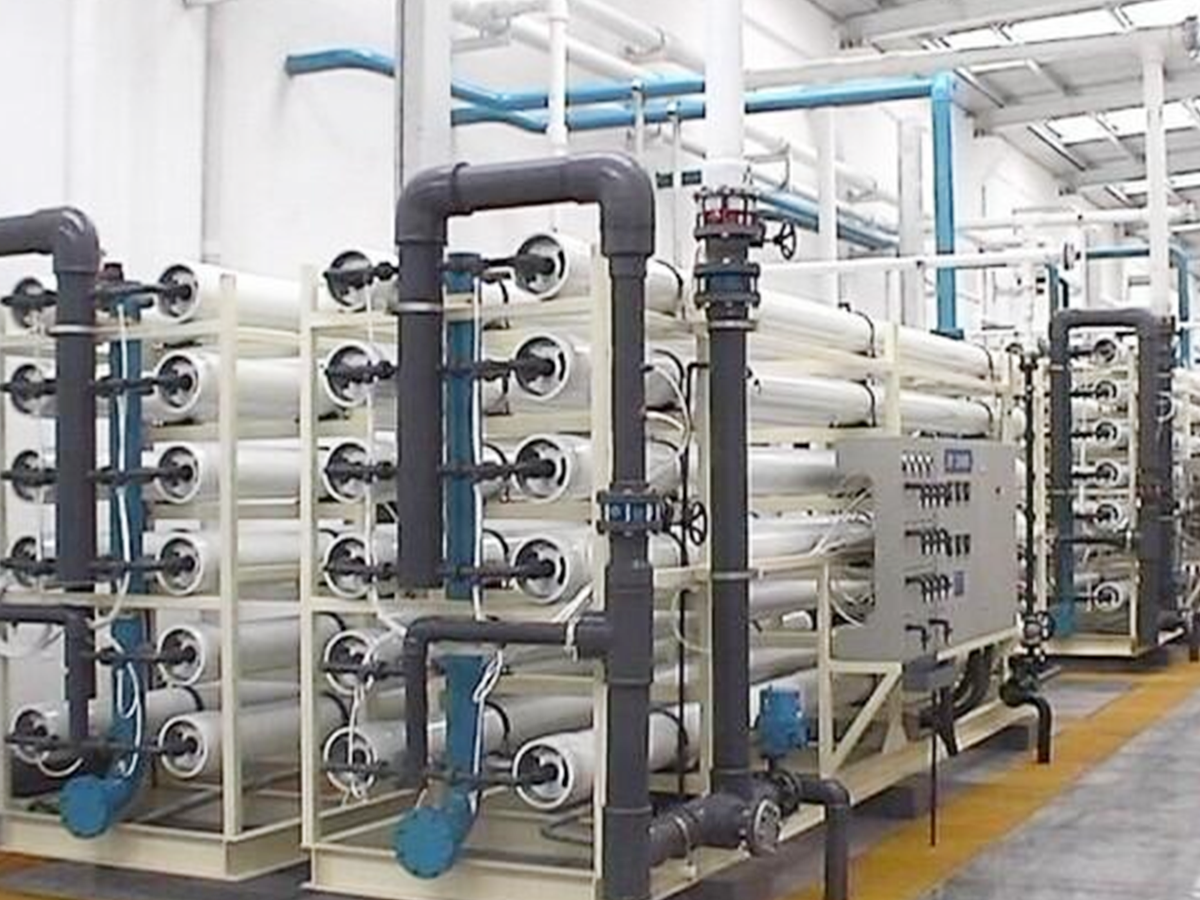
Ultrapure Water Treatment Equipment is a combination of water purification technologies used to produce water with very low levels of contaminants. The exact treatment train depends on the quality of the incoming water and the final application.
In a simple industrial application, the system may use pretreatment followed by reverse osmosis and polishing. For a more demanding application, the system may include multiple purification stages, a pure water storage tank, circulation piping, disinfection, online monitoring, and additional polishing equipment.
The important thing is that “ultrapure” should be connected to measurable water-quality requirements. Parameters such as conductivity, resistivity, total organic carbon (TOC), particles, microorganisms, silica, and specific ions may be considered depending on the application.
ASTM D5127 provides guidance for ultrapure water used in electronics and semiconductor manufacturing. It explains that the required water quality is related to the manufacturing process and that recommendations are applied at the point of distribution. In other words, the water specification should be connected to where and how the water is actually used.
This is one reason we avoid using one fixed equipment configuration for every customer. The correct system for a factory depends on what the factory is making and what the water is doing during production.
These terms are sometimes used interchangeably in commercial discussions, but they do not always mean exactly the same thing.
Pure water generally means water that has been treated to reduce unwanted substances. High-purity water usually means tighter control of dissolved ions, organics, particles, and microorganisms. Ultrapure water is normally associated with applications where contaminant levels must be controlled at very low levels.
For example, ASTM D5127 lists several water-quality classifications for electronics and semiconductor applications. Its data include resistivity and TOC requirements, with different levels corresponding to different manufacturing conditions.
| Water Quality Parameter | What It Tells Us | Why It Matters |
|---|---|---|
| Conductivity | Electrical conductivity of water | Useful for monitoring ionic contamination |
| Resistivity | Electrical resistance of water | Commonly used when discussing very low ionic content |
| TOC | Total organic carbon | Indicates organic contamination |
| Particle count | Number and size of particles | Important for sensitive manufacturing processes |
| Microbial level | Microbiological condition of the water | Important for pharmaceutical and other controlled applications |
Source: ASTM D5127-13(2018), Standard Guide for Ultra-Pure Water Used in the Electronics and Semiconductor Industries. The actual parameters required for a project depend on the application and applicable standards.
There is no single “ultrapure water machine” that removes everything in one step. A reliable system normally uses several treatment stages, with each stage doing a specific job.
A typical process may look like this:
Raw Water → Pretreatment → Fine Filtration → Reverse Osmosis → Polishing → Disinfection → Storage → Distribution
The actual process can be shorter or longer depending on the project.
Before designing the equipment, we need to know what is already in the water.
Raw water may contain suspended solids, hardness, dissolved salts, organic matter, chlorine, microorganisms, silica, iron, manganese, or other substances. The exact combination depends on whether the source is municipal water, groundwater, surface water, seawater, or industrial reuse water.
We therefore recommend a water analysis before final equipment selection. Without this information, it is difficult to determine membrane selection, pretreatment requirements, recovery, operating pressure, or polishing requirements accurately.
Pretreatment protects the more sensitive stages that come later.
Depending on the raw water, pretreatment may include multimedia filtration, activated carbon filtration, softening, cartridge filtration, chemical dosing, or other processes.
The principle is easy to understand. If dirty water is sent directly into a sensitive membrane or polishing system, the downstream equipment has to work harder and may require more frequent maintenance.
EPA notes that pretreatment is frequently needed for RO and NF systems to prevent membrane fouling or plugging.
Reverse osmosis, or RO, is often a key stage in a high-purity water system.
RO uses pressure to push water through a semipermeable membrane. Water passes through the membrane while many dissolved substances are rejected. The process creates a treated water stream called permeate and a concentrated reject stream.
EPA describes RO as a membrane separation process that can remove a wide range of contaminants, including many inorganic contaminants and dissolved solids.
WHO also describes reverse osmosis as a high-pressure membrane process and notes its long-standing use in industrial and pharmaceutical water treatment.
For an Ultrapure Water Treatment Equipment system, RO is usually not the final step when extremely low contamination levels are required. It is often used to prepare the water for the polishing stages.
After RO, additional purification may be used to further reduce ionic and organic contaminants.
Depending on the required water quality, polishing can involve technologies such as ion exchange, electrodeionization (EDI), ultrafiltration, UV treatment, or other suitable processes.
EDI, for example, can be used as a polishing stage after RO in systems designed for higher-purity water. The final process depends on the required conductivity, resistivity, TOC, silica, microbial control, and other parameters.
High-purity water is not automatically free from microbial concerns. In some applications, the system must be designed to limit microbial growth throughout the water generation and distribution process.
For pharmaceutical water systems, WHO guidance discusses measures such as UV disinfection, temperature control, sanitization, and suitable circulation practices. WHO also notes that highly purified water can be produced using double-pass RO combined with ultrafiltration or another qualified purification sequence.
This is a useful reminder that water quality is not only determined at the outlet of the RO membrane. Storage tanks, pipes, valves, circulation loops, and the final point of use can all affect the water after purification.
When we design an Ultrapure Water Purification System, we pay attention to the whole process rather than one piece of equipment.
Every project starts from the raw water and the target water quality.
For one customer, a single-pass RO system may be sufficient. Another customer may require double-pass RO, EDI, UV, ultrafiltration, or additional polishing. We select the process according to the actual requirement rather than adding equipment simply because it sounds more advanced.
Industrial users normally need water every working day, not only when the equipment is new.
For this reason, we consider membrane protection, pretreatment, pump selection, pressure control, water storage, automatic valves, monitoring instruments, and maintenance access during system design.
A stable system is easier for operators to manage and can also make routine maintenance more predictable.
Water treatment equipment operates in a wet environment, and some applications involve high-salinity or chemically demanding water. Material selection therefore needs attention.
Depending on the process, stainless steel components, suitable plastic piping, membrane housings, valves, pumps, and other corrosion-resistant materials can be selected.
The exact material specification is confirmed according to the water chemistry and equipment configuration.
Automation can reduce the amount of routine manual work required from operators.
Depending on project requirements, the control system can monitor parameters such as pressure, flow, conductivity, water level, pump status, valve status, and system alarms.
For smaller systems, a simple control arrangement may be practical. Larger systems may need more detailed monitoring and automatic operation.
Industrial sites rarely have unlimited space.
We therefore consider the available floor area, equipment height, access routes, pipe connections, electrical requirements, maintenance space, and transportation conditions when arranging the equipment.
A compact system should still leave enough room for inspection and maintenance. Saving floor space is useful, but making maintenance impossible is not.
When buying Ultrapure Water Treatment Equipment, customers often focus on the final water quality. That is important, but several other factors can determine whether the system remains stable after installation.
The phrase “ultrapure water” is too broad to be used as the only technical specification.
For example, semiconductor and electronics applications may pay close attention to resistivity, TOC, particles, and specific contaminants. Pharmaceutical applications may place greater emphasis on microbial control, sanitization, and applicable pharmacopeial requirements.
ASTM D5127 provides an example of how water specifications can be linked to semiconductor manufacturing requirements. Its active D5127-13R18 guide lists different classifications and gives reference values for resistivity and TOC.
| ASTM D5127 Classification | Example Linewidth | Resistivity at 25°C (MΩ·cm) | TOC (μg/L) |
|---|---|---|---|
| E-1 | 1.0–0.5 μm | 18.1 | 5 |
| E-1.1 | 0.35–0.25 μm | 18.2 | 2 |
| E-1.2 | 0.18–0.09 μm | 18.2 | 1 |
| E-1.3 | 0.065–0.032 μm | 18.2 | 1 |
Source: ASTM D5127-13R18. ASTM notes that these are guidelines for electronics and semiconductor manufacturing and that water quality is considered at the point of distribution. They should not be treated as universal requirements for every ultrapure water project.
This is why we ask customers to define the actual application before selecting the purification train.
One common misunderstanding is that installing an RO membrane automatically creates ultrapure water.
RO is highly useful, but it is normally one part of the overall treatment process when very high purity is required.
EPA explains that RO can remove a broad range of contaminants but also points out that RO systems generate a concentrate stream and can require pretreatment.
Therefore, we consider RO recovery, membrane protection, reject-water handling, post-treatment, storage, and distribution together.
For high-purity applications, producing good water at the treatment skid is only half the job.
If the water sits too long in an unsuitable tank or travels through poorly selected piping, the final water quality can change before it reaches the production equipment.
This is particularly important for applications where microbial growth, particle contamination, or ionic contamination must be controlled.
RO systems use pressure, so energy consumption is part of the operating cost. They also generate a concentrate stream.
EPA notes that RO and NF can reject part of the feed water as concentrate and that high-pressure operation can contribute to energy consumption.
For an industrial project, we therefore consider not only the required product-water flow but also recovery, reject-water handling, pump selection, and operating schedule.
| Design Consideration | Typical Question | Effect on System Design |
|---|---|---|
| Feed water | What is the source and quality? | Determines pretreatment and membrane selection |
| Product water | What quality is required? | Determines RO and polishing stages |
| Capacity | How much water is needed? | Determines equipment size and storage |
| Operating hours | Continuous or intermittent? | Affects tank volume and control strategy |
| Reject water | Where will concentrate go? | Affects drainage and water-reuse planning |
| Installation area | How much space is available? | Affects equipment layout |
| Automation | How much manual operation is acceptable? | Determines control system configuration |
Source: Engineering selection considerations compiled from general water-treatment practice and EPA membrane-treatment guidance.
Ultrapure Water Treatment Equipment is used where ordinary water treatment is not enough for the production process. The industries can be quite different, but they share one basic need: better control over water quality.
Semiconductor production is one of the most demanding applications for high-purity water.
Water can be used for washing and rinsing semiconductor components, cleaning, etching, and other manufacturing operations. ASTM D5127 specifically addresses ultrapure water for electronics and semiconductor industries and explains that contamination can affect manufacturing yield.
For these projects, water quality may need to be monitored continuously or at defined points. Resistivity, TOC, particles, and other parameters can become important depending on the process.
Pharmaceutical water systems require careful process design because the water may be part of manufacturing, cleaning, or other controlled operations.
WHO guidance for pharmaceutical water discusses highly purified water production, circulation, microbial control, sanitization, and other design considerations.
For this reason, a pharmaceutical water system should be designed around the applicable requirements rather than simply using a general industrial RO system.
Laboratories may require high-purity water for analytical work, preparation, cleaning, and testing.
Different laboratory processes require different grades of water. A laboratory system may therefore need a smaller flow rate but tighter control over certain contaminants.
We can consider point-of-use requirements, storage, circulation, and water-quality monitoring when developing a laboratory water purification solution.
Chemical plants use treated water in many different ways. It may be used for process production, equipment cleaning, formulation, cooling, or other purposes.
Some chemical processes are particularly sensitive to dissolved ions or hardness. In these cases, RO and additional purification can help provide a more controlled water source.
Food and beverage plants use water as an ingredient, cleaning medium, processing water, and utility water.
The required treatment level depends on the actual use. Not every food factory needs ultrapure water, but certain production steps can benefit from better control of water quality.
Where treated water is intended for drinking or direct product contact, the applicable local requirements and safety controls must be considered separately.
Other applications can include precision manufacturing, optical products, surface treatment, research facilities, and other industries where water quality can influence the production process.
In these cases, we focus on the actual process rather than trying to fit the project into a predefined industry package.
A high-purity water system is an engineering project, not simply a collection of filters and pumps. We therefore manage the project in several stages.
We first collect information about the water source, water analysis, required production capacity, target water quality, working hours, installation location, and application.
If the customer has existing equipment, we also need to understand how the new system will connect to the existing water treatment or production line.
After reviewing the information, we determine the treatment sequence.
A possible process could be:
Raw Water → Multimedia Filter → Activated Carbon → Softener → Cartridge Filter → RO → EDI → UV → Pure Water Tank → Distribution
This is only an example. We may remove, add, or change stages according to the actual water quality and application.
Once the treatment process is confirmed, the equipment configuration can be developed.
This may include pumps, filters, membranes, membrane housings, valves, control panels, instruments, storage tanks, piping, and supporting equipment.
Materials and component specifications are selected according to the operating environment and process requirements.
Equipment is manufactured and assembled according to the confirmed design.
We pay attention to pipe arrangement, equipment accessibility, electrical connections, component installation, and overall system layout.
The goal is not simply to make the equipment run. The equipment should also be practical to operate and maintain after delivery.
Before delivery, equipment is assembled and checked according to the project requirements.
Inspection can cover equipment assembly, pipe connections, pump operation, electrical systems, control functions, instruments, and other relevant items.
Technical information and operating documents are also prepared according to the agreed project scope.
After inspection, the equipment is prepared for shipment.
Depending on equipment size and destination, we can arrange land transportation, sea transportation, or multimodal transportation.
Wooden cases, pallets, or containers may be used according to equipment dimensions and shipping requirements. Large components can be reinforced to reduce movement during transportation.
Installation and commissioning can be provided according to the project agreement.
During commissioning, the system is checked under operating conditions and adjusted according to the confirmed process requirements.
| Project Stage | Main Activities | Purpose |
|---|---|---|
| Water analysis | Review raw water parameters | Understand treatment challenges |
| Process design | Select treatment stages | Match process with target water quality |
| Equipment manufacturing | Produce and assemble components | Build the configured system |
| Factory inspection | Check assembly and operation | Reduce installation problems |
| Packaging | Protect and reinforce equipment | Prepare for transportation |
| Installation | Connect equipment and utilities | Prepare the system for operation |
| Commissioning | Test and adjust operation | Confirm system operation |
Source: Project workflow based on our stated engineering and equipment-delivery scope. Specific inspection and commissioning procedures depend on the final equipment design and contract.
There are many companies selling water treatment equipment. From our point of view, the important difference is not simply the number of components inside a machine. It is whether the supplier can understand the water problem and turn that requirement into a workable treatment system.
Qingdao Yanhui Environmental Protection Technology Co., Ltd. was established in 2015. Our business focuses on seawater desalination, high-salinity wastewater treatment, concentration and purification, and industrial wastewater treatment.
This background gives us a practical understanding of difficult water conditions. Seawater and high-salinity wastewater, for example, require careful consideration of salinity, pressure, membrane performance, corrosion, concentrate handling, and equipment materials.
Although ultrapure water applications have different final targets, the engineering principle is similar: understand the water first, determine the treatment process, and then configure the equipment.
We do not expect every customer to use the same equipment configuration.
We can customize the system according to raw water quality, required water volume, target water quality, site conditions, automation requirements, and production process.
This can include the treatment process, equipment capacity, materials, pumps, membranes, control system, storage tank, piping arrangement, and supporting equipment.
Our services cover R&D, design, manufacturing, installation, commissioning, operation, and maintenance according to project requirements.
This integrated approach can make communication easier because the treatment process, equipment design, manufacturing, and installation can be discussed as one project instead of several unrelated purchases.
Water treatment equipment has to work in a real factory, not just in a technical drawing.
That means we consider maintenance access, operator use, equipment layout, water storage, drainage, electrical connections, transportation, and other practical issues.
These details may seem small during the quotation stage, but they become important after the system has been running for months or years.
The production cycle depends on project size and equipment configuration.
Standard equipment usually has a shorter production period, while customized systems need additional time for process confirmation, equipment configuration, manufacturing, assembly, testing, and documentation.
Payment terms can be arranged according to the project contract, such as advance payment, shipment payment, and balance payment.
Pure water is a broad term for treated water with reduced contaminants. Ultrapure water refers to water where contaminant levels are controlled much more tightly. The exact definition should be based on measurable parameters and the application.
RO can remove a large amount of dissolved material and is often an important stage in an ultrapure water system. However, very high-purity applications commonly require additional polishing or treatment after RO.
A system may include pretreatment, filtration, RO, EDI, UV, ultrafiltration, ion exchange, storage, circulation, and online monitoring. The final configuration depends on raw water and required product-water quality.
Yes. We design and configure water treatment systems according to water quality, capacity, site conditions, application requirements, and other project factors.
Capacity is determined by the project requirement. We can configure the system according to required flow rate, daily production, peak demand, operating schedule, and storage requirements.
Useful information includes raw water source, water analysis, required flow rate, desired water quality, operating hours, installation location, available space, power supply, and the intended application.
If a complete water analysis is not available, we can first discuss the project conditions and determine what information is needed before finalizing the treatment process.
The production period depends on the equipment configuration and project size. Standard systems can normally be arranged more quickly, while customized projects require additional engineering and manufacturing time.
Packaging is selected according to equipment size and transportation conditions. Wooden cases, pallets, or containers can be used, with reinforcement applied where necessary to protect equipment during transportation.
Yes. Installation and commissioning support can be included according to the project scope and contract. The exact service arrangement should be confirmed during project planning.
Potentially, but the equipment must be designed according to the applicable pharmaceutical water requirements and the intended use. WHO guidance discusses highly purified water production and emphasizes considerations such as feed-water quality, required water quality, quantity, circulation, temperature control, and sanitization.
Yes, high-purity water systems are widely relevant to semiconductor and electronics manufacturing. However, the required water quality must be defined according to the actual manufacturing process. ASTM D5127 provides guidance for ultrapure water used in electronics and semiconductor industries.
Choosing Ultrapure Water Treatment Equipment is not simply a matter of buying an RO machine and adding more filters. A reliable system needs a clear understanding of the raw water, production process, required water quality, capacity, operating conditions, and site limitations.
For a less demanding application, a practical RO-based system may be enough. For electronics, semiconductor, pharmaceutical, laboratory, or other sensitive applications, additional polishing, microbial control, storage, circulation, and monitoring may be necessary.
At Qingdao Yanhui Environmental Protection Technology Co., Ltd., we approach the project from the water-treatment requirement itself. Since 2015, we have focused on seawater desalination, high-salinity wastewater treatment, concentration and purification, and industrial wastewater treatment.
Our wider experience with difficult water conditions helps us look at the complete treatment process rather than one individual piece of equipment. We can provide customized water treatment equipment and engineering services covering R&D, design, manufacturing, installation, commissioning, operation, and maintenance.
For customers looking for an Ultrapure Water Purification System, Industrial Ultrapure Water Equipment, High Purity Water Treatment Equipment, or a customized Ultrapure RO Water System, the best starting point is simple: provide the raw water information, required capacity, target water quality, and application.
Once those requirements are clear, we can work backward to determine the appropriate treatment process and equipment configuration.
That is how we prefer to build water treatment systems: start with the actual water, design around the real production process, and make the equipment practical for long-term operation.
ASTM International, ASTM D5127-13R18, Standard Guide for Ultra-Pure Water Used in the Electronics and Semiconductor Industries.
U.S. Environmental Protection Agency, Overview of Drinking Water Treatment Technologies – Reverse Osmosis/Nanofiltration.
World Health Organization, Guidelines for Drinking-water Quality – Treatment Methods and Performance.
World Health Organization, WHO Good Manufacturing Practices: Water for Pharmaceutical Use.
Technical note: Reference values from standards are provided for technical context only. Actual ultrapure water requirements should be confirmed according to the customer's raw-water analysis, production process, applicable standards, and final point-of-use requirements. Treatment performance, recovery, capacity, and water quality should be confirmed during project design rather than assumed from general reference data.
This website uses cookies to ensure you get the best experience on our website.
 Portugues
 Pусский
 Français
 العربية
 ไทย
ไทย Indonesia
 Melayu
 Tiếng Việt
 中文
中文 қазақ
қазақ עִברִית
 မြန်မာ
 ພາສາລາວ
 Filipino
 o'zbek
 Кыргызча
 тоҷикӣ
 ខ្មែរ
ខ្មែរ Türkmenler



 Phone
Phone