

Industrial Pure Water Equipment for Reliable Water Treatment and Production
In industrial production, water is rarely just water. Depending on the process, it may be used for cleaning, rinsing, cooling, mixing, washing, production, laboratory work, or as an important raw material. When the quality of incoming water changes, the production process can also become difficult to control. This is why a properly designed Industrial Pure Water Equipment system matters.
At Qingdao Yanhui Environmental Protection Technology Co., Ltd., we have been working in the water treatment field since 2015. Our main business covers Seawater Desalination, high-salinity wastewater treatment, concentration and purification, and industrial wastewater treatment. Based on this experience, we design and supply customized water treatment equipment according to raw water conditions, required water quality, production capacity, and site requirements.
For an industrial pure water system, we do not believe that one standard configuration can solve every project. A factory using municipal water for equipment washing may need a very different system from an electronics manufacturer requiring high-purity process water. The right design starts with understanding the water source and the actual production process.
Our Industrial Pure Water Equipment can be configured with pretreatment, filtration, reverse osmosis, disinfection, storage, pumping, monitoring, and other treatment stages according to the application. The final configuration depends on the required water quality and the customer's operating conditions.
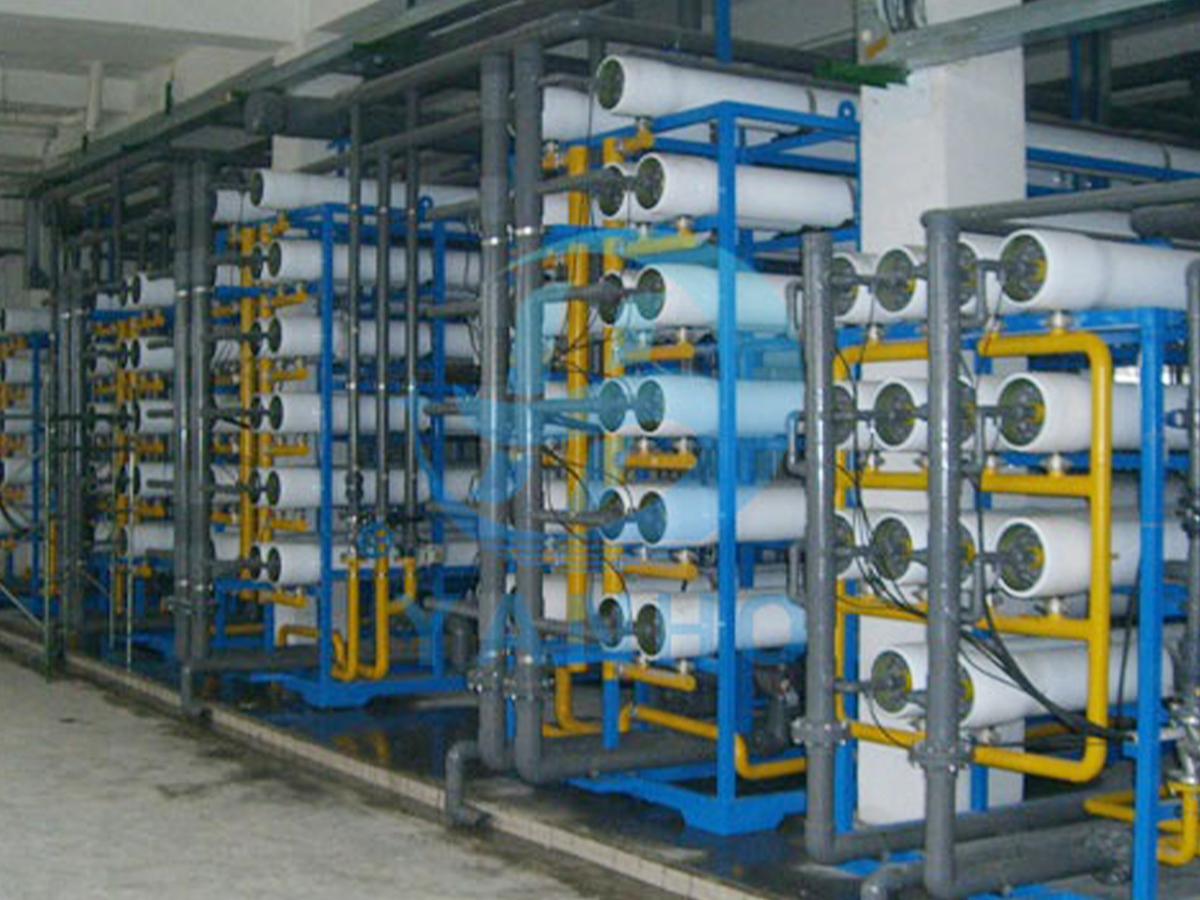
Industrial pure water equipment is a water treatment system designed to reduce unwanted substances in raw water and produce treated water for industrial use. The exact meaning of “pure water” depends on where the water will be used.
For some factories, the goal may simply be to reduce suspended solids, hardness, salts, and other substances that could affect production. For other applications, much cleaner water may be required. Electronics and semiconductor manufacturing, for example, can require carefully controlled high-purity water because contaminants can affect manufacturing processes and product yield. ASTM D5127 provides recommendations for high-purity water used in electronics and semiconductor manufacturing and emphasizes that required water quality depends on the manufacturing process.ASTM D5127
This is an important point when selecting an industrial water purification system: the equipment should be designed around the required water quality rather than simply choosing the largest or most complicated system.
A typical system may contain several treatment stages. Pretreatment can remove larger particles and protect downstream equipment. Filtration can further reduce suspended materials. Reverse osmosis can reduce dissolved salts and many other contaminants. Additional polishing or disinfection stages may be added when the application requires them.
According to the U.S. EPA, reverse osmosis is a pressure-driven membrane process in which water passes through a semipermeable membrane, producing treated water and a concentrate stream. RO can be used to remove many dissolved contaminants and is also applied to brackish and seawater treatment.EPA
For this reason, reverse osmosis is often an important part of an Industrial Pure Water Equipment system, but it is not automatically the correct answer for every water treatment project. Pretreatment, post-treatment, water storage, disinfection, and monitoring can all influence the final result.
The working process is easier to understand if we look at it as a series of steps rather than a single machine. Each stage has a specific job. The purpose is to reduce the burden on the next stage and keep the whole system working steadily.
Before equipment selection, we first need to understand the raw water. Important information may include total dissolved solids, hardness, turbidity, pH, iron, manganese, organic matter, microbial conditions, temperature, and other parameters related to the water source.
The water source could be municipal water, groundwater, surface water, reclaimed water, or another industrial source. Different sources create different treatment challenges.
This is why a good Industrial Pure Water Treatment System should not be selected only by looking at the desired output volume. Two factories may both require 20 cubic meters of pure water per hour but still need different treatment processes because their incoming water is different.
Pretreatment is usually the first practical treatment stage. Depending on the raw water, this part can include multimedia filtration, activated carbon filtration, cartridge filtration, softening, dosing, or other suitable processes.
The basic idea is simple: protect the more sensitive equipment later in the system.
For example, suspended particles can cause problems for pumps and membrane systems. Hardness can contribute to scaling. Chlorine or other oxidizing substances may affect certain membrane materials. By dealing with these issues before the main purification stage, the system can operate more reliably.
Reverse osmosis, commonly called RO, uses pressure to force water through a semipermeable membrane. The membrane allows water to pass while rejecting a large portion of dissolved substances.
WHO describes reverse osmosis as a high-pressure membrane process that produces a treated water stream and a more concentrated waste stream. WHO also notes that RO is commonly used for brackish water and seawater desalination.WHO
In an industrial pure water application, RO can therefore serve as a major purification stage. However, RO performance depends on feed-water quality, operating conditions, membrane selection, pretreatment, temperature, pressure, and other design factors.
After RO, the water may already meet the needs of some applications. In other cases, additional treatment is required.
Depending on the project, post-treatment can include UV disinfection, ozone, polishing filtration, ion exchange, electrodeionization, or other technologies. Storage tanks and circulation loops may also be required where the treated water must be supplied continuously to production equipment.
We select these stages according to the final application instead of adding equipment simply to make the system look more complicated.
A general industrial pure water process may look like this:
Raw Water → Pretreatment → Fine Filtration → High-Pressure Pump → RO → Post-Treatment → Pure Water Tank → Distribution
This is only a general example. The actual process can be changed according to water analysis and production requirements.
When customers compare different Industrial Pure Water Equipment suppliers, we recommend looking beyond the equipment appearance. A water treatment system can look simple from the outside, but the process design inside determines how well it works in daily production.
We can adjust the treatment process according to raw water quality, required capacity, water quality target, available installation space, and the customer's production process.
This approach is particularly useful for factories where water quality requirements are different from common commercial applications. Instead of forcing the project into a fixed configuration, we start with the actual requirements and then determine the appropriate equipment combination.
Water treatment equipment often works in a wet environment, and some projects involve high-salinity water or aggressive operating conditions. Material selection therefore matters.
Depending on the water quality and process requirements, suitable stainless steel, plastic piping, membrane housings, valves, pumps, and other components can be selected. For special water conditions, the material selection should be confirmed during engineering design.
Industrial users usually care about more than initial water quality. They also need equipment that can run steadily during normal production.
We therefore pay attention to pretreatment, pump selection, pressure control, membrane protection, flow arrangement, instrumentation, and maintenance access. These details may not be obvious when looking at product photos, but they make a difference after the system has been installed in a factory.
Depending on the project, automatic controls can be used to monitor and manage pumps, valves, pressure, flow, water levels, alarms, and other operating conditions.
The automation level can be adjusted according to the customer's operating habits and budget. A small industrial system may not need the same control architecture as a large continuous-production facility.
Available space is often a practical problem in industrial projects. Equipment may need to be installed in an existing workshop, utility room, outdoor area, container, or specially prepared equipment room.
For this reason, we consider equipment arrangement, maintenance space, pipe connections, electrical requirements, and transportation conditions during the design stage.
Choosing an Industrial Pure Water Equipment system should start with the water, not the machine name. A few basic technical questions can prevent many problems later.
| Selection Factor | Why It Matters | Typical Information Needed |
|---|---|---|
| Raw water source | Different sources contain different impurities | Municipal water, groundwater, surface water, seawater, reclaimed water |
| Water quality | Determines treatment process and equipment selection | TDS, hardness, turbidity, pH, conductivity, microbial indicators |
| Required capacity | Determines equipment size and system arrangement | m³/h, m³/day, peak demand |
| Required product water quality | Defines how many treatment stages are needed | Conductivity, resistivity, TDS, microbial control and process-specific limits |
| Operating schedule | Affects storage and control strategy | Continuous operation, batch operation, working hours |
| Installation conditions | Affects equipment layout and transportation | Available area, height, access, power and drainage |
Source: General engineering selection framework based on water-treatment practice; WHO and EPA guidance emphasize that treatment requirements depend on source-water conditions, treatment objectives, and application context.WHOEPA
For electronics and semiconductor applications, the requirements can become much more demanding. ASTM D5127 gives different high-purity water classifications and notes that requirements are related to the manufacturing process and the point of distribution.ASTM D5127
| Water Quality Example | Resistivity at 25°C | TOC Example | Application Context |
|---|---|---|---|
| ASTM D5127 Type E-1 | 18.1 MΩ·cm | 5 μg/L | Electronics and semiconductor manufacturing |
| ASTM D5127 Type E-1.1 | 18.2 MΩ·cm | 2 μg/L | Higher-purity electronics applications |
| ASTM D5127 Type E-1.2 | 18.2 MΩ·cm | 1 μg/L | Higher-purity semiconductor processes |
| ASTM D5127 Type E-1.3 | 18.2 MΩ·cm | 1 μg/L | Very high-purity semiconductor applications |
Source: ASTM D5127-13(2018), Standard Guide for Ultra-Pure Water Used in the Electronics and Semiconductor Industries. The values above are examples from the standard and should not be treated as universal requirements for every factory.ASTM D5127
This table also shows why we do not recommend selecting a system simply by saying “I need pure water.” The customer should first define what “pure” means for the production process.
Industrial pure water equipment can be used across many industries. The treatment process changes according to the application, but the basic goal is similar: provide water with controlled quality for a specific production need.
Electronics manufacturing is one of the industries where water quality can be particularly important. Water may be used for rinsing, cleaning, etching, and other manufacturing processes.
ASTM D5127 specifically addresses high-purity water used in electronics and semiconductor manufacturing and explains that contamination control is important because impurities can affect manufacturing yield.ASTM D5127
For these projects, an industrial reverse osmosis water system may be only one part of a more complete high-purity water solution. Additional polishing and monitoring stages may be required depending on the production process.
Pharmaceutical production and laboratory work can have strict requirements for water quality. The exact requirements depend on the product, process, local regulations, and internal quality standards.
In these applications, we focus on understanding the water specification first and then selecting suitable purification, storage, circulation, and monitoring equipment.
Water is used directly or indirectly in many food and beverage processes. It may be used for ingredient preparation, washing, cleaning, production, or other plant operations.
When treated water comes into contact with products, the applicable local food and water requirements need to be considered. WHO's drinking-water guidance provides a broad framework for managing water safety and emphasizes the importance of context-specific risk management.WHO
Chemical plants and other industrial facilities may need treated water for process production, equipment cleaning, cooling systems, or boiler-related applications.
Here, the most suitable system depends heavily on the process. Some users need low-salt water, while others may focus on hardness control or specific contaminants. This is why a customized industrial water purification system can be more practical than a one-size-fits-all unit.
Hotels, commercial buildings, and service facilities may use treated water for drinking-water production, equipment protection, laundry, cleaning, or other purposes.
For these projects, system size and automation level can often be selected according to daily demand and operating staff. Where space is limited, compact layouts can also be considered.
Our wider water-treatment business also includes seawater desalination. In coastal or island projects, the raw water may contain high salt levels, so seawater RO or another desalination process may be needed before further purification.
WHO notes that desalination systems can be used for water supply in locations such as ships and hot or arid regions, while also emphasizing the need to consider the characteristics of desalinated water and the treatment process.WHO
For an industrial water treatment project, the delivery of the equipment is only one part of the job. The system also needs to be properly designed, assembled, checked, transported, installed, and commissioned.
We begin with the customer's water source, water analysis, required production capacity, target water quality, installation conditions, and operating requirements.
Based on these details, we determine the appropriate treatment process and equipment configuration. If the raw water analysis is incomplete, additional water-quality information may be requested before final equipment selection.
After the process and configuration are confirmed, the equipment can be manufactured and assembled according to the project requirements.
The system may include pretreatment vessels, filters, pumps, RO equipment, valves, control components, storage tanks, pipework, instruments, and other supporting components.
Material selection and component specifications are confirmed according to the actual project rather than assuming that every customer needs the same configuration.
Before shipment, the equipment is assembled and checked. Depending on the system, inspection may include pipe connections, electrical wiring, pump operation, control functions, pressure conditions, instrument readings, and other relevant items.
We also prepare technical documents and operating information so that customers have practical references when installing and using the system.
The production period of an Industrial Pure Water Equipment system depends on the project size and configuration.
Standard equipment with a relatively simple configuration generally has a shorter delivery cycle. Customized projects require additional time for process design, equipment configuration, manufacturing, assembly, testing, and customer confirmation.
For this reason, we prefer to confirm the complete technical configuration before giving a final delivery schedule.
After inspection, equipment is prepared for transportation according to its dimensions and delivery method.
Depending on the equipment size and destination, transportation can be arranged by road, sea, or multimodal transport. Wooden cases, pallets, or containers can be used according to the equipment structure and shipping requirements.
Large or heavy components require additional reinforcement to reduce movement and impact during transportation. The packaging plan is therefore considered together with the equipment dimensions and shipping route.
| Project Stage | Main Work | Customer Output |
|---|---|---|
| Requirement confirmation | Water source, capacity, application and site review | Basic technical requirements |
| Process design | Treatment process and equipment configuration | Process proposal and equipment list |
| Manufacturing | Component production and system assembly | Configured treatment equipment |
| Inspection | Assembly, operation and quality checks | Inspection and technical documents |
| Packaging | Reinforcement and protection | Shipment-ready equipment |
| Installation and commissioning | Connection, adjustment and operation testing | Operational treatment system |
Source: Project workflow based on our supplied engineering and delivery process. Specific inspection, documentation, installation, and commissioning items are confirmed according to the individual contract and equipment configuration.
Choosing a water treatment supplier is not only about comparing equipment prices. In our experience, the more important question is whether the supplier understands the water problem behind the equipment.
Qingdao Yanhui Environmental Protection Technology Co., Ltd. was established in 2015. Our business focuses on water treatment technologies including seawater desalination, high-salinity wastewater treatment, concentration and purification, and industrial wastewater treatment.
This background gives us practical experience with different water conditions. It also shapes the way we approach pure water projects: first understand the water, then determine the treatment process, and finally select the equipment.
We provide customized water treatment equipment rather than simply offering a fixed machine model for every application.
For an Industrial Pure Water Equipment project, customization can involve treatment stages, equipment capacity, materials, pumps, membranes, control systems, storage, piping arrangement, and installation layout.
Our services cover R&D, process design, equipment manufacturing, installation, commissioning, operation, and maintenance. The exact service scope depends on the project contract.
This means customers can discuss the water problem with us from the early design stage instead of trying to combine unrelated equipment themselves.
A treatment system should be understandable and maintainable after it reaches the factory. We therefore pay attention to equipment arrangement, maintenance access, operating controls, technical documentation, and spare-part considerations.
Good engineering is not only about getting the system to work on the day of commissioning. It is also about making daily operation easier for the people who will actually use the equipment.
Payment terms can be arranged according to the project contract, such as an advance payment, shipment payment, and balance payment. The exact arrangement depends on the project value, equipment configuration, and agreed commercial terms.
Production and delivery schedules are confirmed after technical specifications are finalized. This helps both sides avoid misunderstandings caused by changing requirements during manufacturing.
Filtered water may only have suspended particles and some other substances reduced. Pure water treatment normally involves additional processes designed to reduce dissolved salts and other contaminants. The exact water quality depends on the treatment process and final application.
Not always. RO is widely used because it can reduce many dissolved contaminants, but whether it is required depends on raw water quality and the target water quality. Some systems may use filtration only, while higher-purity applications may require RO followed by additional polishing stages.
Start with four basic pieces of information: raw water source, raw water analysis, required treated-water quality, and required water production capacity. Installation space, operating hours, electrical conditions, and budget are also useful when preparing the design.
Yes. We can customize the treatment process and equipment configuration according to water quality, production capacity, site conditions, and application requirements. Customized projects require technical confirmation before the final quotation and delivery schedule.
There is no single production period for every project. Standard equipment generally requires less manufacturing time, while customized systems require additional time for engineering design, component confirmation, manufacturing, assembly, testing, and documentation.
Transportation can be arranged by land, sea, or multimodal transport. The appropriate method depends on the destination, equipment dimensions, weight, and delivery conditions. Wooden cases, pallets, and containers can be used with additional reinforcement when necessary.
The documentation depends on the project. Typical project documents may include equipment information, operating instructions, technical specifications, inspection records, and other agreed technical materials.
Yes. Installation and commissioning services can be included according to the project requirements and contract. The specific scope should be confirmed before the project starts.
Water treatment equipment must be designed and operated according to the intended use. Drinking-water applications have their own safety and regulatory requirements. WHO's current drinking-water guidance provides a framework for managing health risks and developing locally applicable water-quality requirements.WHO
Therefore, an industrial pure water system should not automatically be described as a drinking-water system simply because it produces low-TDS or treated water. The application, treatment process, materials, disinfection, monitoring, and applicable local regulations all need to be considered.
A reliable Industrial Pure Water Equipment system starts with a clear understanding of the water and the production process. There is no universal equipment configuration that fits every factory.
For some applications, a basic filtration system may be enough. For others, reverse osmosis is an important purification stage. More demanding applications may require additional polishing, disinfection, storage, circulation, and online monitoring.
At Qingdao Yanhui Environmental Protection Technology Co., Ltd., we approach each project from the actual water-treatment requirement. Since 2015, our work has focused on seawater desalination, high-salinity wastewater treatment, concentration and purification, and industrial wastewater treatment. We use this engineering background to develop customized water treatment solutions for different industrial conditions.
From initial process design to equipment manufacturing, assembly, inspection, delivery, installation, commissioning, operation, and maintenance, we can support the project according to the agreed scope. For customers looking for an industrial pure water treatment system, industrial reverse osmosis water system, or customized Industrial Water Purification Equipment, the first step is to define the water source, required capacity, target water quality, and site conditions.
Once these details are clear, the equipment configuration becomes much easier to determine. That is also how we prefer to work: practical requirements first, engineering design second, and equipment selection based on the actual project.
World Health Organization, Guidelines for Drinking-water Quality, including information on water quality management and treatment technologies.WHO
U.S. Environmental Protection Agency, information on reverse osmosis and nanofiltration as membrane separation processes.EPA
ASTM International, ASTM D5127-13(2018), Standard Guide for Ultra-Pure Water Used in the Electronics and Semiconductor Industries.ASTM
Note: Technical data and treatment performance should be confirmed against the actual raw-water analysis, process requirements, applicable standards, and final equipment configuration. Reference values from standards and public technical guidance are provided for engineering context and should not be treated as a performance guarantee for a specific project.
This website uses cookies to ensure you get the best experience on our website.
 Portugues
 Pусский
 Français
 العربية
 ไทย
ไทย Indonesia
 Melayu
 Tiếng Việt
 中文
中文 қазақ
қазақ עִברִית
 မြန်မာ
 ພາສາລາວ
 Filipino
 o'zbek
 Кыргызча
 тоҷикӣ
 ខ្មែរ
ខ្មែរ Türkmenler



 Phone
Phone