

| UC BW-8040-400 FR/34 | ||||||||||
| Brand Name | Membrane series | Membrane element diameter | Membrane element length | Effective membrane area | Film properties | Flow channel network | ||||
| abbreviation | BW: Brackish water; SW: Seawater | 80:8.0 inches 40:4.0 inches | 40:40 inches | 440:440ft² 400:400ft² 365:365ft² 82:82ft² | HR: High desalination; HRLE: High desalination, low energy consumption; XHR: Ultra-high desalination; FR: Anti-fouling ; XFR : Ultra-anti-fouling ; XLE : Ultra-low energy consumption; FRLE: Anti-fouling, low energy consumption; HRFR: High desalination, anti-fouling. | 28:28mil 34:34mil | ||||
| Performance overview of Seawater Desalination Reverse Osmosis Membrane Elements | ||||||||||
| Membrane element type | Membrane type | Effective membrane area ft2 (m2) | Average water production (gpd, m³/d) | Minimum desalination rate (%) | Stable desalination rate (%) | Stable boron removal rate (%) | Test conditions | |||
| Test pressure psi (MPa) | Test solution concentration NaCl (ppm) | Recovery rate (%) | ||||||||
| High desalination rate | UC SW-8040-400HR | 400(37.2) | 6500(24.5) | 99.65 | 99.8 | 92 | 800(5.5) | 32000 | 8 | |
| UC SW-4040-82HR | 82(7.6) | 1320(5) | 99.6 | 99.75 | / | |||||
| High desalination and low energy consumption | UC SW-8040-400HRLE | 400(37.2) | 7400(28) | 99.65 | 99.8 | 92 | ||||
| UC SW-8040-440HRLE | 440(41) | 7900(30) | 99.65 | 99.8 | 92 | |||||
| UC SW-4040-82HRLE | 82(7.6) | 1600(6.1) | 99.6 | 99.7 | / | |||||
| Ultra-high desalination rate | UC SW-8040-400XHR | 400(37.2) | 6100(23) | 99.7 | 99.82 | 92 | ||||
| UC SW-8040-440XHR | 440(41) | 6600(25) | 99.7 | 99.82 | 92 | |||||
| Ultra-low energy consumption | UC SW-8040-400XLE | 400(37.2) | 9000(34) | 99.6 | 99.8 | 92 | ||||
| UC SW-8040-440XLE | 440(41) | 9750(37) | 99.6 | 99.8 | 92 | |||||
| UC SW-4040-82XLE | 82(7.6) | 1660(6.3) | 99.6 | 99.65 | / | |||||
| High desalination and pollution resistance | UC SW-8040-400HRFR/34 | 400(37) | 7400(28) | 99.65 | 99.8 | 92 | ||||
| Performance overview of industrial-grade brackish water reverse osmosis membrane elements | ||||||||||
| Membrane element type | Membrane type | Effective membrane area ft2 (m2) | Average water production (gpd, m³/d) | Minimum desalination rate (%) | Stable desalination rate (%) | Test pressure psi (MPa) | Test solution concentration NaCl (ppm) | Recovery rate (%) | ||
| Industrial brackish water | UC BW-8040-400HR | 400(37.2) | 11350(43) | 99.4 | 99.7 | 225(1.55) | 2000 | 15 | ||
| UC BW-8040-440HR | 440(41) | 12560(48) | 99.4 | 99.7 | ||||||
| UC BW-4040-82HR | 82(7.6) | 2250(8.6) | 99.3 | 99.5 | ||||||
| Anti-pollution | UC BW-8040-400FR/34 | 400(37.2) | 11100(42) | 99.35 | 99.5 | |||||
| UC BW-4040-82FR/34 | 82(7.6) | 2000 (7.6) | 99.3 | 99.5 | ||||||
| Super pollution resistant | UC BW-8040-400XFR/34 | 400(37.2) | 11350 (43) | 99.4 | 99.6 | |||||
| UC BW-4040-82XFR/34 | 82(7.6) | 2050(7.8) | 99.4 | 99.6 | ||||||
| Pollution-resistant and low-energy consumption | UC BW-8040-400FRLE/34 | 400(37.2) | 10500 (40) | 99.1 | 99.3 | |||||
| UC BW-4040-82FRLE/34 | 82(7.6) | 1900(7.2) | 99 | 99.3 | ||||||
| High desalination and low energy consumption | UC BW-8040-400HRLE | 400(37.2) | 11350 (43) | 99.1 | 99.3 | 150(1.03) | 1500 | |||
| UC BW-8040-440HRLE | 440(41) | 12560(48) | 99.1 | 99.3 | ||||||
| UC BW-4040-82HRLE | 82(7.6) | 2250(8.5) | 99 | 99.3 | ||||||
| Ultra-low energy consumption | UC BW-8040-400XLE | 400(37.2) | 12550 (47.5) | 98 | 99 | 125(0.86) | 500 | |||
| UC BW-8040-440XLE | 440(41) | 14000(53) | 98 | 99 | ||||||
| UC BW-4040-82XLE | 82(7.6) | 2400(9.1) | 98 | 99 | ||||||
| UC ULP-8040-400 | ||||||||
| Brand Name | Membrane series | Membrane element diameter | Membrane element length | Effective membrane area | ||||
| abbreviation | LP: Low voltage | 80:8.0 inches | 40:40 inches | 440:440ft 2 | ||||
| ULP: Low Energy Consumption | 40:4.0 inches | 21:21 inches | 400:400ft 2 | |||||
| XLP: Ultra-low energy consumption | 25:2.5 inches | 82:82ft 2 | ||||||
| Performance overview of brackish water membrane elements | ||||||||
| Membrane element type | Membrane type | Effective membrane area ft³ ( m² ) | Average water production gpd (m³ / d) | Minimum desalination rate (%) | Stable desalination rate (%) | Test conditions | ||
| Test pressure psi (MPa) | Test solution concentration NaCl (ppm) | Recovery rate (%) | ||||||
| low pressure | UC LP-4040-82 | 82(7.6) | 2250 (8.6) | 99.3 | 99.6 | 225 (1.55) | 2000 | 15 |
| UC LP-8040-400 | 400 (37.2) | 11100(42) | 99.3 | 99.6 | ||||
| Ultra-low pressure | UC ULP-4040-82 | 82(7.6) | 2250 (8.6) | 99 | 99.5 | 150 (1.03) | 1500 | 15 |
| UC ULP-8040-400 | 400 (37.2) | 11350(43) | 99 | 99.5 | ||||
| UC ULP-8040-440 | 440(41) | 12650(48) | 99 | 99.5 | ||||
| Extremely low pressure | UC XLP-4040-82 | 82(7.6) | 2220(8.4) | 98 | 99 | 100 (0.69) | 500 | 15 |
| UC XLP-8040-400 | 400 (37.2) | 11900(45) | 98 | 99 | ||||
| UC XLP-8040-440 | 440(41) | 13200(50) | 98 | 99 | ||||
| Commercial membrane element performance overview | ||||||||
| Membrane element type | Membrane type | Effective membrane area ft² ( m² ) | Average water production gpd (m³ / d) | Minimum desalination rate (%) | Stable desalination rate (%) | Test conditions | ||
| Test pressure psi (MPa) | Test solution concentration NaCl (ppm) | Recovery rate (%) | ||||||
| Commercial seawater desalination | UC SW-2540-28HR | 28(2.6) | 580(2.2) | 99.55 | 99.7 | 800(5.5) | 32000 | 8 |
| UC SW-4021-33HR | 33(3.1) | 660(2.5) | 99.55 | 99.65 | 5 | |||
| UC SW-2521-12HR | 12(1.1) | 240(0.9) | 99.5 | 99.6 | 8 | |||
| UC SW-2540-28HRLE | 28(2.6) | 680(2.6) | 99.5 | 99.65 | 5 | |||
| UC SW-4021-33HRLE | 33(3.1) | 790(3) | 99.5 | 99.6 | ||||
| UC SW-2521-12HRLE | 12(1.1) | 290(1.1) | 99.4 | 99.55 | ||||
| UC NF-90-8040-400/34 | |||||||
| Brand Name | Membrane series | Effective molecular weight cutoff | Membrane element diameter | Membrane element length | Effective membrane area | Flow channel width | |
| abbreviation | nanofiltration | 90 | 80:8.0 inches | 40:4.0 inches | 400:400ft² | 28:28mil | |
| 150 | 40:4.0 inches | 82:82 ft² | 34:34mil | ||||
| 280 | 25:2.5 inches | ||||||
| 500 | |||||||
| Nanofiltration membrane element performance overview | |||||||
| Membrane element type | Membrane type | Effective membrane area ft² ( m² ) | Average water production gpd (m² / d) | Stable desalination rate (%) | Test conditions | ||
| Test pressure psi (MPa) | Test solution concentration (ppm) | Recovery rate (%) | |||||
| 90 series | UC NF90-400 | 400 (37.2) | 8200(31) | >98.5 | 70 (0.48) | 2000ppm MgSO4 | 15 |
| UC NF90-82 | 82(7.6) | 1580 (6) | >98.5 | ||||
| 150 series | UC NF150-400/34 | 400 (37.2) | 8950(34) | >98 | |||
| UC NF150-82 | 82(7.6) | 1850(7) | >98 | ||||
| 280 series | UC NF280-400 | 400 (37.2) | 12410(47) | >97 | |||
| UC NF280-82 | 82(7.6) | 2430(9.2) | >97 | ||||
| 500 series | UC NF500-400 | 400 (37.2) | 13200(50) | >90 | |||
| UC NF500-82 | 82(7.6) | 2900(11) | >90 | ||||
Industrial Brackish Water RO Membranes for Industrial Water Treatment and Desalination
When I talk with customers about brackish water treatment, one question comes up again and again: which RO membrane should we use? It sounds like a simple question, but in real projects, the answer depends on much more than the membrane itself.
Brackish water can come from shallow wells, coastal groundwater, rivers affected by saltwater intrusion, industrial water sources, or other underground water systems. Its salt level may be much lower than seawater, but that does not mean it is easy to treat. Iron, manganese, hardness, silica, organic matter, suspended solids and seasonal changes in water quality can all affect the performance and service life of an RO membrane.
At Qingdao Yanhui Environmental Protection Technology Co., Ltd., we approach Industrial Brackish Water RO Membranes as one part of a complete water treatment system. We look at the raw water first, then determine pretreatment, membrane selection, system capacity, recovery, cleaning requirements and final water use.
This approach is especially important for industrial customers. A membrane that looks good on a product data sheet may not be the right choice for a particular well, factory or water reuse project. Good membrane selection starts with understanding the water.
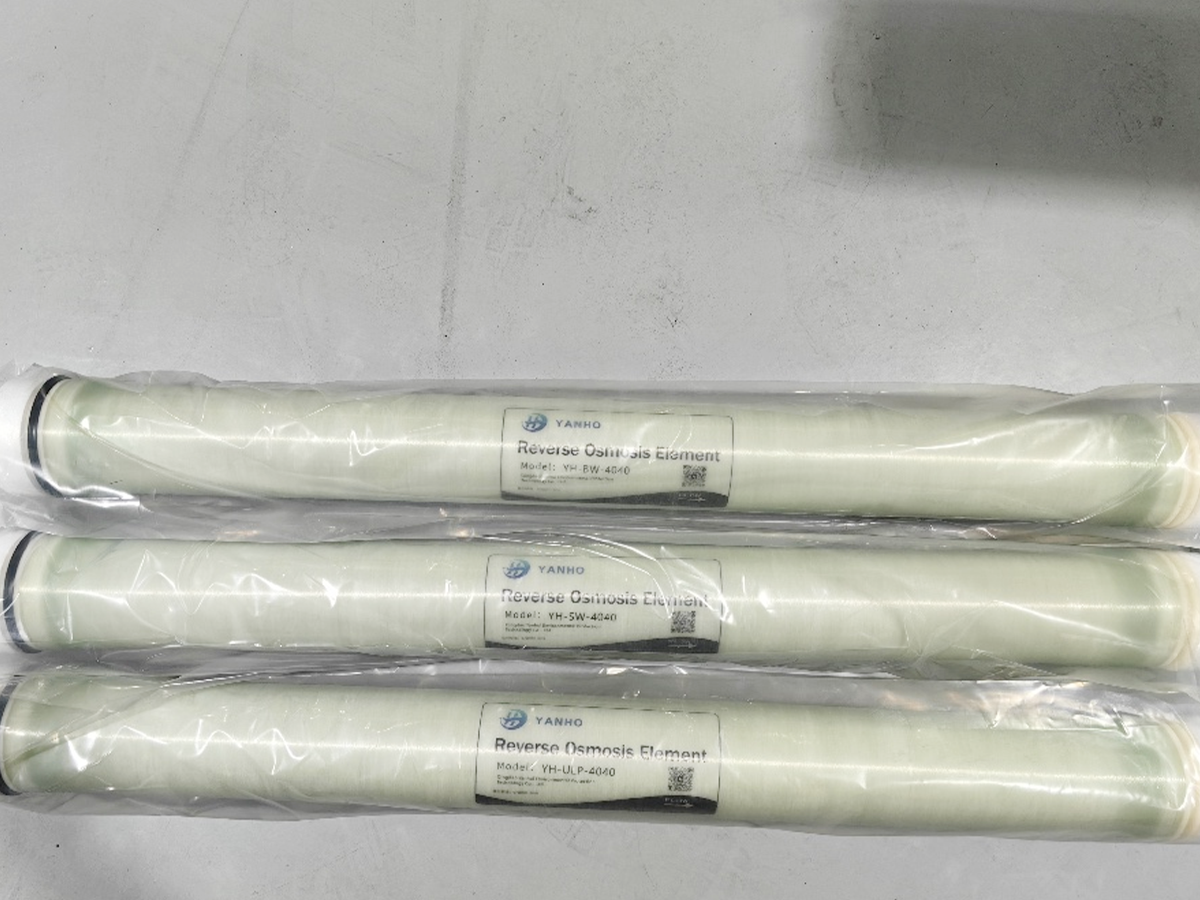
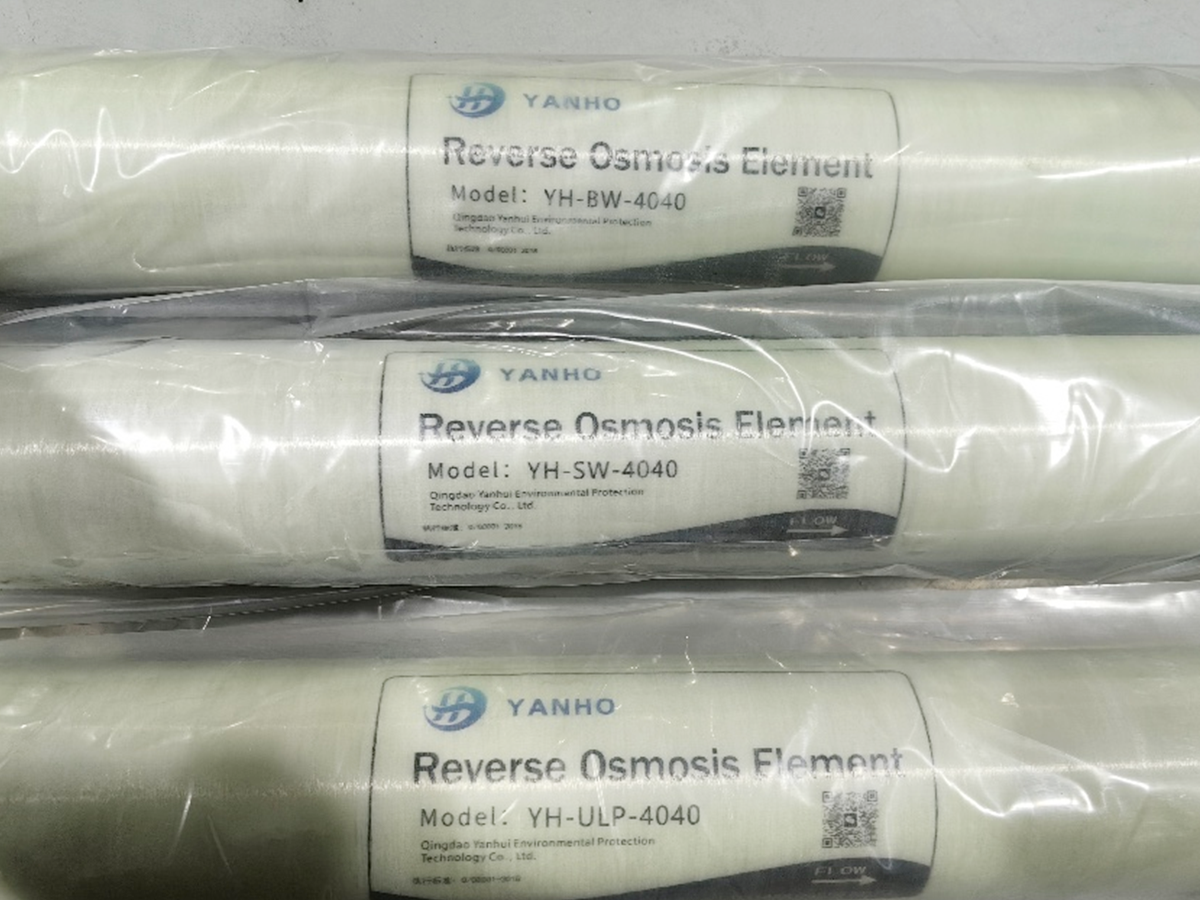
Industrial Brackish Water RO Membranes are Reverse Osmosis Membrane Elements designed for treating water that contains a higher concentration of dissolved salts than typical freshwater but generally requires different operating conditions from Seawater Desalination.
In an RO system, pressure is applied to the feed water. Water passes through the semi-permeable membrane, while a large portion of dissolved salts and other dissolved substances are retained in the concentrated stream. The result is a permeate stream with a much lower dissolved-solids concentration.
According to the World Health Organization, reverse osmosis is commonly used for desalination of both brackish water and seawater. WHO also notes that RO systems can reject many dissolved substances, although the rejection performance depends on the membrane and the substances being treated.
That last point is important. I do not recommend describing an RO membrane as a device that simply “removes everything.” Different compounds behave differently during membrane treatment. Some substances may have lower rejection than others, and pretreatment can have a major influence on final performance.
For industrial applications, we therefore consider the membrane together with the complete process. A typical system may include:
Raw water intake
Raw water storage
Multimedia filtration
Activated carbon filtration when required
Iron and manganese removal
Antiscalant dosing or other scale-control measures
Cartridge filtration
High-pressure pump
Brackish water RO membrane vessels
Permeate storage
Post-treatment and disinfection
Concentrate discharge or further treatment
The membrane is the heart of the RO stage, but the equipment around it determines how well that heart can work over time.
The basic principle is easier to understand than many people expect.
Imagine that brackish water contains dissolved salts that we do not want in the final water. A normal filter can catch sand, rust and other larger particles, but dissolved salts are much smaller. An RO membrane uses pressure to separate water from many of these dissolved substances.
The feed water enters the RO system after pretreatment. A high-pressure pump increases the pressure of the water. The pressurized water flows across the membrane surface. Part of the water passes through the membrane as permeate, while the remaining water carries a higher concentration of rejected substances and leaves as concentrate.
A simplified process looks like this:
Brackish Water → Pretreatment → Cartridge Filter → High-Pressure Pump → RO Membrane → Permeate + Concentrate
The quality of the final permeate depends on several factors, including feed-water composition, pressure, temperature, recovery, membrane type, membrane age and system design.
DuPont's technical manual explains that RO rejection is influenced by membrane type, feed composition, temperature and system design. Its published technical material gives typical RO salt-rejection ranges from approximately 95% to above 99%, depending on these factors.
For this reason, we normally treat published membrane rejection figures as reference values rather than a guarantee for every installation.
One of the most common mistakes in water treatment projects is focusing heavily on the RO membrane while paying too little attention to pretreatment.
For example, if raw well water contains a high level of iron and manganese, putting an RO membrane directly after a basic cartridge filter is usually not a sensible design. The upstream treatment should first address the substances that can cause fouling or scaling.
Depending on the raw water analysis, pretreatment may include multimedia filtration, activated carbon, iron and manganese removal, softening, chemical dosing, ultrafiltration or other processes.
In practical projects, I prefer to say that the membrane should be protected, not simply “used.” A well-protected membrane is easier to operate, easier to clean and more predictable over its service life.
Not every water treatment problem requires RO. Before selecting an Industrial Brackish Water RO Membrane, we first need to understand what the customer wants to remove.
RO is especially useful when dissolved salts and total dissolved solids are a major concern. UF and MF are generally more focused on suspended solids, colloids, microorganisms and larger particles, while NF sits between RO and UF in terms of separation characteristics.
| Technology | Typical Function | Typical Pressure Range | Common Application |
|---|---|---|---|
| Microfiltration (MF) | Particle and suspended-solid removal | About 1–2 bar | Particle removal and pretreatment |
| Ultrafiltration (UF) | Removal of larger colloids and organic molecules | Generally below 5 bar | Water clarification and RO pretreatment |
| Nanofiltration (NF) | Removal of many divalent ions and selected organics | About 5 bar | Softening and selective separation |
| Reverse Osmosis (RO) | Reduction of dissolved salts and many dissolved contaminants | Application dependent; commonly higher than NF | Brackish water desalination and water purification |
Source: World Health Organization, Guidelines for Drinking-water Quality treatment-method information. Actual operating pressure varies according to feed water, membrane type and system design.
This comparison is useful when discussing a new project because it prevents us from selecting a membrane technology simply because it is popular.
If the main problem is turbidity and suspended solids, UF may be more appropriate as a treatment stage. If the main issue is dissolved salt, RO is usually the more relevant technology. In some systems, the technologies are combined rather than used separately.
When we select industrial RO Membrane Elements, I normally pay attention to several practical factors rather than looking at one specification in isolation.
The primary purpose of a brackish water RO membrane is to reduce dissolved salts. Commercial membrane products can achieve very high salt rejection under specified test conditions.
For example, DuPont's published BWRO product information lists representative stabilized salt rejection values of approximately 99.55% to 99.80% for several FilmTec brackish-water elements under specified test conditions. These values are based on controlled conditions such as 2,000 ppm NaCl feed, specified pressure, temperature, pH and recovery.
This is why I always recommend checking the actual test conditions behind a membrane specification. A 99.8% figure without the test conditions does not tell the whole story.
Salt rejection is important, but water production is also important. Industrial users need a membrane system that can produce the required amount of permeate within the available operating window.
Membrane productivity is affected by temperature, feed pressure, feed concentration, recovery and membrane condition. As the water temperature changes, permeate flow can change as well. Fouling and scaling can also reduce productivity over time.
Energy consumption is an important operating cost in RO plants. Some modern brackish-water membrane products are designed for lower-pressure operation while maintaining useful salt rejection.
DuPont, for example, publishes low-energy brackish-water elements with test conditions at lower pressure than some conventional BWRO elements. Its technical information shows representative low-energy products tested at approximately 8.6–10.3 bar, depending on the element.
Actual plant pressure should never be copied directly from a product brochure. It needs to be calculated from feed-water quality, temperature, recovery, membrane arrangement and required permeate flow.
Industrial water is rarely as clean as laboratory test water. Real feed water may contain organic matter, colloids, silica, microorganisms, hardness and other substances.
A membrane that is easier to clean can be useful in projects where feed-water quality changes over time. Proper pretreatment remains the first line of defense, but membrane cleaning capability provides another practical layer of protection.
Industrial RO systems use different membrane element sizes according to plant capacity and membrane housing configuration. Smaller elements can be useful in compact commercial systems, while larger elements are commonly used in industrial and municipal installations.
DuPont's published product information, for example, distinguishes 4-inch and 8-inch brackish-water RO elements for different system sizes. Its 8-inch BWRO products are positioned for larger industrial and municipal treatment systems, while smaller elements are used in lower-capacity systems.
When comparing membrane products, I recommend looking at the complete test condition rather than comparing one number.
The following table gives several representative values published by DuPont for brackish-water RO elements. They are included as reference data, not as guaranteed performance for every project.
| Representative Element | Permeate Flow | Active Membrane Area | Stabilized Salt Rejection | Published Test Pressure |
|---|---|---|---|---|
| BW30 PRO-365 | 10,000 GPD / 37.9 m³/day | 365 ft² / 34 m² | 99.55% | 225 psi / 15.5 bar |
| BW30 PRO-400 | 11,000 GPD / 41.6 m³/day | 400 ft² / 37 m² | 99.60% | 225 psi / 15.5 bar |
| BW30HR-440 | 12,650 GPD / 47.9 m³/day | 440 ft² / 41 m² | 99.70% | 225 psi / 15.5 bar |
| BW30XHR PRO-440 | 12,650 GPD / 47.9 m³/day | 440 ft² / 41 m² | 99.80% | 225 psi / 15.5 bar |
Source: DuPont FilmTec Brackish Water Reverse Osmosis Solutions. Published standard test conditions include 2,000 ppm NaCl, 225 psi, 25°C, pH 8 and 15% recovery.
These numbers show why membrane selection is not simply about choosing the product with the highest rejection number.
For example, a project may have a lower required permeate flow but a difficult feed-water condition. Another project may prioritize lower operating pressure and energy consumption. A third project may need a larger membrane area because the available installation space or system configuration is different.
We therefore look at membrane performance together with the actual water analysis and plant requirements.
Before recommending an Industrial Brackish Water RO Membrane, I normally want to understand six basic things.
Is it groundwater, shallow well water, surface water, industrial wastewater or another source?
This matters because two water sources with similar TDS values can behave very differently. One may contain high hardness, while another may contain iron, manganese or organic matter.
TDS gives us a useful starting point. It tells us approximately how much dissolved material is present in the water.
However, TDS alone is not enough for membrane selection. A proper water analysis should ideally include hardness, alkalinity, silica, iron, manganese, chloride, sulfate, pH, turbidity, conductivity and other relevant parameters depending on the application.
Capacity is normally expressed in m³/day or m³/h. We need to know both the average demand and the peak demand.
For example, a factory requiring 200 m³/day of permeate should not automatically be designed around exactly 200 m³/day. Operating hours, maintenance periods, seasonal demand, membrane performance decline and storage capacity should all be considered.
The final application changes the design.
Water for general industrial washing may have different quality requirements from boiler feedwater. Water used for food processing may have different post-treatment requirements from cooling tower makeup water.
Recovery describes the percentage of feed water converted into permeate. Higher recovery can reduce concentrate volume, but it can also increase the concentration of salts and scaling substances inside the system.
We therefore do not simply push recovery as high as possible. The appropriate value depends on feed-water chemistry, membrane characteristics, pretreatment and concentrate management.
Industrial water treatment equipment may be installed inside a factory, outdoors, in a container, near a well, on an island or in a coastal environment.
Temperature, humidity, corrosion risk, available electrical power, drainage, equipment footprint and maintenance access all need to be considered.
Industrial brackish water RO membranes are used in many situations where the available water contains too much dissolved salt or other dissolved substances for direct use.
Groundwater is one of the common applications. In coastal regions, shallow wells may experience saltwater intrusion. Other wells may contain naturally high TDS, hardness, iron or manganese.
In these cases, pretreatment can be designed according to the water analysis before the RO stage.
Manufacturing facilities often need treated water for production, washing, equipment operation or other process requirements. An industrial RO system can provide a more controlled water source for these applications.
RO membranes can also be part of water reuse systems. Depending on the wastewater characteristics, pretreatment may include biological treatment, filtration, UF or other processes before the RO stage.
DuPont identifies industrial wastewater reuse and industrial utility water among the applications for its low-energy brackish-water RO products.
Where treated water is required for boiler makeup, RO can be used as part of the pretreatment process before additional polishing technologies such as ion exchange or other high-purity treatment stages.
RO can reduce the dissolved-solids load entering downstream treatment equipment, which can help the overall water treatment process.
Brackish groundwater can be a practical challenge for coastal hotels, resorts and commercial properties. An appropriately designed RO system can provide treated water for drinking water production, utility water or other applications according to the project's water-quality requirements.
In areas where freshwater resources are limited but brackish groundwater is available, BWRO technology can be incorporated into centralized water treatment systems.
The final process depends on raw-water quality, local regulations, required water quality, distribution requirements and concentrate management.
For us, manufacturing an RO membrane product is not just about assembling equipment around a membrane element. The final system has to match the customer's actual water conditions.
At Qingdao Yanhui Environmental Protection Technology Co., Ltd., our work covers research and development, process design, equipment manufacturing, installation, commissioning, operation and maintenance. This gives us a practical understanding of how membrane equipment performs after it leaves the factory.
We start with the water. If a customer provides a complete water analysis, we can use those results to evaluate pretreatment and membrane requirements.
For projects where the water quality changes seasonally, we also recommend considering the expected operating range rather than designing around one ideal test result.
Depending on project requirements, a brackish water RO system may include pretreatment filters, chemical dosing, cartridge filters, high-pressure pumps, membrane pressure vessels, RO membrane elements, control instruments, flow meters, pressure gauges, conductivity monitoring and automatic control components.
The configuration can be adjusted according to capacity, water quality, installation conditions and final water use.
Before delivery, the equipment is assembled and checked according to the agreed configuration. Commissioning and quality inspection are completed before shipment, and we provide technical documents and operating instructions for the customer.
For standard equipment, the delivery cycle is generally shorter. Customized projects require additional time for process design, equipment configuration, manufacturing and testing. The actual production schedule is confirmed according to the project scope.
Industrial water treatment equipment may be shipped by road, sea or multimodal transportation. Depending on equipment dimensions and destination, we can use reinforced wooden cases, pallets or containers for transportation.
The purpose is simple: keep the equipment protected during loading, transportation and unloading so that the customer receives the system in good condition.
There are many membrane products on the market. So why work with us?
My answer is that we do not look at the membrane as an isolated component. We look at the complete water treatment problem.
Our business covers seawater desalination, high-salinity wastewater treatment, concentration and purification, and industrial wastewater treatment. Because of this background, we understand that membrane performance is closely connected with pretreatment, hydraulic design, water chemistry and operation.
Not every brackish water project needs the same membrane arrangement. A small well-water system and a large industrial water reuse plant have very different requirements.
We can configure the treatment system according to feed-water quality, required capacity, installation conditions and final water application.
A water treatment system should not only look good on a drawing. Operators need to be able to understand it, maintain it and run it.
That is why we pay attention to equipment access, control functions, filtration stages, monitoring points, cleaning arrangements and operating documentation during system design.
Our service covers process design, equipment manufacturing, installation, commissioning and operation and maintenance support. This gives customers a single engineering partner for a wide range of industrial water treatment projects.
For overseas projects, equipment packaging, transportation method, technical documentation and installation conditions need to be considered at an early stage.
We can arrange transportation by road, sea or multimodal logistics according to the equipment size and destination. Technical documentation and operating instructions are also provided as part of project delivery.
The following checklist is the one I recommend customers use before purchasing brackish water RO membrane elements.
| Item to Check | Why It Matters | Information We Need |
|---|---|---|
| Feed Water | Determines pretreatment and membrane suitability | Well water, groundwater, surface water, industrial water, etc. |
| TDS / Conductivity | Influences osmotic pressure and RO design | TDS or conductivity analysis |
| Hardness / Scaling Potential | Helps evaluate scaling risk | Hardness, alkalinity, sulfate, silica and related data |
| Iron and Manganese | May cause fouling if not properly treated | Fe and Mn concentration |
| Required Capacity | Determines membrane quantity and system size | m³/day or m³/h |
| Final Water Use | Determines permeate quality requirements | Drinking, process water, boiler feed, reuse, etc. |
| Installation Conditions | Affects equipment configuration | Indoor/outdoor, footprint, power, climate and access |
| Concentrate Disposal | Important for system operation and environmental compliance | Available drainage or concentrate treatment route |
Source: Selection considerations summarized from standard RO system design principles and manufacturer technical documentation. Final membrane selection should be based on project-specific water analysis and system design.
If a customer sends us only the TDS value, we can make a preliminary assessment, but we prefer to have a complete water analysis whenever possible. It gives us a much better basis for designing the pretreatment and RO stages.
The main difference is the feed-water condition and the operating requirements. Brackish water generally has lower salinity than seawater, so BWRO systems can often operate at lower pressure than SWRO systems. The actual pressure depends on feed-water chemistry, temperature, recovery and membrane selection.
Yes. Brackish well water is a common application. However, well water should be tested before selecting the membrane system. Iron, manganese, hardness, silica and suspended solids may require pretreatment.
Yes. Reverse osmosis is specifically used to reduce dissolved salts and total dissolved solids. The actual rejection depends on membrane type, feed-water composition, temperature, pressure, recovery and system condition.
There is no single TDS value that applies to every BWRO membrane. The correct selection depends on the complete feed-water chemistry and required permeate quality. We recommend sending a water analysis before confirming membrane specifications.
Not necessarily. Salt rejection is important, but permeate flow, operating pressure, fouling resistance, cleaning capability, feed-water conditions and total operating cost also matter.
There is no fixed replacement interval that applies to every system. Proper pretreatment, operating conditions, cleaning procedures, feed-water quality and maintenance all affect membrane life. A membrane should be evaluated based on normalized permeate flow, salt rejection and operating pressure rather than replaced simply because a certain number of years has passed.
Yes, RO can be used as part of industrial water reuse systems. However, wastewater normally requires appropriate pretreatment before entering the RO stage. The exact process depends heavily on the wastewater composition.
For an industrial project, I strongly recommend it. A water analysis helps us understand TDS, hardness, silica, iron, manganese, organic matter and other parameters that may influence membrane selection and pretreatment.
Yes. We can configure the system according to raw-water quality, required production capacity, final water use, installation space, power supply and project conditions. The membrane element is selected as part of the overall process design rather than treated as a standalone product.
Depending on the project configuration and contract requirements, we can provide technical documentation, equipment information, operating instructions and other project-related documents. The specific documentation package is confirmed before delivery.
The production period depends on the equipment capacity and configuration. Standard systems generally have a shorter delivery cycle, while customized projects require additional time for process design, equipment configuration, manufacturing, assembly and testing. We confirm the actual schedule according to the project requirements.
Depending on equipment size and destination, transportation can be arranged by road, sea or multimodal logistics. Equipment can be protected with reinforced wooden cases, pallets or containers according to the transportation requirements.
Choosing an Industrial Brackish Water RO Membrane should not start with a catalog number. It should start with the water.
We need to know where the water comes from, how much TDS it contains, what other substances are present, how much treated water is required, where the equipment will be installed and what the final water will be used for.
Once these questions are clear, membrane selection becomes much more straightforward.
For a small groundwater purification project, the solution may be a compact brackish water RO system. For a factory, the design may include multiple membrane vessels, automatic pretreatment, chemical dosing, monitoring and a dedicated concentrate management system. For water reuse, additional pretreatment may be necessary before the RO stage.
At Qingdao Yanhui Environmental Protection Technology Co., Ltd., we focus on building the complete treatment solution around the customer's actual water conditions. Our experience covers seawater desalination, high-salinity wastewater treatment, concentration and purification, and industrial wastewater treatment.
We can support the project from process design and equipment manufacturing through assembly, commissioning and delivery. If you are looking for Industrial Brackish Water RO Membranes, brackish water RO membrane elements, or a complete industrial brackish water reverse osmosis system, the most useful first step is to evaluate your raw-water analysis and required capacity.
That gives us a solid starting point for selecting the membrane, designing pretreatment and building a system that is practical to operate in the real world.
This website uses cookies to ensure you get the best experience on our website.
 Portugues
 Pусский
 Français
 العربية
 ไทย
ไทย Indonesia
 Melayu
 Tiếng Việt
 中文
中文 қазақ
қазақ עִברִית
 မြန်မာ
 ພາສາລາວ
 Filipino
 o'zbek
 Кыргызча
 тоҷикӣ
 ខ្មែរ
ខ្មែរ Türkmenler



 Phone
Phone