

| Product Model | Water Production Capacity (m³/d) | Recovery Rate (%) | Permeate Water Standard | Permeate Water Conductivity (PPM) | Operating Power (kW) | Overall Dimension L×W×H (mm) | Weight (kg) |
| YH-HD-001 | 1 | 8 | GB5749-2022 | ≤700 | 1.18 | 800X440X500 | 88 |
| YH-HD-003 | 3 | 20 | GB5749-2022 | ≤700 | 1.36 | 800X440X1500 | 140 |
| YH-HD-005 | 5 | 25 | GB5749-2022 | ≤700 | 1.74 | 900X500X1600 | 179 |
| YH-HD-010 | 10 | 28 | GB5749-2022 | ≤700 | 2.98 | 900X840X1700 | 210 |
| YH-HD-015 | 15 | 32 | GB5749-2022 | ≤700 | 3.76 | 1200X840X1700 | 249 |
| YH-HD-020 | 20 | 32 | GB5749-2022 | ≤700 | 4.85 | 1200X950X1800 | 260 |
| YH-HD-030 | 30 | 32 | GB5749-2022 | ≤700 | 7.19 | 1700X1100X2100 | 349 |
| YH-HD-050 | 50 | 35 | GB5749-2022 | ≤700 | 10.89 | 1700X1100X2100 | 530 |
| YH-HD-100 | 100 | 40 | GB5749-2022 | ≤700 | 19.79 | 6000X2300X2400 | 1250 |
| YH-HD-150 | 150 | 42 | GB5749-2022 | ≤700 | 22.96 | 6000X2300X2400 | 1580 |
| YH-HD-200 | 200 | 45 | GB5749-2022 | ≤700 | 26.44 | 6000X2300X2400 | 1700 |
| YH-HD-250 | 250 | 45 | GB5749-2022 | ≤700 | 29.93 | 6000X2300X2400 | 1700 |
| YH-HD-400 | 400 | 45 | GB5749-2022 | ≤700 | 44.79 | 12000X2300X2600 | 3900 |
| YH-HD-500 | 500 | 45 | GB5749-2022 | ≤700 | 59.26 | 12000X2300X2600 | 5500 |
| YH-HD-800 | 800 | 45 | GB5749-2022 | ≤700 | 97.4 | 12000X2300X2600 | 24000 |
| YH-HD-1000 | 1000 | 45 | GB5749-2022 | ≤700 | 101.6 | 12000X2300X2600 | 36000 |
Note: The models listed above are for reference only. All models can be customized according to your requirements.
Containerized Seawater Desalination System for Flexible Freshwater Production
When freshwater is difficult to obtain, the real challenge is not simply removing salt from seawater. The system also needs to fit the site, handle changing water conditions, operate reliably, and be practical to transport and maintain. This is exactly where a Containerized Seawater Desalination System can make a difference.
At Qingdao Yanhui Environmental Protection Technology Co., Ltd., we have been working in water treatment since 2015. Our work covers Seawater Desalination, high-salinity wastewater treatment, concentration and purification, and industrial wastewater treatment. We do not only supply individual machines. We also provide customized water treatment equipment and integrated engineering services, including process design, manufacturing, installation, commissioning, operation, and maintenance.
For containerized desalination projects, our basic idea is straightforward: put the key treatment equipment into a practical containerized structure, complete as much assembly and testing as possible before shipment, and make the system easier for the customer to install and manage at the final site.
A typical Containerized Seawater RO System can include seawater intake connections, pretreatment equipment, cartridge filtration, high-pressure pumps, reverse osmosis membranes, energy-related components, control panels, instruments, freshwater piping, and supporting equipment. The exact configuration depends on seawater quality, required freshwater production, site conditions, and the customer's operating requirements.
This means there is no single configuration that is suitable for every project. A system for an island hotel may be quite different from a system for a fishing operation, offshore platform, industrial plant, or remote coastal facility.
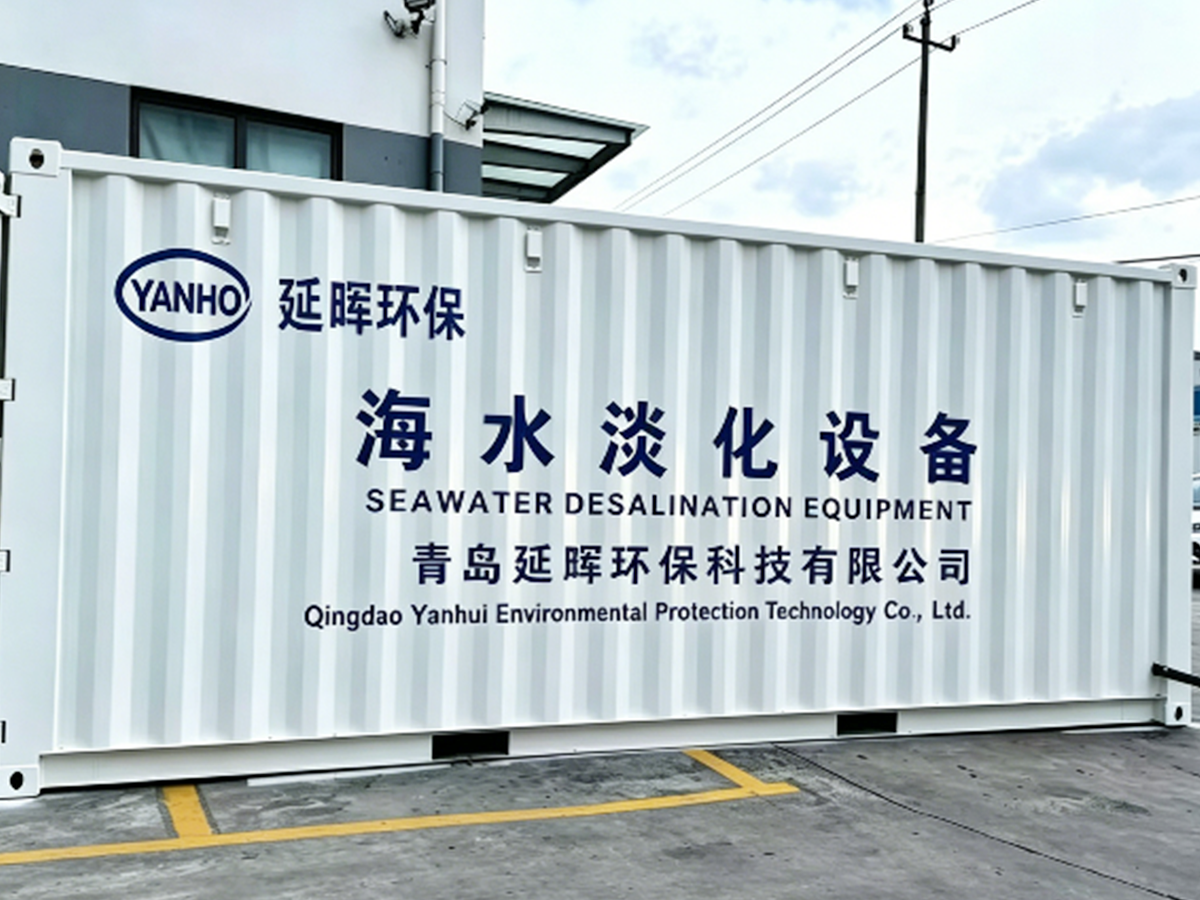
A containerized seawater desalination system is a desalination plant assembled inside a standard or customized container structure. Instead of building the entire treatment system directly on site, major components are integrated into the container before delivery.
The main treatment process is usually seawater reverse osmosis (SWRO). During RO treatment, high-pressure seawater is pushed through a semi-permeable membrane. Water molecules can pass through the membrane, while a large portion of dissolved salts and other unwanted substances are retained in the concentrate stream.
The World Health Organization identifies reverse osmosis as one of the major membrane treatment processes and notes that it is commonly used for desalination of seawater and brackish water. Typical RO operating pressure can vary significantly by application, with WHO guidance giving a broad range of approximately 15–50 bar for RO processes. Actual seawater RO pressure depends on feed-water salinity, temperature, membrane selection, recovery, and system design.
| Membrane Process | Typical Operating Pressure | Typical Treatment Role |
|---|---|---|
| Microfiltration (MF) | About 1–2 bar | Removal of suspended and colloidal particles |
| Ultrafiltration (UF) | Usually below 5 bar | Removal of larger organic molecules and fine particles |
| Nanofiltration (NF) | About 5 bar | Selective removal of hardness and some dissolved substances |
| Reverse Osmosis (RO) | About 15–50 bar | Desalination and removal of dissolved salts |
Source: World Health Organization, Guidelines for Drinking-water Quality, membrane processes. Values are general reference ranges, not guaranteed operating parameters for a specific project.
The container itself does not perform desalination. Its purpose is to provide a compact, protected and transportable structure for the treatment system. This distinction is important when discussing containerized Desalination Equipment. The treatment technology still needs to be correctly designed; the container simply makes the overall equipment package easier to deploy.
In our projects, we normally consider the container layout, equipment size, maintenance access, ventilation, drainage, electrical system, pipe arrangement, lifting requirements, and transportation method together rather than treating the container as an afterthought.
The basic working principle is not complicated, although the engineering behind stable operation requires careful design.
Seawater first enters the system through an intake arrangement. The intake method depends on the site. Some projects use direct seawater intake, while others use beach wells, intake tanks, or other arrangements depending on local conditions.
At this stage, we pay attention to suspended solids, algae, turbidity, temperature, oil contamination, organic matter, and other conditions that could affect downstream equipment.
Pretreatment is one of the most important parts of a seawater desalination system. It is tempting to focus only on the RO membrane because the membrane is where salt separation takes place. In practice, however, poor pretreatment can create fouling, scaling, pressure loss, and unstable operation.
Depending on the raw water quality, pretreatment may include multimedia filtration, ultrafiltration, cartridge filtration, chemical dosing, pH adjustment, antiscalant dosing, or other treatment stages.
WHO guidance explains that pretreatment is normally designed to remove contaminants that could interfere with desalination through problems such as membrane fouling or scale formation.
After pretreatment, the water is sent to the high-pressure pump. Reverse osmosis requires pressure because seawater naturally has high osmotic pressure. The pump supplies the pressure required for water to pass through the RO membrane.
The actual pressure is not simply selected from a fixed number. We consider seawater salinity, temperature, membrane characteristics, required production, recovery, and other process parameters.
The pressurized seawater enters the RO membrane vessels. The membrane separates the incoming flow into two streams: permeate, which is the treated water passing through the membrane, and concentrate, which contains a higher concentration of retained salts and other substances.
The US EPA describes RO as a pressure-driven membrane process that produces a treated water stream called permeate and a concentrate or reject stream. RO can also be used to remove salts from seawater and brackish water.
The RO permeate may not always be ready for its final use immediately. Depending on the application, post-treatment can include pH adjustment, remineralization, disinfection, polishing filtration, or other processes.
This is particularly important when the product water is intended for drinking water supply. Water quality requirements should be established according to the intended use and applicable local regulations rather than assuming that every desalination system produces water suitable for every purpose.
WHO's desalination guidance emphasizes risk assessment and risk management throughout source-water management, treatment, and final water handling.
We often recommend a containerized configuration when the customer needs a relatively compact system that can be transported, installed, expanded, or relocated with less site construction work.
Compared with a conventional open-frame installation, the container format provides a physical enclosure for the main equipment. It can also simplify factory assembly and provide a clearer equipment layout.
Space can be expensive or simply unavailable on islands, ships, offshore platforms, construction sites, and remote industrial facilities. A containerized system allows us to arrange multiple treatment components within a defined footprint.
The layout still needs enough space for operation and maintenance. We do not treat every available corner as usable equipment space. Pumps, filters, electrical cabinets, valves and membrane housings all need practical access.
A containerized seawater desalination system can be designed around standard container dimensions or customized transport requirements. This makes logistics easier to plan, especially for projects that need equipment shipped by sea.
Depending on equipment dimensions, transportation may involve road freight, sea freight, or multimodal transportation. For oversized or special projects, transportation conditions are considered during the equipment design stage.
Another practical benefit is that much of the equipment can be assembled before shipment. We can check piping, electrical connections, equipment arrangement, instruments, control functions, and other components before the system leaves our facility.
This does not eliminate the need for site commissioning. Seawater conditions, intake systems, electrical supply, discharge arrangements and final piping connections still need to be checked at the project location.
WHO notes that desalination plants can have a relatively small physical footprint and that modular designs are increasingly available. This makes modular equipment particularly useful where water demand may change over time.
For some customers, a single container is enough. For larger water demand, multiple treatment modules can be considered as part of an overall system design.
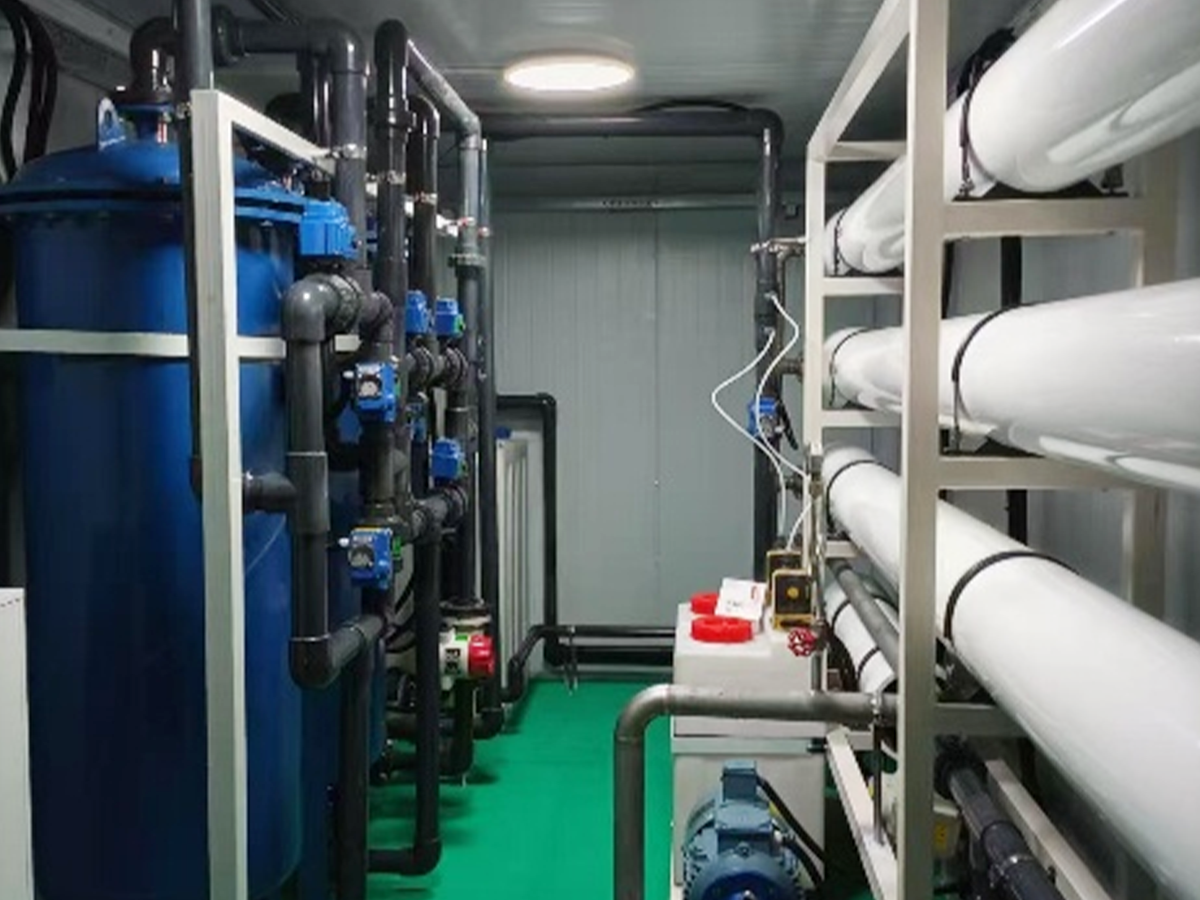
A container looks simple from the outside. Inside, however, the equipment needs to work as one system. Our design approach therefore focuses on the interaction between water quality, treatment process, equipment materials, control logic, and maintenance requirements.
Seawater is highly corrosive compared with ordinary freshwater. Material selection is therefore an important part of Seawater Desalination Equipment design.
Depending on the application and component, corrosion-resistant materials may be selected for pipes, fittings, valves, pumps, membrane housings and other wetted components. The exact material should be determined according to pressure, seawater chemistry, temperature, equipment function, and project budget.
We avoid treating material selection as a simple “use one material everywhere” decision. Different components can have different operating conditions, so the appropriate material may also differ.
Stable operation depends on more than the membrane itself. Pretreatment quality, feed pressure, temperature, water chemistry, recovery, cleaning procedures and operating control all affect RO performance.
We therefore consider the whole process when configuring a containerized seawater RO system.
The control system can monitor important operating parameters such as pressure, flow, conductivity, tank levels and equipment status. Depending on the project, automatic alarms, interlocks, shutdown protection and remote monitoring functions can also be integrated.
Automation does not mean that the operator never needs to check the system. It means routine operation can be made easier and abnormal conditions can be identified more quickly.
Seawater quality is not identical everywhere. Even two coastal locations can have different turbidity, temperature, algae levels, salinity and organic matter.
For this reason, we prefer to collect actual raw-water information before finalizing the process configuration.
| Project Factor | Why It Matters | Typical Design Consideration |
|---|---|---|
| Seawater salinity | Influences osmotic pressure and RO pressure requirements | RO membrane selection and operating pressure |
| Temperature | Affects membrane water permeability | Capacity and pressure correction |
| Turbidity and suspended solids | Can contribute to fouling | Pretreatment and filtration |
| Organic matter and algae | Can increase membrane fouling risk | Pretreatment and chemical control |
| Required freshwater production | Determines system capacity | Number of membrane elements and trains |
| Site space | Controls equipment arrangement | Container size and internal layout |
| Final water use | Determines required water quality | Post-treatment and disinfection |
Source basis: WHO guidance on desalination, membrane treatment, pretreatment and water safety. Specific engineering values must be confirmed through project water analysis and process design.
One reason we see continued interest in containerized desalination equipment is its flexibility. It can be used in locations where conventional freshwater infrastructure is limited, expensive, or difficult to extend.
Small islands may have limited freshwater resources while having direct access to seawater. A compact Seawater Desalination Plant can provide an additional source of freshwater without relying entirely on long-distance water transportation.
WHO specifically identifies small-island settings as an important application area for desalination technologies.
Hotels and resorts often have relatively predictable water demand, but the demand can increase significantly during busy periods. A containerized seawater desalination system can be configured to provide process water or freshwater according to the hotel's water management plan.
Ships and marine facilities have a practical reason to consider compact desalination equipment: freshwater storage space is limited, while seawater is readily available.
The equipment may be integrated with other onboard systems depending on the vessel type, available power, space, and freshwater demand.
Offshore platforms face strict requirements on footprint, weight, corrosion resistance, maintenance access, and equipment reliability. A containerized configuration can help organize the equipment within a defined area.
Fishing bases and related coastal operations may require freshwater for workers, cleaning, processing, equipment washing, and other purposes. The required water quality varies according to the actual use, so the treatment system should be designed accordingly.
Industrial facilities may use desalinated water for production processes, equipment cleaning, cooling-related applications, utility systems, or other purposes.
Industrial projects usually benefit from a detailed water balance before equipment selection. We need to understand how much water is needed, when it is needed, and what quality is required.
Remote sites can have high logistics costs. Delivering freshwater by truck or ship may become expensive over time. A containerized seawater desalination system provides another option where seawater is available and sufficient electrical or other energy resources can be supplied.
For us, manufacturing a containerized desalination system is not simply a matter of putting equipment inside a box. The internal arrangement has to support real operation.
We first review the customer's raw-water information, required freshwater production, intended use, site conditions, available power, installation environment, and transportation requirements.
From there, we develop the process route and equipment configuration. For a seawater RO system, this commonly includes pretreatment, high-pressure pumping, membrane separation, post-treatment, controls, and associated piping.
Equipment is selected according to process requirements rather than simply using a fixed equipment list. Pumps, membrane elements, filters, valves, instruments, electrical components and other parts need to work together.
We then consider how the equipment will fit into the container. Maintenance access, pipe routing, drainage, ventilation, electrical cabinet placement, lifting points and operator movement all need to be considered.
After manufacturing, the equipment is assembled and checked. Depending on the project scope, we inspect mechanical connections, piping, electrical systems, control functions, instruments and other important components.
Before delivery, we also prepare relevant technical documents and operating information so that the customer has a clear reference when installing and operating the system.
Transportation is selected according to the equipment dimensions, destination and delivery conditions. Road transportation, sea transportation and multimodal transportation can all be considered.
For individual components, wooden cases or pallets may be used. Larger integrated systems can be transported as containers. Equipment is reinforced according to transportation conditions to reduce the risk of movement or damage during shipment.
After arrival, the system needs to be connected to the local seawater intake, power supply, freshwater outlet, concentrate discharge system and other site utilities.
Commissioning normally includes inspection of connections, system flushing, instrument checks, pump operation, pressure adjustment, RO operation, water-quality monitoring, and control-system verification.
| Project Stage | Main Work | Customer Information Typically Needed |
|---|---|---|
| Initial evaluation | Review water demand and site conditions | Water source, required capacity, application |
| Process design | Define treatment route and equipment configuration | Water analysis and target water quality |
| Manufacturing | Equipment fabrication and container integration | Approved technical specification |
| Factory inspection | Assembly, testing and quality checks | Inspection requirements if applicable |
| Delivery | Packaging and transportation | Destination and logistics information |
| Installation | Connect utilities and treatment lines | Site preparation and utility connections |
| Commissioning | Start-up, adjustment and operating checks | Actual site water and operating conditions |
Source: Engineering workflow described here reflects our project approach. Water-treatment design principles regarding pretreatment, RO operation and final-water management are consistent with WHO guidance.
There are many suppliers of RO equipment, so we understand that a customer needs more than a product name and a quotation before making a decision.
Our company was established in 2015, and our business has developed around water-treatment engineering rather than one single piece of equipment. Our experience includes seawater desalination, high-salinity wastewater treatment, concentration and purification, and industrial wastewater treatment.
This broader experience matters because seawater desalination projects are not always isolated from other water-treatment processes. Some customers need desalinated water for an industrial process. Others have wastewater that needs additional treatment after production. In these situations, understanding the complete water cycle helps us design a more practical solution.
We can adjust the equipment configuration according to seawater quality, required freshwater production, site limitations, operating conditions and customer requirements.
For example, one customer may need a compact system for an island facility, while another may require a higher-capacity system for industrial water supply. Their pretreatment requirements, materials, controls and container arrangement may not be the same.
Our service can cover R&D, process design, equipment manufacturing, installation, commissioning, operation and maintenance. This gives customers one technical team to communicate with throughout the project.
Production time is not the same for every project. Standard equipment can usually follow a more straightforward production schedule, while customized systems require additional time for process confirmation, engineering design, component selection and configuration.
We confirm the production cycle according to the actual project scope rather than giving an unrealistic fixed delivery promise.
Before delivery, we complete equipment assembly, testing and quality inspection according to the agreed project requirements. Technical information and operating documents are also prepared to support installation and operation.
Payment arrangements can be defined in the project contract and may include an advance payment, shipment payment, and balance payment. Transportation can be arranged by land, sea or multimodal logistics according to the destination and equipment dimensions.
For us, these details are part of the project rather than something to discuss only after the equipment has been manufactured.
It is a seawater desalination system integrated into a containerized structure. The system commonly includes pretreatment, high-pressure pumping, RO membrane equipment, controls, piping and other supporting components. The exact configuration depends on water quality, capacity and site requirements.
No. Different desalination technologies exist, including reverse osmosis and thermal processes. However, reverse osmosis is widely used for seawater desalination and is particularly suitable for modular equipment configurations. WHO lists reverse osmosis among the major desalination technologies used for seawater and brackish water.
We normally need information such as raw-water analysis, required freshwater production, intended water use, site location, available power supply, seawater intake conditions, installation space and concentrate discharge conditions.
A complete water analysis is especially useful because seawater conditions can vary from one location to another.
Yes. We can customize the treatment capacity, pretreatment process, materials, control system, container arrangement, piping, post-treatment and other components according to project requirements.
It can be designed for drinking-water applications, but the final configuration must be based on the required water quality and applicable local drinking-water regulations. RO treatment alone should not automatically be assumed to satisfy every drinking-water requirement.
WHO recommends a risk-based approach to desalinated drinking water that considers source water, treatment processes and final water management.
The RO process produces a concentrate stream containing a higher concentration of retained salts. The concentrate needs to be managed according to the project location, environmental requirements and applicable regulations.
Discharge design should be considered during the project planning stage rather than after the desalination equipment has been installed.
The production cycle depends on the system capacity, equipment configuration, degree of customization and component availability. Standard configurations can generally follow a shorter production process, while customized projects require additional design and configuration confirmation.
Transportation can be arranged by land, sea or multimodal transport. For containerized equipment, the complete unit can normally be shipped according to the agreed container and logistics requirements. Smaller components may be packed in wooden cases or on reinforced pallets.
Regular maintenance normally includes checking pumps, filters, valves, instruments, electrical components and membrane operating conditions. Pretreatment equipment also needs regular attention because poor pretreatment can increase the fouling load on RO membranes.
Membrane cleaning is an important part of maintaining treatment performance. WHO guidance also notes the importance of proper membrane cleaning, flushing and management of cleaning solutions.
Yes. Our service scope can include installation guidance, commissioning, operation support and maintenance according to the project contract. We can also provide technical documents and operating information for the delivered equipment.
A Containerized Seawater Desalination System is not simply a seawater RO machine placed inside a container. A useful system needs to combine the treatment process, equipment selection, corrosion protection, control system, container layout, transportation plan, installation requirements and future maintenance into one practical package.
For customers operating on islands, coastal sites, ships, offshore platforms, fishing facilities, industrial plants, hotels or remote locations, this type of system can provide a flexible way to turn available seawater into usable freshwater.
At Qingdao Yanhui Environmental Protection Technology Co., Ltd., we approach each project from the actual water and site conditions. We review the raw water, required capacity, intended application and installation environment before confirming the equipment configuration.
Our goal is not to make every project look the same. It is to build a customized seawater desalination system that makes sense for the customer's actual operating conditions.
If you are planning a containerized seawater desalination plant, containerized seawater RO system, or modular seawater desalination equipment project, providing your raw-water analysis, required freshwater capacity and site information will allow us to evaluate the appropriate process and equipment configuration more accurately.
World Health Organization, Guidelines for Drinking-water Quality — membrane processes and reverse osmosis treatment principles.
World Health Organization, Safe Drinking-water from Desalination — risk assessment and risk management for desalinated drinking water.
World Health Organization, Water and Sanitation Technologies — desalination applications, modular systems, energy requirements and operation considerations.
U.S. Environmental Protection Agency, Overview of Drinking Water Treatment Technologies — reverse osmosis, permeate and concentrate principles.
This website uses cookies to ensure you get the best experience on our website.
 Portugues
 Pусский
 Français
 العربية
 ไทย
ไทย Indonesia
 Melayu
 Tiếng Việt
 中文
中文 қазақ
қазақ עִברִית
 မြန်မာ
 ພາສາລາວ
 Filipino
 o'zbek
 Кыргызча
 тоҷикӣ
 ខ្មែរ
ខ្មែរ Türkmenler



 Phone
Phone