

| Packaging Speed | 2000–2500 packs/hour |
| Filling Volume | 200–500 ml per pack |
| Packaging Accuracy | ±1.5% |
| Film Width | 320 mm |
| Motor Power | 0.75 kW |
| Vertical Sealing Power | 300 W |
| Horizontal Sealing Power | 500 W |
| Sterilizing Lamp Power | 15 W |
| Voltage | 220V 50Hz (customizable for special motors) |
| Weight | 300 KG |
| Overall Dimension (L × W × H) | 830 × 760 × 1830 mm |
Equipment Technical Drawing:
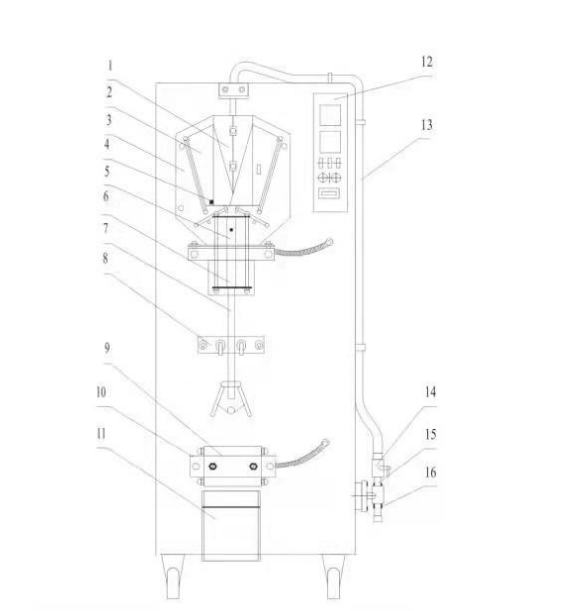
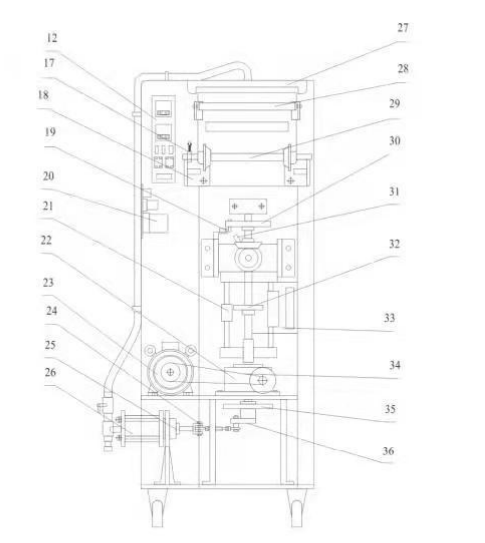
1. Molding machine center plate | 2. Folding plate for forming machine | 3. Molding machine base plate |
4. Bag pressure roller | 5. Copper block for vertical sealing | 6. Printer |
7. Central tube | 8. Delivery bag | 9. Heat-sealed transverse sealing device; transverse sealing |
10. Heat sealing pressure regulating screw | 11. Hopper | 12. Control panel |
13. Water supply pipe | 14. Three-way directional control valve | 15. Upper check valve |
16. Lower check valve | 17. Buffer swing arm | 18. Roll material display board |
19. Direction Counter | 20. Electrical control cabinet | 21. Bag Moving Slider |
22. Speed reducer | 23. Electric motor | 24. Connecting rod of a fixed displacement pump |
25. Piston ring rod of a fixed displacement pump | 26. Metering pump | 27. Germicidal lamp |
28. Bag delivery pump | 29. Bag position adjustment rack | 30. Vertical sealing cam |
31. Bag shift crank | 32. Bag delivery cam | 33. Delivery bag and sliding cover |
34. Transmission belt | 35. Horizontal sealing cam | 36. Displacement pump crank |
500g Bagged Liquid Packaging Machine for Automatic Liquid Filling and Packing
When a liquid product needs to be packed into bags at a consistent 500g quantity, the packaging process has to do more than simply fill a bag. The machine needs to control the filling amount, handle the packaging film properly, make a reliable seal, and keep the whole process moving at a steady pace.
That is where a 500g Bagged Liquid Packaging Machine comes in. It is designed for businesses that need to package liquid products into bags with a target filling weight of around 500g. Depending on the product and packaging material, the equipment can be configured for filling, bag forming or bag feeding, sealing, cutting, date coding, counting, and other packaging operations.
We look at this type of equipment from a practical point of view. A packaging machine should not only look compact in a catalog. It should also be easy to operate, suitable for the actual liquid being packed, compatible with the selected film or bag, and convenient to clean and maintain.
For different projects, we can consider the product characteristics, required bag size, filling accuracy, packaging material, production capacity, electrical requirements, and operating environment when discussing the appropriate machine configuration.
This article explains how a 500g liquid filling and packaging machine works, what factors matter when selecting one, which products can use it, and what we normally consider during manufacturing, testing, delivery, and commissioning.
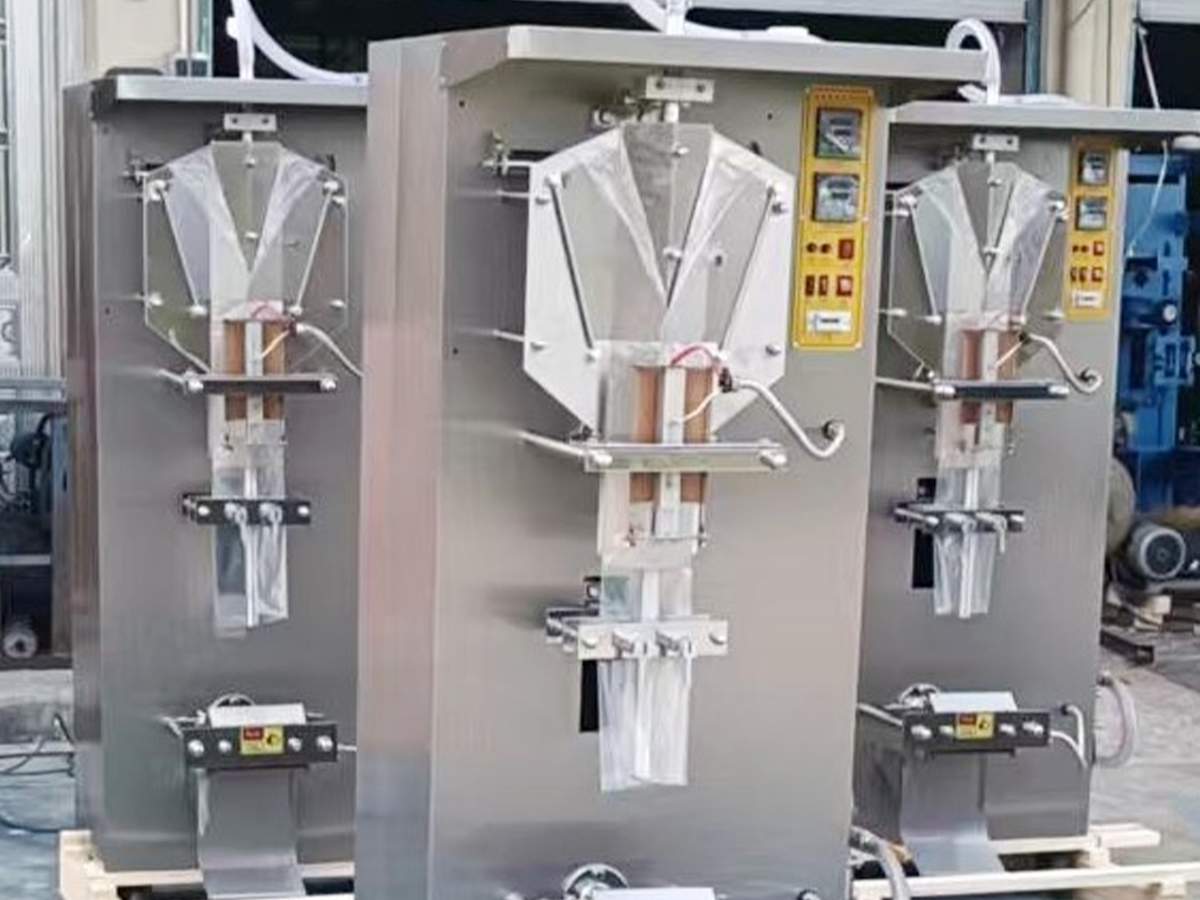
A 500g Bagged Liquid Packaging Machine is packaging equipment designed to fill liquid products into bags at a nominal 500g package size and then seal the package for handling, storage, transportation, or sale.
The actual machine structure can vary considerably. Some systems use a continuous roll of flexible film to form bags during operation. Others use preformed bags that are opened, filled, and sealed by the machine. The correct design depends on the packaging material, product properties, required output, and packaging style.
For a typical liquid pouch packaging system using roll film, the basic process can include:
Film feeding
Film forming
Bag shaping
Liquid filling
Heat sealing
Bag cutting
Date or batch coding
Finished bag discharge
The machine may also include sensors, a control panel, liquid pumps, filling valves, temperature controllers, pneumatic components, and other supporting parts.
The important point is that “500g” describes the target package quantity. It does not automatically mean that every liquid product can use exactly the same filling system.
Water, juice, milk, sauce, detergent, liquid soap, edible oil, and other liquids can have very different flow characteristics. A thin liquid may flow easily through a filling valve, while a thicker sauce may require a different pump or filling mechanism.
That is why we recommend confirming the product characteristics before selecting the final equipment configuration.
In real production, the 500g package size is only one part of the design. We also need to consider:
Liquid viscosity
Product temperature
Presence of particles
Foaming characteristics
Required packaging speed
Bag dimensions
Film thickness
Film structure
Sealing temperature
Filling method
Cleaning requirements
Available electrical power
This is one reason we avoid using a single standard specification for every customer. The right machine is the one that matches the actual product and production process.
The basic process is easy to understand. The machine prepares the bag, measures or meters the liquid, fills the bag, seals it, and then sends the finished package to the discharge area.
For machines using roll film, the packaging film is installed on a film holder and pulled through the machine by a controlled feeding system.
The film needs to move at a stable speed. If the feeding is not consistent, bag length can vary, which can affect the appearance of the finished package and the amount of material used.
Depending on the equipment design, sensors can be used to detect printed marks on the film. This is useful when the packaging film contains graphics, logos, or other printed information that needs to remain in the correct position.
The film is shaped into the required bag structure. The forming section needs to work smoothly because poor alignment can lead to uneven sealing or distorted bags.
For some applications, preformed bags may be used instead. In that case, the machine does not need to create the bag from a film roll, but it still needs to open, position, fill, and seal each bag correctly.
The filling system controls how much liquid enters each package.
For low-viscosity liquids, a pump and controlled filling valve may be suitable. For thicker liquids, the filling method may need to be changed. If the product contains small particles, the valve and pipe diameter also need to be considered.
Filling accuracy is affected by several factors, including the filling method, liquid temperature, viscosity, pressure, product flow, and control settings.
We therefore do not recommend judging a machine only by its stated filling range. Actual testing with the customer's product is much more useful when accuracy is an important production requirement.
After filling, the bag is sealed. Heat sealing is commonly used with flexible packaging films, although the exact sealing method depends on the packaging material.
Three basic factors are especially important for heat sealing:
Sealing temperature
Sealing pressure
Sealing time
If the temperature is too low, the seal may not bond properly. If it is too high, the film can deform or become damaged. If the pressure or sealing time is not suitable, the finished package may also have sealing problems.
For this reason, sealing parameters should be tested against the actual packaging material instead of simply using one setting for every film.
Once the sealing process is complete, individual bags can be separated by a cutting mechanism. The finished packages are then transferred to the discharge area for collection or the next packaging process.
Depending on the production line, the finished bags may then go to a conveyor, counting system, secondary packaging machine, inspection station, or manual packing area.
When we discuss a 500g Bagged Liquid Packaging Machine, we focus on the details that affect everyday production rather than only the appearance of the machine.
The machine is designed around a target filling quantity of 500g. The actual tolerance should be confirmed according to the product, filling mechanism, legal metrology requirements, and customer production standard.
For commercial food products, quantity control is not only a production issue. The declared quantity on a package needs to follow the applicable market requirements.
The Codex General Standard for the Labelling of Pre-packaged Foods states that net contents are declared in metric units and provides different conventions depending on whether the product is liquid, solid, semi-solid, or viscous.
Flexible bags are useful when the customer wants a lightweight package that takes relatively little storage space.
The actual bag shape and dimensions depend on the film width, filling volume, sealing structure, and product characteristics.
Once the machine is properly set up, filling and sealing can be completed automatically. This reduces the need for an operator to manually fill and seal every individual bag.
The operator can instead focus on material loading, machine monitoring, product checks, cleaning, and routine adjustments.
A practical control interface is important. Operators should be able to understand basic settings such as filling quantity, sealing temperature, packaging speed, and other operating parameters without needing advanced technical knowledge for every adjustment.
We can consider different filling systems for different liquid products. This is particularly important when moving from water-like liquids to thicker products.
A machine for clean water does not necessarily need the same filling arrangement as a machine for tomato sauce or liquid detergent.
Liquid packaging equipment should be designed with routine maintenance in mind. Areas that come into contact with the product should be accessible for cleaning and inspection.
This becomes especially important for food and beverage applications, where cleaning procedures are part of normal production management.
We often find that customers start with one simple question: “Can this machine pack 500g?”
That is a useful starting point, but it is not enough to select the right machine.
Before confirming a 500g Bagged Liquid Packaging Machine, we recommend looking at several points.
Viscosity describes how easily a liquid flows. Water has low viscosity, while honey, syrup, and many sauces have much higher viscosity.
Higher-viscosity products may need stronger pumps, larger passages, different valves, or a different filling method.
Some products are filled at room temperature. Others are filled warm or hot.
If the product temperature is high, the filling system, sealing process, film material, and machine construction need to be selected accordingly.
Some liquids create foam during filling. Foam can make accurate filling more difficult and may affect the appearance of the package.
In these cases, filling speed, nozzle design, liquid flow, and filling sequence may need to be adjusted.
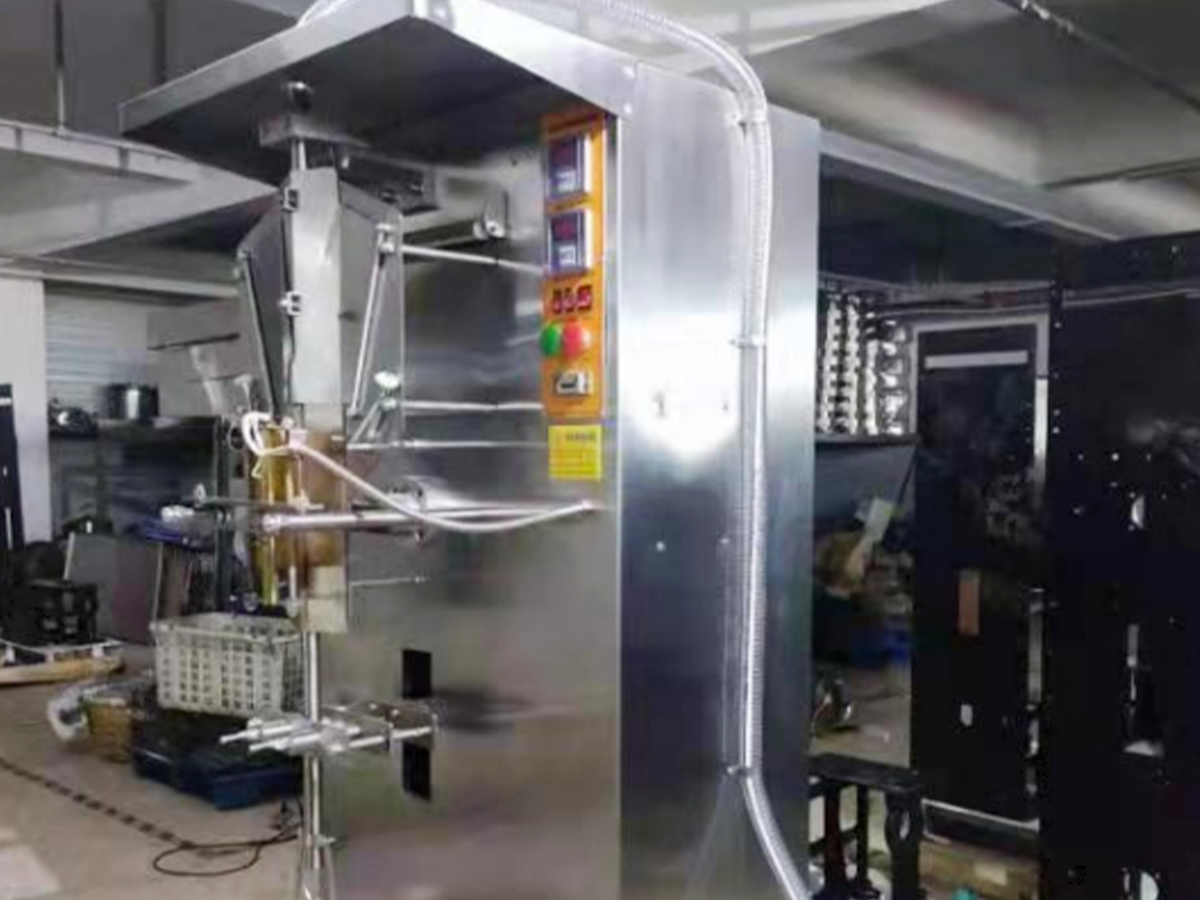
The packaging material is another major factor.
Different films have different thicknesses, heat-sealing temperatures, mechanical strength, and barrier properties. Food packaging, detergent packaging, and industrial liquid packaging may require different film structures.
For products intended to contact food, packaging materials are subject to applicable food-contact requirements. The U.S. FDA explains that food-contact substances can include materials used in packaging and that their safety depends on the intended conditions of use.
Filling accuracy should be discussed together with the product and filling method. A customer who needs a narrow quantity tolerance may require more precise metering and control than a customer with a wider acceptable range.
We normally recommend testing the actual liquid before final equipment selection when the filling tolerance is important.
Production capacity is usually expressed as bags per minute or bags per hour. However, the actual output depends on the bag size, filling volume, product properties, machine configuration, sealing time, and operating conditions.
| Selection Factor | Example Requirement | Possible Equipment Impact |
|---|---|---|
| Filling quantity | 500g per bag | Filling system and control range |
| Liquid viscosity | Low, medium, or high | Pump and valve selection |
| Product temperature | Ambient or heated | Material and sealing configuration |
| Film type | PE, laminated film, multilayer film, etc. | Film feeding and sealing settings |
| Bag size | Based on 500g product volume | Film width and forming structure |
| Required output | Bags per minute/hour | Machine speed and automation level |
| Product characteristics | Water-like, viscous, foaming, etc. | Filling method and operating parameters |
| Cleaning requirements | Regular product-contact cleaning | Sanitary design and access |
Source: Equipment-selection factors are based on general liquid packaging engineering practice. Final specifications should be confirmed through product and packaging tests.
A 500g liquid package can be useful in many different markets. The actual application depends on the product and local packaging requirements.
Water is one of the easier liquids to handle from a filling perspective because it has relatively low viscosity. A 500g bagged liquid packaging machine for water can be configured around the desired bag material, filling speed, sealing format, and production environment.
For drinking-water packaging, the complete production process should also consider hygiene, water quality, packaging material suitability, and local regulations.
Juices, drinks, flavored beverages, and other liquid products may be packed in flexible bags where this package format fits the market.
The machine configuration depends on whether the beverage contains pulp, suspended particles, foam, or other ingredients.
Sauces, cooking ingredients, syrups, and similar products can also be packaged in 500g bags.
These products often have higher viscosity than water, so the filling system becomes more important.
For products with small particles, we also need to check whether the particles can pass through the filling valve smoothly.
Liquid detergents, cleaning solutions, and similar household or industrial products may use flexible bag packaging where the product chemistry and packaging material are compatible.
For chemical products, the machine's wetted components and sealing materials should be selected according to the product's chemical properties.
Some shampoos, liquid soaps, conditioners, and other personal care products can be packed in flexible bags.
Because these products often have medium or high viscosity, the filling system needs to be selected based on actual product flow behavior.
Some industrial liquids can also use flexible bag packaging, especially when the package size is convenient for transportation and daily use.
In this case, chemical compatibility, bag strength, sealing reliability, and operator safety become important selection points.
| Application | Typical Product Characteristics | Important Considerations |
|---|---|---|
| Water | Low viscosity | Filling accuracy, hygiene, sealing |
| Beverages | Low to medium viscosity | Foaming, particles, food-contact packaging |
| Sauces | Medium to high viscosity | Pump type, valve size, cleaning |
| Detergents | Varies by formula | Chemical compatibility and film strength |
| Liquid soap | Medium to high viscosity | Filling speed and product flow |
| Industrial liquids | Varies significantly | Chemical compatibility and safety |
Source: Application categories are based on common flexible liquid packaging uses. Actual suitability depends on product composition, viscosity, packaging film, and applicable regulations.
One thing we always tell customers is that a good filling machine cannot compensate for an unsuitable packaging film.
The machine and the film work together.
If the film is difficult to seal, the sealing temperature window may be narrow. If the film is too weak, transportation may cause leakage or damage. If the film structure does not match the product, the package may not provide the required protection during storage.
Common flexible packaging structures can include polyethylene-based films and laminated multilayer films. The actual choice depends on the product, required barrier properties, sealing requirements, storage conditions, and applicable regulations.
For food applications, the film must be suitable for the intended food-contact conditions. FDA guidance explains that packaging and other food-contact substances are regulated according to their intended use and safety requirements.
The seal is the part that keeps the liquid inside the package.
In simple terms, the machine needs to heat the sealing layer enough to bond it, apply suitable pressure, and maintain the required sealing time.
Too little heat can create a weak seal. Too much heat can damage the film. The correct setting depends on the actual film structure.
During machine testing, we recommend checking whether the seal is continuous and clean. For demanding applications, additional leakage or package-strength testing may be appropriate.
The importance of sealing is also recognized in packaging standards for other industries. For example, ISO 11607-2 focuses specifically on the development and validation of forming, sealing, and assembly processes for sterile medical-device packaging. That standard does not apply to ordinary food or liquid packaging, but it illustrates why sealing should be treated as a controlled process rather than an afterthought.
Once the product and packaging requirements are confirmed, the machine moves into the engineering and manufacturing stage.
We first need to understand what the customer wants to pack. Product name alone is not enough.
We normally consider:
Product viscosity
Filling temperature
Target package weight
Bag dimensions
Packaging film
Expected production capacity
Filling accuracy
Power supply
Machine installation space
Cleaning requirements
For customized equipment, this information helps avoid a common problem: selecting a machine that looks suitable on paper but does not perform well with the actual product.
During manufacturing, the machine frame, filling system, film-feeding structure, sealing mechanism, control components, and other parts are assembled according to the agreed configuration.
Attention is given to alignment because film movement, filling position, sealing position, and cutting position need to work together.
The control system connects sensors, motors, pumps, heaters, valves, and other operating components.
The goal is not to make the control panel unnecessarily complicated. We prefer a practical interface that allows operators to understand the main machine status and make routine adjustments.
Before shipment, the machine can be inspected and tested according to the agreed project scope.
Where possible, testing with the customer's actual product and packaging material is useful. It provides a more realistic picture of filling behavior, sealing performance, package appearance, and operating stability.
Depending on the project, technical documentation can include equipment information, operating instructions, electrical documentation, maintenance information, and other relevant materials.
After testing and inspection, the equipment is prepared for shipment.
Transportation can be arranged by land, sea, or multimodal logistics according to the destination and machine dimensions.
Smaller components may be protected with suitable cases or pallets, while larger equipment can be secured according to the transportation method. The purpose is simple: reduce movement, impact, moisture exposure, and other risks during transportation.
| Stage | Main Work | Purpose |
|---|---|---|
| Requirement review | Confirm product and package specifications | Define suitable machine configuration |
| Engineering | Design filling, sealing and control arrangement | Match machine to production requirements |
| Manufacturing | Fabricate and assemble equipment | Build the agreed system |
| Testing | Run machine and check functions | Identify issues before shipment |
| Inspection | Check mechanical and electrical components | Confirm equipment condition |
| Packaging | Secure equipment for transportation | Reduce shipping-related risks |
| Installation | Connect power, product and supporting systems | Prepare for production |
| Commissioning | Adjust filling and sealing parameters | Match actual site conditions |
Source: The workflow above represents a practical equipment project process. Exact inspection, documentation, packaging, and commissioning requirements should be agreed in the project contract.
Qingdao Yanhui Environmental Protection Technology Co., Ltd. was established in 2015. Our main business focuses on water-treatment equipment and engineering, including Seawater Desalination, high-salinity wastewater treatment, concentration and purification, and industrial wastewater treatment.
Because our established business is centered on water-treatment engineering rather than packaging machinery, we believe it is important to be transparent about the scope of our service. For a 500g Bagged Liquid Packaging Machine project, the actual machine configuration, manufacturing scope, and technical responsibilities should be confirmed according to the specific equipment project.
Our engineering approach is based on understanding the application first and then confirming the equipment configuration. This way of working is especially useful for customized machinery, where the product itself can affect the machine design.
We can work with customers to clarify the required packaging weight, liquid characteristics, packaging material, production capacity, machine layout, and other technical details before the final configuration is confirmed.
Different customers may have different production goals. Some need a compact machine for a smaller workshop. Others need the equipment to connect with an existing conveyor, filling line, coding machine, or secondary packaging system.
Customization can be considered for filling systems, bag dimensions, control functions, material selection, machine layout, and other areas where the project requires it.
The production cycle depends on the equipment configuration. A relatively standard machine can normally follow a simpler manufacturing process, while a customized project may require additional engineering time.
We prefer to confirm the delivery schedule after the technical configuration is clear rather than giving a fixed production time before the project requirements are known.
Equipment installation, operation, and maintenance are important parts of a machinery project. We can provide relevant technical information and support according to the agreed project scope.
It can be considered for water, beverages, sauces, liquid food products, detergents, liquid soap, and some industrial liquids. However, the correct filling system depends on viscosity, temperature, particles, foaming, and chemical properties.
Not necessarily. Depending on the filling system and machine configuration, different package sizes may be possible. The available range should be confirmed according to the specific equipment design rather than assumed from the product name.
A filling machine mainly focuses on measuring and dispensing the product. A complete packaging machine normally combines filling with bag forming or bag feeding, sealing, cutting, and sometimes coding or counting.
Yes, in many cases, but high-viscosity products require a suitable filling system. Pump type, valve design, pipe diameter, filling speed, and product temperature may all need to be adjusted.
Some products containing small particles can be handled, but particle size and concentration need to be checked first. The filling valve and product passage must be suitable for the actual product.
The appropriate film depends on the machine structure, sealing method, product properties, and packaging requirements. PE-based films and laminated films are common possibilities, but the exact film should be confirmed through compatibility and sealing tests.
Filling accuracy depends on the product, filling mechanism, temperature, viscosity, machine settings, and other conditions. We recommend defining the required tolerance before equipment selection and conducting product testing when precise filling is important.
Some configurations may use pneumatic cylinders or valves and therefore require compressed air. Other machine designs may use different drive systems. The actual utility requirements depend on the final configuration.
Yes, depending on the machine configuration. It may be possible to connect the liquid packaging machine with conveyors, coding equipment, inspection systems, secondary packaging equipment, or other downstream machinery.
The production cycle depends on the machine type, customization level, component selection, and technical requirements. Standard equipment generally requires less engineering time, while customized systems need additional time for design and configuration confirmation.
Transportation can be arranged by land, sea, or multimodal logistics. Packaging methods depend on machine size and transportation requirements and may include wooden cases, pallets, protective materials, or reinforced shipping arrangements.
Technical documents and operating information can be provided according to the agreed project scope. The exact document list can be confirmed before production.
A 500g Bagged Liquid Packaging Machine may look like a relatively simple piece of packaging equipment, but reliable operation depends on many small details.
The filling system needs to match the liquid. The film needs to match the sealing process. The bag size needs to match the filling volume. The machine speed needs to match the production target. And the control system needs to be simple enough for operators to use during everyday production.
That is why we recommend starting with the product rather than starting with the machine model.
Tell us what liquid you need to pack, whether it is thin or thick, whether it contains particles, what type of packaging film you plan to use, what filling weight you need, and how many bags you expect to produce.
From there, we can discuss the appropriate 500g liquid filling and packaging machine, 500g Bagged Liquid Filling Machine, or customized Liquid Pouch Packaging Machine configuration.
For food-related applications, packaging material selection and labeling requirements should also be checked against the regulations of the target market. Codex provides international guidance for pre-packaged food labeling, while national authorities such as the U.S. FDA have their own requirements for food-contact materials and packaging.
In the end, a useful packaging machine is not defined by how many features appear in a specification sheet. It is defined by whether it works properly with the customer's real product, packaging material, production process, and working environment.
U.S. Food and Drug Administration (FDA), Food Packaging & Other Substances that Come in Contact with Food.
U.S. Food and Drug Administration (FDA), Food Ingredients & Packaging.
FAO/WHO Codex Alimentarius, General Standard for the Labelling of Pre-packaged Foods, CXS 1-1985.
ISO, ISO 11607-2:2019 Packaging for terminally sterilized medical devices — Validation requirements for forming, sealing and assembly processes. This reference is relevant to sealing-process principles but does not apply directly to ordinary food or liquid packaging.
This website uses cookies to ensure you get the best experience on our website.
 Portugues
 Pусский
 Français
 العربية
 ไทย
ไทย Indonesia
 Melayu
 Tiếng Việt
 中文
中文 қазақ
қазақ עִברִית
 မြန်မာ
 ພາສາລາວ
 Filipino
 o'zbek
 Кыргызча
 тоҷикӣ
 ខ្មែរ
ខ្មែរ Türkmenler



 Phone
Phone