

Main parameters:
Molding group specifications | Clamping force | 28000KG |
Mold Stroke | 280mm | |
lever travel | 450mm | |
Bottle spacing | 90-120mm | |
Number of mold cavities | 1 cavity | |
Number of embryos | 96 | |
Theoretical output | 300-400pcs | |
Electricity Specifications | Heating power | 28*0.5kw |
Number of lamp layers | 10 | |
Air compressor specifications | Operating pressure | 7-9KG |
Blow molding pressure | 20-30 BAR | |
chiller specifications | Operating pressure | 2-4BAR |
Temperature range | 10-12 degrees | |
Main unit specifications | size | 1950*650*1750 |
weight | 1250KG | |
Oven Specifications | size | 2170*670*1600 |
weight | 400KG |
1 |
Semi-automatic blow molding machine oven 380V 50HZ | FG10L |
2 | Semi-automatic mold | One out of 10L |
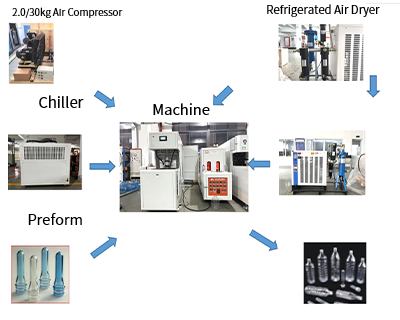
6 | Filter oil-water separator | 2.4 m³/min 3.0 MPa |
7 | Refrigerated dryer | 2.4 m³/min 3.0 MPa |
8 | gas tank | 0.6m³/30kg |
9 | 380V 50HZ high-pressure air compressor | 2.0 m³/min 3.0 MPa |
10 | 3HP air-cooled chiller | 3HP |
Process Flow Connection Diagram
300–400 BPH 10L Semi-Automatic Single-Cavity Blow Molding Machine
When a bottled water project needs large PET containers, the bottle-making process deserves just as much attention as the filling and water treatment systems. A good bottle has to hold its shape, fit the filling line, seal properly, and remain stable during storage and transportation. This is where a suitable 300–400 BPH 10L Semi-Automatic Single-Cavity Blow Molding Machine becomes useful.
This machine is designed around a relatively simple idea: heat a PET preform to the right condition, place it into a mould, and use compressed air to form the bottle against the mould wall. The process sounds simple, but anyone who has worked with plastic bottles knows that the details matter. Heating temperature, preform design, air pressure, mould temperature, bottle shape, material distribution, and cooling can all affect the final bottle.
Our company, Qingdao Yanhui Environmental Protection Technology Co., Ltd., was established in 2015. Our core business focuses on Seawater Desalination, high-salinity wastewater treatment, concentration and purification, and industrial wastewater treatment. We provide customized water treatment equipment and integrated engineering services covering R&D, design, manufacturing, installation, commissioning, operation, and maintenance.
For a bottled-water project, this background gives us a useful perspective. We do not look at the bottle-making machine as an isolated piece of equipment. We look at the whole process, from the original water source and treatment system to bottle production, filling, packaging, storage, and final delivery.
The 300–400 BPH 10L Semi-Automatic Single-Cavity Blow Molding Machine can be considered for small and medium-scale bottle production where the customer wants to produce 10L PET containers on site rather than purchasing all finished bottles from another supplier.
Its semi-automatic operating concept is also practical for projects that do not need the production speed or investment level of a large fully automatic industrial blow molding line.
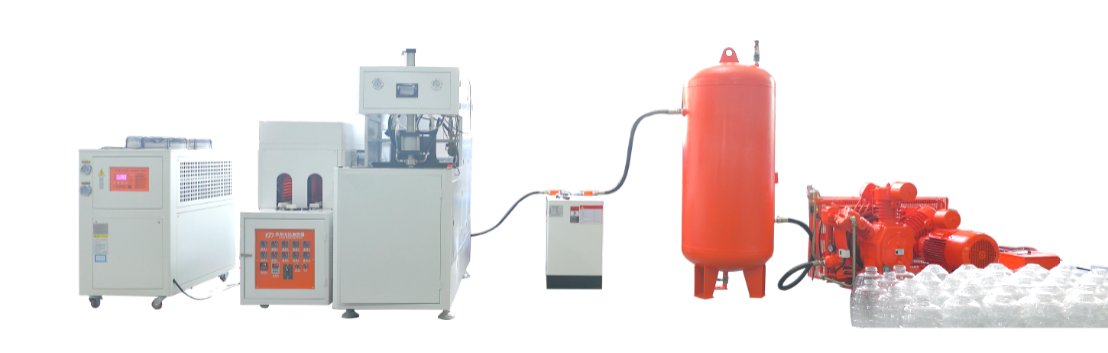
A 300–400 BPH 10L Semi-Automatic Single-Cavity Blow Molding Machine is a PET bottle production machine designed around a single mould cavity and a stated production range of approximately 300 to 400 bottles per hour.
Here, BPH means bottles per hour. The 10L specification refers to the intended bottle capacity, while single-cavity means that one bottle cavity is formed during each moulding cycle.
The machine is described as semi-automatic because some operations may still require operator involvement. Depending on the actual configuration, the operator may need to load preforms, transfer heated preforms, remove finished bottles, or manage certain production steps manually.
This is different from a high-speed automatic PET bottle line where preform feeding, heating, stretching, blowing, bottle discharge, and downstream conveying are highly integrated.
For a smaller water plant, however, semi-automatic operation can be perfectly practical. A customer may not need thousands of bottles every hour. Instead, the goal may be to produce a controlled quantity of large bottles according to daily demand while keeping the equipment relatively simple.
A nominal production range of 300–400 bottles per hour means that the theoretical hourly output is around 300 to 400 bottles under the specified operating conditions.
It is important not to confuse nominal machine capacity with guaranteed daily production.
Actual output can be affected by several factors, including:
Preform heating time
Preform weight and design
Bottle shape
Operator working speed
Compressed-air conditions
Mould design
Cooling time
Machine adjustment
Maintenance condition
Production interruptions
For this reason, we recommend evaluating a machine using the actual bottle design and production conditions rather than looking at BPH alone.
A single-cavity machine forms one bottle at a time. This makes the equipment concept relatively straightforward.
For smaller production requirements, this can be useful because the operator has a clear production rhythm and the machine does not need to manage multiple cavities simultaneously.
It can also make mould changes and production adjustments easier in certain small-scale applications.
For a customer producing one main 10L bottle format, a single-cavity configuration can be a reasonable solution when the required output is within the machine's working range.
The basic PET bottle blow molding process starts with a preform.
A preform looks like a small plastic tube with the bottle neck already formed. It is not yet the final bottle. Instead, it is heated and stretched into the required bottle shape.
Stretch blow molding uses heat, mechanical stretching, compressed air, and a mould to transform the preform into a finished PET container.
Commercial PET bottle production commonly uses this basic principle. Industrial equipment suppliers such as Sidel describe PET bottle production as a stretch blow-moulding process involving preform reheating followed by controlled blowing inside a mould.
The first step is selecting the correct PET preform.
The preform needs to match the intended bottle design. Its weight, length, wall distribution, neck specification, and material characteristics all influence the final bottle.
A 10L bottle normally requires a much heavier and larger preform than a small 500ml or 1.5L bottle. Therefore, a preform that works well for a small bottle cannot simply be used for a 10L bottle without considering the mould and process.
The preform is heated so that the PET becomes suitable for stretching and forming.
This is one of the most important parts of the process.
If the preform is too cold, it may not stretch properly. If it is overheated, the material can become too soft or develop unwanted deformation.
Uniform heating is also important. Different areas of the preform need to reach suitable temperatures so that the PET material can spread properly during stretching and blowing.
This is why the heating system needs to be adjusted according to the actual preform rather than simply using one temperature setting for every bottle design.
After heating, the preform is placed into the bottle mould.
The neck must be positioned correctly because the bottle neck is normally retained while the body expands into the mould.
Accurate positioning helps keep the bottle shape consistent from one cycle to the next.
The heated preform is stretched inside the mould.
The stretching process helps distribute the PET material along the length of the bottle.
For larger bottles, material distribution deserves special attention. The bottle must have enough strength in areas such as the shoulder, body, base, and neck transition without unnecessarily using too much material.
Compressed air is introduced into the heated preform.
The air expands the plastic until it reaches the mould wall.
The mould defines the external shape of the bottle. Once the PET reaches the mould surface and cools sufficiently, the bottle keeps its new shape.
After the bottle is formed, it needs to cool enough to maintain its shape.
The mould and cooling conditions therefore have a direct effect on bottle stability.
The finished bottle is then removed from the mould and transferred to the next stage.
In a bottled-water project, that next stage may be inspection, bottle storage, or the bottle washing and filling process.
For a machine in this production range, we believe practical operation is more important than adding unnecessary complexity.
Semi-automatic operation provides a balance between manual work and mechanical production.
The operator remains involved in certain stages, while the core bottle forming process is handled by the machine.
This approach can be suitable for small water plants, regional water suppliers, startup projects, and customers who want to produce bottles internally without installing a large automated line.
The single-cavity configuration forms one bottle per moulding cycle.
It is particularly suitable when the customer has a relatively focused product range and does not need very high output.
The machine can also be considered for customized bottle designs when a suitable mould is developed for the target container.
The 10L bottle format provides a practical solution for applications where a small bottle is not enough but a very large commercial container is not necessary.
Typical applications may include drinking water, purified water, commercial water distribution, and other liquid packaging projects where a 10L PET container is appropriate.
The stated output range of 300–400 BPH gives the machine a clear production target.
For example, if a plant operates for eight hours under suitable conditions, a theoretical calculation based on the stated hourly output would be:
| Production Rate | Operating Time | Theoretical Output |
|---|---|---|
| 300 BPH | 8 hours | 2,400 bottles |
| 350 BPH | 8 hours | 2,800 bottles |
| 400 BPH | 8 hours | 3,200 bottles |
Source: Calculated from the stated machine capacity of 300–400 BPH. Actual daily production depends on operating schedule, preform loading, heating, moulding conditions, operator efficiency, maintenance, and production downtime.
If each bottle is filled to a nominal 10L, the corresponding theoretical water volume would be approximately 24,000–32,000 liters during eight hours at 300–400 bottles per hour. This is a simple capacity calculation rather than a guarantee of actual water production.
Not every customer needs a high-speed bottle manufacturing system.
A regional water plant may only need several thousand large bottles per day. In this situation, a semi-automatic machine can be easier to operate and manage than a much larger automated system.
The right machine is the one that matches the actual production requirement.

A common mistake when selecting a blow molding machine is to focus only on machine speed.
For us, bottle quality starts much earlier.
The preform, bottle design, mould, heating system, air supply, and cooling process all need to work together.
Preform weight is closely related to the amount of PET available to form the bottle.
If the preform is too light for the bottle design, some areas may become too thin. If it is unnecessarily heavy, the bottle may use more material than required.
Industrial PET bottle production increasingly pays attention to material distribution because bottle weight, design, process conditions, and machine configuration all influence production efficiency and environmental impact. Sidel notes that preform design, material quantity, heating, blowing technology, and machine operation are interconnected factors in PET container production.
Heating needs to be controlled carefully.
The goal is not simply to make the preform hot. The goal is to create the right material condition for stretching and blowing.
Different preforms may require different heating settings.
The stretch ratio describes how much the PET material is stretched during bottle formation.
It affects material distribution and bottle performance.
For a 10L bottle, the bottle design and preform dimensions should be considered together. A long, narrow bottle and a short, wide bottle may require very different process settings even though both have a nominal capacity of 10L.
Compressed air provides the force needed to expand the heated preform against the mould.
Stable air pressure is therefore important for repeatable bottle formation.
The actual pressure requirement depends on the machine design, preform, bottle geometry, and process.
The mould gives the bottle its external shape.
The mould needs to match the bottle drawing accurately, including the bottle body, shoulder, base, neck position, and other design details.
If the customer wants a custom bottle, the mould becomes an important part of the project rather than a minor accessory.
Once the PET has reached the mould surface, it needs to cool enough to retain the desired shape.
Poor cooling can lead to deformation or dimensional instability.
This becomes particularly important for large containers because the bottle body has a greater volume and may require more attention to shape stability.
| Process Factor | What It Influences | Practical Check |
|---|---|---|
| Preform weight | Material quantity and wall distribution | Match preform to bottle design |
| Preform heating | Stretching and forming behavior | Check heating uniformity |
| Stretching | PET material distribution | Evaluate bottle wall consistency |
| Compressed air | Bottle expansion and forming | Maintain suitable air supply |
| Mould design | Final bottle shape | Confirm bottle drawing and dimensions |
| Cooling | Shape stability | Check bottle condition after demoulding |
Source: General PET stretch-blow-moulding relationships are consistent with industrial PET bottle production descriptions from Sidel. Exact process settings must be established from the actual preform, mould, bottle design, and machine configuration.
The main application we see for this type of equipment is large-capacity water packaging.
However, the machine concept can also be considered for other PET container applications if the material, bottle design, mould, and process are suitable.
This is the most direct application.
A water plant can produce its own 10L PET bottles and then send them to the bottle washing, filling, and capping section.
This can reduce dependence on external empty-bottle suppliers and gives the plant greater control over bottle production scheduling.
Purified water projects often require a complete process consisting of raw-water treatment, purified-water storage, filling, capping, and finished-product handling.
The blow molding machine can form the PET containers used in the filling process.
Some regional water suppliers distribute larger containers to offices, hotels, shops, restaurants, and households.
A 10L bottle can be useful where customers want more water per container without moving to a very large bottle format.
Large-capacity water packaging can also be considered for hotels, commercial buildings, campuses, and other facilities that require regular drinking-water supply.
With the correct bottle material, mould and production process, PET blow molding technology can also be used for various non-water packaging applications.
However, we do not recommend assuming that a bottle designed for water is automatically suitable for every liquid.
The product characteristics, chemical compatibility, filling temperature, closure, bottle wall strength, and applicable packaging requirements should be evaluated separately.
PET is widely used for beverage packaging because it can be formed into lightweight containers with useful mechanical and optical properties.
But material selection still needs to match the intended application.
When PET bottles are intended for drinking water or other food products, the material and any other components that contact the product need to meet the requirements applicable in the target market.
For example, the U.S. FDA maintains an inventory of substances authorized for food-contact applications under Title 21 of the Code of Federal Regulations, with authorization depending on the specific substance, intended use, and conditions of use.
FDA also identifies 21 CFR Part 129 for the processing and bottling of bottled drinking water and 21 CFR Part 165.110 for bottled water.
This does not mean that every machine or bottle automatically meets U.S. requirements. The finished product, packaging materials, manufacturing conditions, labeling, and local regulatory requirements must be assessed by the responsible producer.
For new PET bottles, the production process normally starts with a suitable PET preform.
The preform is heated and formed into the final container.
Recycled PET, commonly called rPET, is increasingly used in beverage packaging projects where local regulations and product requirements allow it.
However, using recycled material requires careful attention to material quality, process compatibility, food-contact requirements, and the applicable market rules.
We recommend confirming these points before selecting the material for a new bottle project.
A well-designed bottle does not simply use as little plastic as possible.
It needs enough strength for filling, stacking, transportation, handling, and storage.
Reducing material without considering bottle performance can create new problems.
Sidel's discussion of PET container production also highlights the relationship between preform design, material quantity, heating, blowing technology, and machine configuration when considering PET bottle production and environmental impact.
| Bottle Design Consideration | Possible Effect | What We Recommend Checking |
|---|---|---|
| Bottle weight | Material consumption and bottle strength | Balance weight with actual performance |
| Body shape | Stacking and handling behavior | Check filled-bottle stability |
| Shoulder design | Material distribution | Inspect formed bottle shape |
| Base design | Standing stability | Test on the actual filling line |
| Neck finish | Cap compatibility | Match cap and filling equipment |
| Material selection | Product compatibility | Confirm intended application and regulations |
Source: General PET packaging considerations are supported by FDA food-contact information and industrial PET bottle production guidance.
One reason we prefer project-based discussions is that a bottle-making machine is rarely the only equipment needed by a water producer.
Suppose a customer wants to produce 10L purified water bottles.
The complete process may look something like this:
Raw water → Pretreatment → Purification → Storage → PET bottle production → Bottle washing/rinsing → Filling → Capping → Labeling → Finished product storage → Distribution
The exact process will change according to the water source and product requirements.
Our main technical background is water treatment, so we naturally start with the water.
For ordinary freshwater sources, the treatment process may include filtration, activated carbon, softening, membrane treatment, disinfection, and other stages.
For seawater or high-salinity water, reverse osmosis desalination may become an important part of the process.
Our Seawater Desalination Equipment is designed with attention to corrosion resistance, stable operation, automation, and adaptation to different water conditions.
Once the water production process is understood, the bottle requirements can be considered.
The 10L bottle needs to match the filling equipment, cap, label, transport method, and customer requirements.
This is where the 300–400 BPH 10L Semi-Automatic Single-Cavity Blow Molding Machine can fit into the project.
After bottles are produced, they can enter the washing, rinsing, filling, and capping process.
For large-capacity containers, bottle handling should be considered carefully because a filled 10L bottle is much heavier than a small beverage bottle.
Different water plants have different conditions.
A customer on an island may have different logistics and water sources from a customer in a coastal industrial area. A small regional water distributor may have completely different production needs from a large bottled-water company.
That is why we prefer to confirm the project requirements before recommending the final equipment configuration.
For customized equipment projects, the production process normally starts with technical confirmation rather than immediately building the machine.
We recommend collecting the following information before confirming the machine:
Target bottle volume
Bottle drawing or sample
PET preform specification
Preform weight
Bottle neck specification
Required production capacity
Available power supply
Compressed-air conditions
Factory layout
Downstream filling requirements
These details help reduce unnecessary changes later.
The bottle mould is closely related to the final container shape.
For a standard bottle, an existing mould configuration may be possible depending on the equipment and project requirements.
For a customized bottle, mould design and production need to be considered as part of the project.
After the configuration is confirmed, the machine is assembled and the main mechanical and electrical functions are checked.
The goal is to make sure that the equipment is physically ready for testing before shipment.
Testing can cover heating, mould opening and closing, stretching, air blowing, control functions, sensors, and other operating components according to the machine configuration.
Where practical, testing with the actual preform and bottle mould gives more useful information than testing with unrelated materials.
Before delivery, the equipment can undergo assembly inspection, operating checks, and configuration confirmation according to the project agreement.
Technical documentation and operating information can also be prepared for the customer.
We do not recommend promising one fixed delivery period before the project configuration is confirmed.
Standard equipment can normally follow a more straightforward production schedule. Customized machines may require additional time for engineering design, mould confirmation, component preparation, assembly, testing, and inspection.
Equipment transportation can be arranged by land, sea, or multimodal logistics depending on the destination and machine dimensions.
Wooden cases, pallets, protective materials, or reinforced container packaging can be selected according to the actual equipment and transportation conditions.
Large equipment should be properly fixed to reduce movement and impact during transportation.
After arrival, the machine needs to be connected to the required power supply and compressed-air system.
Commissioning normally includes machine operation checks, heating adjustment, mould alignment, blowing tests, bottle inspection, and production adjustment.
If the equipment is part of a larger water production project, the relationship between bottle production, bottle washing, filling, and water treatment should also be checked.
| Project Stage | Main Work | Purpose |
|---|---|---|
| Requirement review | Confirm bottle, preform and output requirements | Define project scope |
| Technical design | Confirm machine and mould configuration | Prepare production plan |
| Assembly | Mechanical and electrical installation | Build complete equipment |
| Testing | Run functional and bottle-forming tests | Check operating performance |
| Inspection | Check configuration and equipment condition | Prepare for shipment |
| Packaging | Protect and reinforce equipment | Reduce transport risk |
| Commissioning | Adjust machine under actual conditions | Prepare for production |
Source: Project workflow reflects practical equipment-engineering procedures. Exact testing, documentation, packaging, installation, and commissioning requirements should be defined in the individual project contract.
Our company was established in 2015, and our main experience is in water treatment rather than simply selling individual machines from a catalogue.
This difference matters when a customer is building a complete water production project.
Our core business covers seawater desalination, high-salinity wastewater treatment, concentration and purification, and industrial wastewater treatment.
We understand that water quality changes from one location to another.
A system designed for municipal freshwater cannot simply be copied for seawater. Likewise, a treatment process suitable for one industrial wastewater source may not work for another.
The same practical idea applies to bottled water projects.
We provide customized water treatment equipment according to water quality, required capacity, site conditions, and project objectives.
For customers developing a water production facility, this means we can focus on the relationship between water treatment and downstream production requirements.
Our service scope covers R&D, design, manufacturing, installation, commissioning, operation, and maintenance.
This gives us a project-oriented way of working rather than treating every machine as an isolated product.
Our experience includes seawater and high-salinity water, which can be important for coastal projects, islands, marine facilities, and other locations where conventional freshwater resources are limited.
When a project requires both desalination and bottled-water production, the two systems can be evaluated together during the planning stage.
Equipment is only useful if operators can understand and maintain it.
We therefore pay attention to technical documentation, operating information, installation requirements, and commissioning procedures as part of the project.
BPH means bottles per hour. In this product specification, 300–400 BPH refers to a stated production range of approximately 300 to 400 bottles per hour under suitable operating conditions.
Single-cavity means the mould has one bottle-forming cavity. One bottle is formed during each moulding cycle.
No. The product is described as semi-automatic, which means some operations require operator involvement. The exact manual and automatic steps depend on the equipment configuration.
The machine is intended for 10L PET bottle production based on the specified configuration. The actual bottle shape depends on the mould and preform. A bottle drawing or sample should be reviewed before confirming compatibility.
Potentially, yes. Custom bottle production requires a suitable mould and compatible preform. The bottle design should be reviewed before mould production.
A PET preform is the intermediate plastic part used before blow molding. It already has the bottle neck but does not have the final bottle body. During the blow molding process, the heated preform is stretched and expanded inside the mould to form the finished bottle.
Blow molding uses compressed air to expand the heated preform against the mould. The required air conditions depend on the specific machine, preform, and bottle design and should be confirmed during technical configuration.
Yes, the 10L PET bottle format can be considered for bottled-water applications when the bottle, material, filling system, and applicable regulatory requirements are suitable.
Yes. The bottle production machine can be planned as an upstream part of a larger water bottling project. The produced bottles can then move to washing, rinsing, filling, capping, labeling, and other downstream processes.
It can be considered as part of a broader project where desalinated water is subsequently treated and packaged as a suitable drinking-water product. However, desalination and bottle production are different processes and should be designed separately before being connected into one production flow.
The preform should be selected according to the bottle volume, bottle shape, neck finish, material requirements, wall distribution, and mould design. We recommend confirming the preform specification together with the bottle drawing instead of selecting it by bottle volume alone.
The production period depends on the equipment configuration, mould requirements, customization level, component availability, assembly schedule, and testing requirements. A standard configuration may have a shorter schedule, while a customized project needs to be confirmed after technical design.
Depending on equipment size and shipping method, packaging may use wooden cases, pallets, protective materials, or reinforced container packaging. The equipment should be properly secured to reduce movement and impact during transportation.
Yes. Commissioning can include equipment operation checks, mould adjustment, heating adjustment, bottle-forming tests, and other setup work according to the project scope.
For an accurate quotation, we recommend providing the target bottle volume, bottle drawing or sample, preform information, required output, bottle material, mould requirements, power supply, compressed-air conditions, factory location, and downstream filling requirements.
A 300–400 BPH 10L Semi-Automatic Single-Cavity Blow Molding Machine is not designed to compete with every high-speed PET bottle production system. Its value is in matching a specific production requirement.
For a small or medium-scale water project, a semi-automatic single-cavity system can provide a practical way to produce 10L PET bottles without moving immediately to a large and complicated automated line.
The most important thing is to match the machine with the actual bottle.
Preform size, bottle shape, material weight, mould design, heating, stretching, compressed air, cooling, and operator workflow all influence the final result.
For us, the machine is also only one part of the project.
When the final application is bottled water, the complete process may include raw-water treatment, purification or desalination, treated-water storage, bottle production, bottle washing, filling, capping, and finished-product handling.
Our experience is primarily in water treatment engineering, including seawater desalination, high-salinity wastewater treatment, concentration and purification, and industrial wastewater treatment. This allows us to look at water production projects from the upstream water source through to the equipment requirements.
If you are planning a 10L PET bottle production line, 300–400 BPH blow molding machine, semi-automatic PET bottle making machine, or a complete bottled-water project, the best starting point is to confirm the bottle drawing, preform specification, required production capacity, water source, and downstream filling process.
Once these details are clear, equipment selection becomes much more straightforward.
U.S. Food and Drug Administration, Inventory of Food Contact Substances Listed in 21 CFR. The FDA database provides information on substances authorized for specified food-contact uses and conditions.
U.S. Food and Drug Administration, Bottled Water/Carbonated Soft Drinks Guidance Documents & Regulatory Information. FDA identifies 21 CFR Part 129 for processing and bottling bottled drinking water and 21 CFR Part 165.110 for bottled water.
U.S. Food and Drug Administration, Small Entity Compliance Guide: Bottled Water and Total Coliform and E. coli. The guidance describes bottled-water source and finished-product microbiological requirements under the U.S. regulatory framework.
Sidel, Combi SF700 – Heat-Resistant Blowing. Sidel describes PET stretch blow molding as a process involving preform reheating and controlled blowing, and provides examples of specialized hot-fill PET processing.
Sidel, Eco-Audit and PET Container Production. Sidel discusses the relationship between preform design, material quantity, heating, blowing technology, machine configuration, and PET container production.
Sidel, Meeting the Challenges of Hot Filling PET Bottles. The technical material explains that heat-resistant PET bottles require a specific stretch blow-moulding process and controlled mould conditions.
This website uses cookies to ensure you get the best experience on our website.
 Portugues
 Pусский
 Français
 العربية
 ไทย
ไทย Indonesia
 Melayu
 Tiếng Việt
 中文
中文 қазақ
қазақ עִברִית
 မြန်မာ
 ພາສາລາວ
 Filipino
 o'zbek
 Кыргызча
 тоҷикӣ
 ខ្មែរ
ខ្មែរ Türkmenler



 Phone
Phone